There is no credible universal number for the ROI of B2B influencer marketing. If somebody tells you every dollar spent with B2B creators returns exactly $5, $6 or $10, they are simplifying a channel that can do very different jobs.
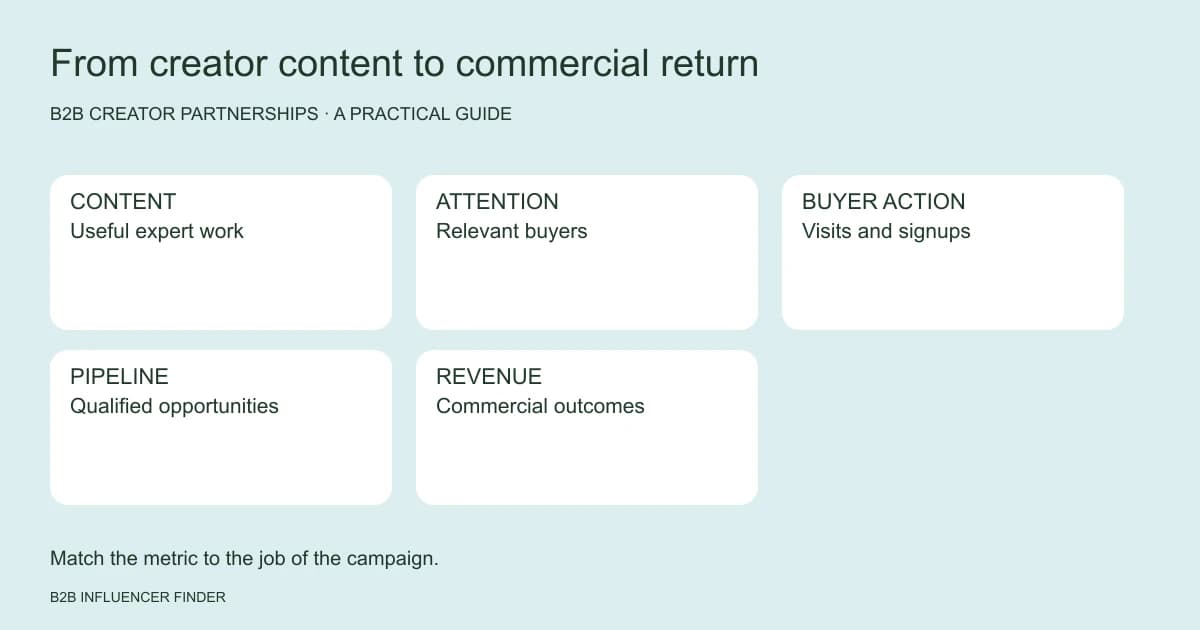
A creator campaign might be designed to make more of your target market know you exist. Another might generate demo requests. Another might influence an enterprise deal six months after the creator first mentioned you. Those campaigns should not be judged with the same metric.
The useful answer is this: B2B creator marketing can influence awareness, trust, engagement, leads, pipeline and revenue. Current research suggests brands using creators are seeing stronger outcomes across several of those areas. But your actual ROI depends on creator fit, the offer, the content, distribution, sales cycle and how well you measure the journey.
What does the current B2B research actually show?
LinkedIn and Ipsos published useful B2B creator research in 2025. In a study of 1,500 B2B marketers, teams using influencer marketing reported stronger success than non-users across goals including customer engagement, brand awareness, thought leadership, qualified pipeline and revenue growth.Sources: LinkedIn + Ipsos, 2025 B2B Marketing Benchmark: Trust Is the New KPI
The reported gap was 39 percentage points for customer engagement and brand awareness, 32 points for thought leadership, 30 points for qualified leads for the sales pipeline and 30 points for revenue growth.Sources: LinkedIn + Ipsos, 2025 B2B Marketing Benchmark: Trust Is the New KPI
That is meaningful evidence that creator marketing is associated with better business outcomes. It is not the same as saying creator marketing caused a specific revenue multiple. The study compares marketers' reported success against objectives. It does not give you a universal dollar-in, dollar-out ROI benchmark.
LinkedIn's separate 2025 buyer research also found that 82% of surveyed B2B buyers said creator content directly influences their decisions, while 87% said they prefer credible content from industry influencers. Again, that tells us creators can matter in the buying process. It does not mean every creator campaign works.Sources: LinkedIn, The Rise of B2B Influence: How Creators Are Influencing Buyers
Why B2B influencer ROI is difficult to reduce to one number
B2B buying journeys are annoyingly long. There can be several decision-makers, months between first exposure and purchase, multiple marketing touches and a salesperson involved before money changes hands.
LinkedIn and YouGov found that 78% of B2B CMOs said proving ROI had become more important, while LinkedIn also reported that 87% of B2B marketers said measuring the long-term impact of a campaign was getting harder. This is not a creator-specific problem. It is a B2B measurement problem.Sources: LinkedIn, The Era of Outcomes-based Measurement · LinkedIn News, Helping B2B Marketers Prove Campaign Performance
A buyer might read a creator's LinkedIn post today, hear your company discussed on a podcast next month, visit your website through Google later and finally book a demo after a colleague mentions you. Last-click attribution may credit Google. That does not mean the creator did nothing.
Start by deciding what return you actually want
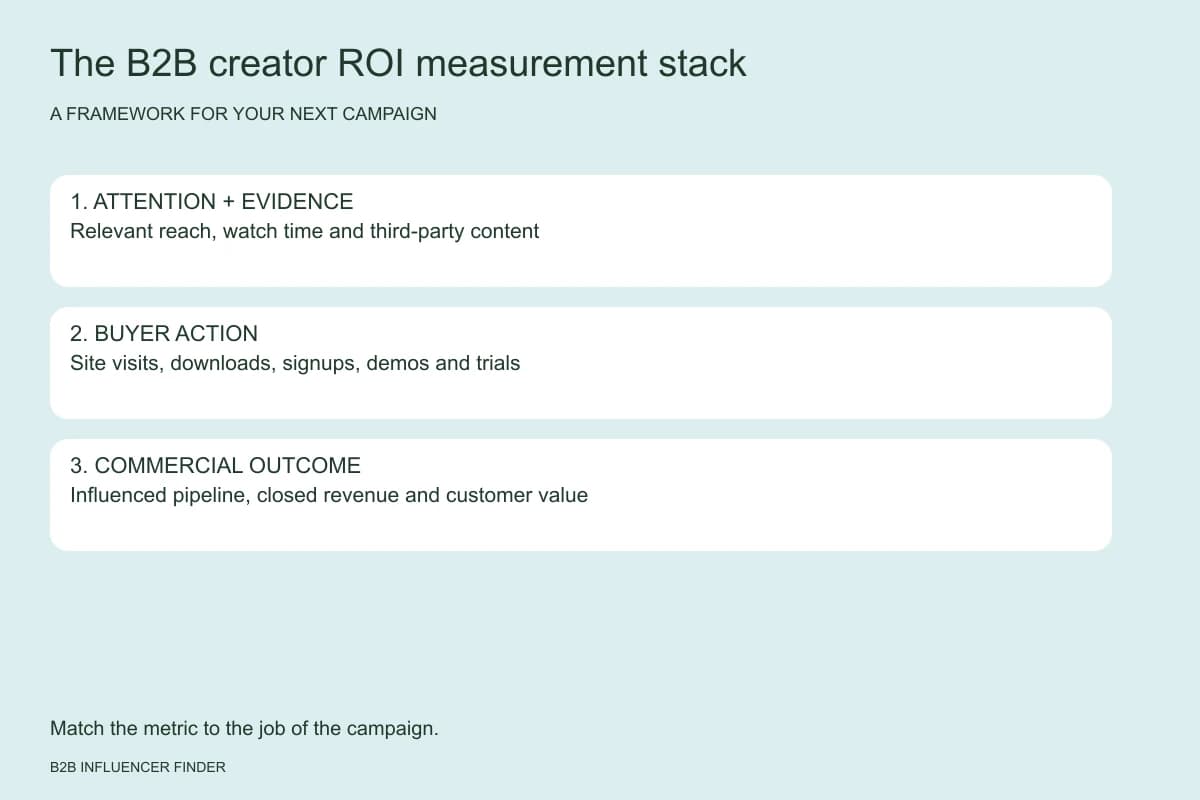
Before you calculate ROI, define the job of the campaign. I would put B2B creator outcomes into three layers.
Layer 1: Attention and evidence
This is the earliest layer: relevant reach, views, watch time, article reads, engagement from the right people, branded search movement and useful third-party content about your company.
This layer matters when the goal is awareness, category association or Creator AEO. A credible expert publishing a detailed explanation of your approach can create an asset that continues to exist after the initial campaign. But do not pretend an impression is revenue. It is evidence that the campaign reached people, not proof that they bought.
Layer 2: Buyer action
Now look for people moving closer to the business: site visits, newsletter signups, content downloads, event registrations, demo requests, trial starts, direct messages and other identifiable actions.
Creator-specific landing pages, UTM parameters, referral links and self-reported attribution questions can all help. None is perfect on its own, so use several signals where possible.
Layer 3: Pipeline and revenue
For B2B companies with a CRM, this is where the commercial case becomes much stronger. Track creator-sourced or creator-influenced leads, opportunities, pipeline, closed-won revenue and eventually customer value.
LinkedIn's Revenue Attribution Report is built around this problem for paid LinkedIn activity. It connects campaign exposure with CRM outcomes and can report metrics such as pipeline amount, revenue influenced and ROAS. Your organic creator program may use different tooling, but the principle is useful: connect marketing exposure to account and revenue data rather than stopping at clicks.Sources: LinkedIn, The Era of Outcomes-based Measurement
The basic ROI formula is simple
If you can attribute revenue and costs with reasonable confidence, the basic calculation is straightforward:
ROI = (return from the campaign - campaign cost) / campaign cost x 100Sources: LinkedIn, Key Drivers of ROI with LinkedIn Video Ads
If you spend $10,000 and can reasonably attribute $20,000 of gross profit to the campaign, the simple ROI is 100%. If you use revenue rather than profit, label the metric properly. Revenue return and profit ROI are not the same thing.
The arithmetic is easy. Attribution is the hard part.
Include the real campaign cost
Do not calculate ROI using only creator fees. Include the costs that were necessary to make the program happen: creator payments, software, paid amplification, agency or managed-service fees, production and meaningful internal time.Further reading: How Much Does B2B Influencer Marketing Cost?
This is especially important when comparing an outsourced creator program with an in-house one. The in-house campaign is not free just because salaries sit somewhere else in the budget.
Do not force brand campaigns into direct-response maths
Some creator work should be expected to generate leads. Some should not.
If you pay a respected cybersecurity practitioner to discuss a piece of original research with CISOs, the value may be reach into a difficult audience, credibility, third-party evidence and future consideration. Demanding five demo requests within 48 hours can cause you to optimize the campaign into a bad ad.
Measure the outcome that matches the job. Then watch whether those early signals eventually connect to commercial ones.
Use a longer measurement window than you would for ecommerce
B2B deals often take time. A creator post can influence a buyer long before an opportunity appears in the CRM.
LinkedIn extended the lookback window in its Revenue Attribution Report to 365 days, specifically noting that B2B transactions often involve multiple stakeholders and longer sales cycles. That does not mean every creator campaign needs a one-year attribution window. It does show why a seven-day conversion window can badly understate B2B influence.Sources: LinkedIn News, Helping B2B Marketers Prove Campaign Performance
Measure creator quality, not just campaign totals
If you work with ten creators, do not only report the combined impressions. You need to learn which creators are worth working with again.
Compare relevant reach, engagement quality, traffic, buyer actions, assisted opportunities, content quality and cost. Also record softer evidence: did the creator understand the brief, did the audience discussion contain your target buyers, and did the resulting content give your brand something worth reusing or referencing?
A creator with fewer impressions may be the better commercial partner if their audience is much closer to your ICP.Further reading: What Makes a Good B2B Influencer for Your Brand?
Creator content can have a second life
One reason creator ROI is easy to undercount is that the original post is not always the end of the asset.
A strong interview can become clips. A useful LinkedIn post can be amplified. A creator quote can support a sales deck if rights allow it. A podcast can create a public episode page and transcript. An article can remain searchable. Good creator work can keep producing value after the initial distribution spike.
Track that reuse separately rather than pretending all value happened on publication day.
What ROI should you expect from your first campaign?
For a first campaign, i would not put a universal revenue multiple into the forecast. I would build a hypothesis.
For example: we will spend $8,000 working with eight specialist creators. We expect them to reach people in our target market, produce eight useful pieces of third-party content and generate enough qualified engagement and site activity to identify which creators deserve a second campaign. We will track any influenced pipeline over the following months.
That gives you something you can actually learn from. After several campaigns, your own data becomes far more useful than an internet benchmark. You will know what creators in your niche cost, who responds, what formats work, what traffic converts and how long influenced opportunities take to close.
When should you call a campaign successful?
A campaign is successful when it achieved the outcome you funded it to achieve at a cost you can justify.
For a demand-generation campaign, that might mean qualified pipeline. For a thought-leadership campaign, it may be relevant reach, expert engagement and strong third-party content, with pipeline tracked as a longer-term secondary outcome. For Creator AEO, it may include the growth of credible public evidence around the topics you want your brand associated with.
Be precise about the claim. More third-party coverage does not guarantee that ChatGPT or another AI system will mention your brand. Treat AI visibility as something to measure before and after, not something a creator can promise you.Further reading: How Do You Measure the ROI of Creator AEO?
Where B2B Influencer Finder fits
B2B Influencer Finder is designed to improve the part of ROI that happens before you spend money: creator selection.Further reading: Explore B2B Influencer Finder
It finds B2B creators and compares what they already talk about with the content, evidence and expertise your company already has. Instead of starting with the biggest audience, you can shortlist people because there is a clear subject and buyer fit.
That does not guarantee ROI. It removes one very avoidable way to waste budget: paying someone whose audience or expertise was never relevant in the first place.
The benchmark that matters most will eventually be your own
External research is useful for deciding whether B2B creator marketing deserves a test. It is much less useful for predicting the exact return your company will get.
Run the campaign with proper tracking. Keep creator-level data. Connect it to your CRM where possible. Measure the immediate content signals and keep watching the accounts and opportunities that follow.
After a few cycles, you should be able to answer a much better question than 'what is the average ROI of influencer marketing?'
You will know what B2B creator marketing returns for your company.
Sources
LinkedIn + Ipsos, 2025 B2B Marketing Benchmark: Trust Is the New KPISources: LinkedIn + Ipsos, 2025 B2B Marketing Benchmark: Trust Is the New KPI
LinkedIn, The Rise of B2B Influence: How Creators Are Influencing BuyersSources: LinkedIn, The Rise of B2B Influence: How Creators Are Influencing Buyers
LinkedIn, The Era of Outcomes-based MeasurementSources: LinkedIn, The Era of Outcomes-based Measurement
LinkedIn News, Helping B2B Marketers Prove Campaign PerformanceSources: LinkedIn News, Helping B2B Marketers Prove Campaign Performance
LinkedIn, Key Drivers of ROI with LinkedIn Video AdsSources: LinkedIn, Key Drivers of ROI with LinkedIn Video Ads