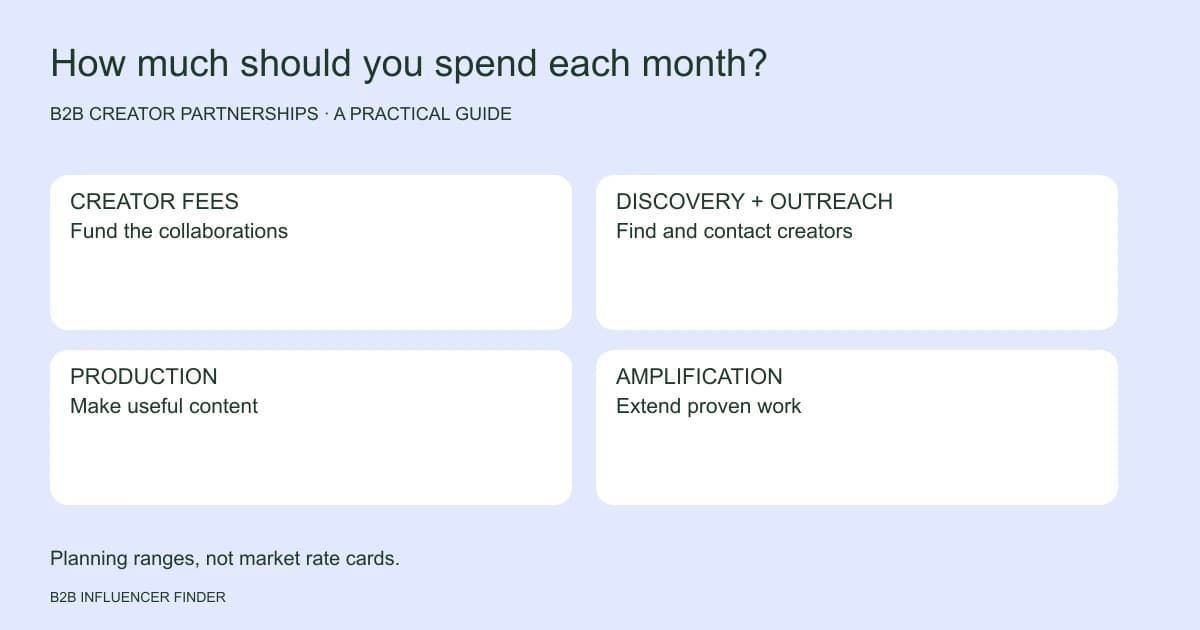
A good starting monthly budget for B2B creator marketing is often around $2,000 to $5,000 if your goal is to test a small number of relevant creator partnerships. If you want a consistent program with several collaborations going live each month, $5,000 to $15,000 is a more useful planning range. Programs using established creators, video, paid amplification or significant production can move beyond $15,000 to $30,000 a month very quickly.
Those are planning ranges, not industry rate cards. There isn't one correct monthly budget because B2B creator pricing varies enormously by niche, format, audience, rights and the amount of work the creator is actually doing.
The better question is: how many genuinely useful creator collaborations do you want to get live each month, and what will each one require?
Do not start by copying enterprise creator budgets
Creator marketing budgets are growing fast. CreatorIQ's 2026-2027 research says average annual creator marketing investment across its surveyed organizations reached $4.8 million, up 33% year over year, while enterprise investment averaged $8.8 million. Those numbers are useful evidence that creator marketing has become a serious channel. They are not a sensible starting budget for most B2B companies.Sources: CreatorIQ, State of Creator Marketing 2026-2027
The survey covers large brands and agencies across many industries. A B2B SaaS company trying to build relationships with ten specialist creators does not need to budget like a multinational consumer brand.
TopRank's B2B-specific research points in the same direction on momentum rather than absolute spend. Its 2025 report found 53% of surveyed B2B teams said their dedicated influencer budget was growing, and 72% of the most advanced programs reported growing budgets. More mature programs tend to invest more because they have already learned what works.Sources: TopRank Marketing, B2B Influencer Marketing Budgets and Best Practices (2025)
That is how i would budget too: start small enough to learn, then increase spend when you can see which creators, formats and topics are producing useful outcomes.
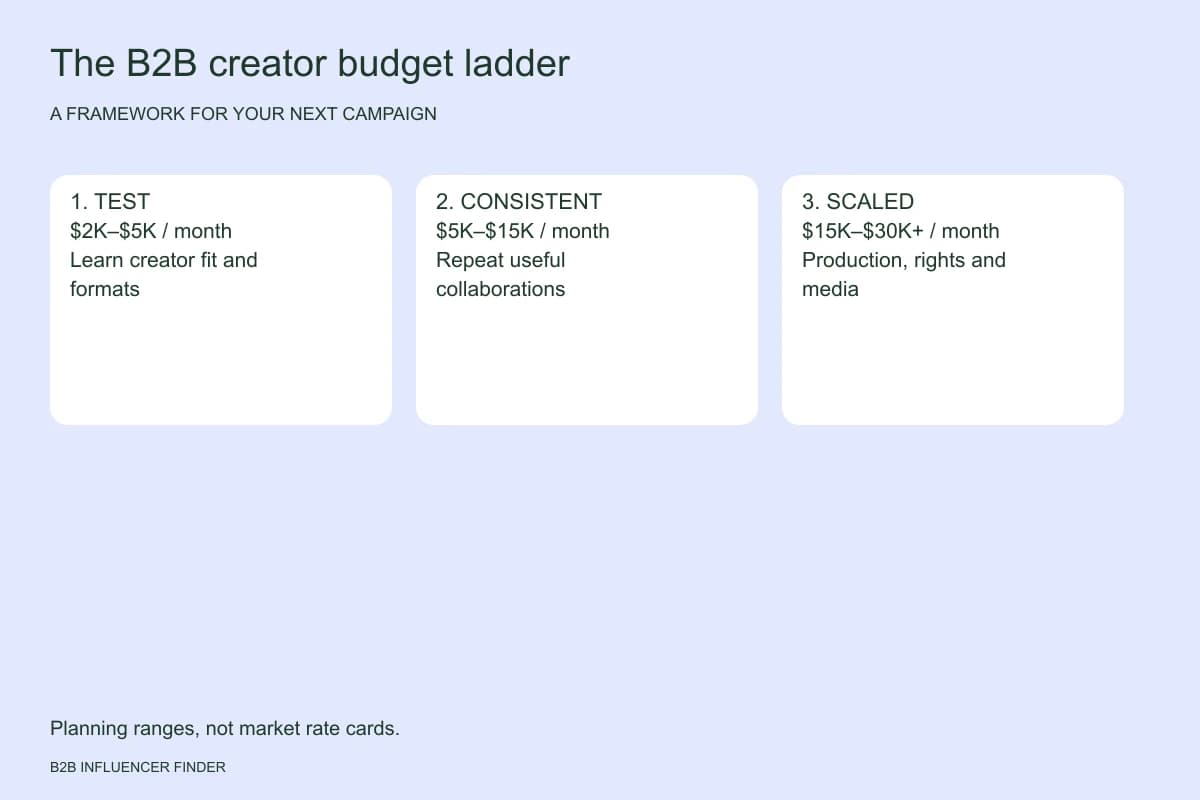
A simple monthly budget ladder
You can make this much less complicated by thinking in three stages.
1. Test: roughly $2,000 to $5,000 per month
This is enough to learn if creator marketing fits your category without turning the test into a giant campaign. You might work with a handful of smaller specialist creators, test different collaboration formats, and learn what creators actually respond to.
At this stage i would spend more energy on relevance than reach. One strong collaboration with a creator who is trusted by your exact buyers can teach you more than ten generic sponsored posts.
2. Consistent program: roughly $5,000 to $15,000 per month
This is where creator marketing starts becoming a repeatable operating motion rather than an experiment. You can keep discovery and outreach running every month, pay for several collaborations, and build relationships with creators who have already shown a good fit.
The important word is consistent. TopRank's 2025 B2B research found that 58% of surveyed B2B marketers were using an always-on influencer approach. Among marketers reporting the most success, 82% used always-on programs compared with 39% of all others. That is correlation, not proof that always-on activity causes success, but it is a useful signal that mature B2B programs tend to treat creator relationships as ongoing rather than one-off.Sources: TopRank Marketing, B2B Influencer Marketing Budgets and Best Practices (2025)
3. Scaled program: $15,000 to $30,000+ per month
Once you are buying larger creator partnerships, video, newsletters, podcasts, events, content licensing or paid amplification, the budget can expand quickly. At this point you may also have internal staff or an agency managing creator relationships, contracts, approvals, measurement and reuse.
There is no reason to jump to this level until the smaller program has taught you what deserves more money.
What actually belongs in the monthly budget?
Creator fees are only one line item.Further reading: How Much Does B2B Influencer Marketing Cost?
A useful B2B creator budget can include creator payments, discovery software, outreach and relationship management, content production, design or editing, product access, event or travel costs, usage rights, paid amplification and measurement.
If your team is doing everything manually, staff time belongs in the calculation too. A campaign that spends $3,000 on creators but consumes 50 hours of a senior marketer's month did not really cost $3,000.
How much should go directly to creators?
There is no fixed percentage i would apply across every program. Early on, keep the operating layer lean so a meaningful share of the budget can reach actual creator collaborations.
For example, if you have $5,000 a month, spending $4,000 on software, agency retainers and administration before a creator has been paid probably makes no sense. At $50,000 a month, more infrastructure can be justified because there are more relationships, contracts and assets to manage.
CreatorIQ's 2026-2027 research also shows creator content increasingly crossing into paid media. It reports that 92% of paid media leaders and marketing executives surveyed use creator content in paid media. If you plan to do that, budget for usage rights and amplification separately rather than assuming the creator's base fee covers everything.Sources: CreatorIQ, State of Creator Marketing 2026-2027
Work backwards from collaborations, not followers
Suppose you have $6,000 a month. You could spend almost all of it on one recognizable creator. Or you could work with several smaller specialists. Neither is automatically better.
Start with the buyers you need to reach and the subjects you want your brand associated with. Then find creators who already talk about those subjects. Get real quotes from them. Only then decide how many partnerships your budget can support.
This is also why follower-count formulas are weak budgeting tools. In B2B, topic relevance, buyer overlap, credibility, content format and commercial value can matter more than raw audience size.
A $5,000 budget example
Imagine a B2B software company has $5,000 per month to test creator marketing.
It might reserve around $3,000 to $4,000 for creator collaborations, use the remainder for discovery, outreach, management and lightweight production, and avoid paid amplification until it knows which creator content is worth amplifying.
That could mean three $1,000 collaborations. It could mean six smaller collaborations. It could mean one $2,500 expert partnership plus a few smaller tests. The point is not the exact split. The point is to create enough attempts to learn without spreading the budget across dozens of low-fit creators.
Your first budget should buy learning
For the first two or three months, i would optimize for information.Further reading: What ROI Can You Expect From B2B Influencer Marketing?
Which creators reply? Which topics get them interested? What do they quote? Which formats are easy to get live? Which creators actually understand your buyers? Which collaborations create useful content that you would want associated with your brand six months later?
That data should determine the next budget. Not a generic benchmark.
What if you only have $1,000 a month?
You can still start, but i would narrow the goal. Do not try to run a full influencer program across LinkedIn, YouTube, newsletters and podcasts at once.
Pick one niche, one or two content formats and a small number of creators. You may also prioritize unpaid expert collaborations where you have something genuinely useful to offer, such as original research, proprietary data, customer insight or access to a strong subject-matter expert.Further reading: How Do You Reach Out to B2B Influencers for a Collaboration?
A small budget is a problem when it is paired with a huge campaign plan. It is not necessarily a problem when the scope is equally small.
What if you have $20,000 a month?
Do not automatically buy bigger creators. First decide whether the extra money should buy more creators, deeper collaborations, better production, paid distribution, stronger measurement or a combination.
A portfolio of specialist creators can be more useful to a B2B brand than one large general-business name. The right answer depends on the audience and what you want those creators to create.
Budget for the relationship, not just the post
One-off posts are easy to price because they look like media inventory. B2B creator marketing becomes more interesting when the creator actually understands the brand and the brand understands what that creator is good at.
That can lead to research commentary, expert interviews, webinars, newsletter features, product education, podcasts, videos and repeated collaborations. Your monthly budget should leave room to continue relationships that work rather than constantly replacing them with new names.
Where B2B Influencer Finder fits
B2B Influencer Finder is designed to reduce the research part of the budget. It searches for relevant B2B creators and matches them with the content and expertise your company already has, so you can see why someone is a fit and what a collaboration could actually be about.Further reading: Explore B2B Influencer Finder
The Finder plan is $80 per month if you want to handle outreach yourself. The managed plan is $800 per month if you want support with creator outreach and collaborations. Creator fees are separate, which means you can see clearly how much of your budget is going to creators rather than hiding it inside one blended campaign fee.Further reading: Compare Finder and Managed plans
The budget i would start with
If i were launching a B2B creator program from zero, i would rather have $3,000 to $5,000 a month for three months than spend $15,000 in one burst.
That gives you time to find creators, get real market pricing, test collaboration angles and learn which relationships are worth repeating.
Then increase the budget because the evidence tells you to. Not because an influencer marketing benchmark said your company should be spending more.
Sources
CreatorIQ, State of Creator Marketing 2026-2027Sources: CreatorIQ, State of Creator Marketing 2026-2027
TopRank Marketing, B2B Influencer Marketing Budgets and Best Practices (2025)Sources: TopRank Marketing, B2B Influencer Marketing Budgets and Best Practices (2025)