B2B influencer marketing can cost a few hundred dollars for a small specialist collaboration, several thousand dollars for an established creator, or much more once you add video, multiple deliverables, usage rights, paid amplification and campaign management. There is no universal B2B influencer rate card.
If you're trying to set a first budget, i would not start with a follower-based formula. Start with the kind of collaboration you want, the creators you need and how many useful partnerships you want to get live.
As a rough planning range, a small B2B test might use a few thousand dollars in creator spend. A more serious multi-creator campaign can move into five figures quickly. Those are budget envelopes, not market rates. Individual creator quotes vary enormously.
Why is B2B influencer pricing so messy?
Because you are not buying a standardized ad unit.
One creator might charge for a LinkedIn post. Another might offer a newsletter sponsorship. Another may quote for a YouTube integration, an interview, a webinar, a research collaboration or a package across several channels.
The creator's job also changes. Are they simply distributing an approved message? Are they researching and writing the content? Do they need to test the product? Are you asking for their face and voice in a video? Can your brand reuse the content in ads? Is there exclusivity? All of that affects the commercial value.
This is why two creators with the same follower count can quote completely different prices and both can be rational.
What do current B2B pricing benchmarks show?
The public data is still fragmented, so i would treat any benchmark as a reference point rather than a tariff.
One 2025 dataset shared by B2B influencer agency specialist Margo Laz analysed nearly 200 LinkedIn collaborations. It reported an average post price of GBP 842 for creators with up to 50,000 followers, GBP 1,032 for 51,000 to 250,000 followers, GBP 2,178 for 250,000 to 500,000, and GBP 1,247 for creators above 500,000. The strange-looking final tier is actually useful: bigger audience did not translate neatly into a higher price.Sources: Margo Laz - 2025 B2B LinkedIn collaboration pricing dataset
Another practitioner benchmark shared by Jamie Pitt put the average around four cents per follower, while noting a very wide range from roughly one cent to more than ten cents per follower depending on engagement, format, creator experience and content quality. I would not use cents-per-follower as a pricing model, but it shows how wide the market can be.Sources: Jamie Pitt - B2B creator pricing benchmark
A 2026 marketplace analysis from Naano reported a median transacted price of EUR 111 for a LinkedIn sponsored post among creators under 10,000 followers in its 300-post sample. That is dramatically lower than many negotiated creator quotes. The useful lesson is not that EUR 111 is the 'right' price. It is that deal structure and marketplace context can change pricing just as much as audience size.Sources: Naano - B2B Influencer Marketing Cost in 2026
Limelight also said its 2026 B2B Influencer Pricing Benchmarks were built from thousands of brand-creator partnership deals plus input from more than 30 industry advisors and creators. The existence of these datasets is progress, but there still isn't one clean market price you can apply across LinkedIn, YouTube, newsletters and podcasts.Sources: David Walsh / Limelight - 2026 B2B Influencer Pricing Benchmarks announcement
So what should you expect to pay?
For planning, think in bands rather than exact rates.
A smaller niche creator may accept a few hundred dollars for a straightforward social collaboration. Established specialist creators often quote into the low thousands. Larger names, video-heavy work, bundles, events, licensing or exclusivity can move well beyond that.
Do not turn those bands into a promise. A niche expert with 8,000 followers can charge more than a general business creator with 80,000 if their audience is difficult to reach and commercially valuable.
That is especially true in B2B categories where one buyer can be worth tens of thousands of dollars to the brand.
Follower count is one input, not the price
It is tempting to make a spreadsheet with follower count on the left and a fixed fee on the right. B2B rarely behaves that neatly.
LinkedIn and Ipsos found in their 2025 B2B Marketing Benchmark that marketers selecting B2B creators prioritized authenticity and credibility at 58%, industry relevance at 49%, brand alignment and subject-matter expertise at 47% each, and audience engagement at 45%. That is a much better picture of what creates value than follower count alone.Sources: LinkedIn + Ipsos - 2025 B2B Marketing Benchmark: Trust Is the New KPI
If a creator reaches 5,000 people who influence enterprise security purchases, the commercial value of that audience can be very different from 100,000 broad business followers.
What actually changes a B2B creator fee?
The biggest pricing variables usually have little to do with one headline audience number.
1. Platform and format
A short LinkedIn post is not the same production job as a researched newsletter article, podcast episode or YouTube video. Video normally creates more work. Long-form content can require research, editing and production. Live events add preparation and scheduling.
2. Subject expertise
Some B2B creators are valuable because they have knowledge that is difficult to fake. A former CISO, fintech operator, procurement leader or respected analyst may have a relatively small audience but command a premium because the audience trusts their judgement.
3. Audience fit
A concentrated audience of the exact people you sell to can be worth more than broad reach. Ask who the creator reaches, not only how many people follow them.
4. Deliverables
One post costs less than a package of a post, video, newsletter inclusion and webinar. Be precise about what is included so quotes are comparable.
5. Usage rights
If you want to reuse creator content on your website, in paid ads, in sales collateral or across your own social channels, discuss that separately. Content licensing can have real value and should not be quietly assumed to be included forever.
6. Paid amplification
You may want to put media spend behind creator content after it is published. That paid media budget is separate from the creator's fee, even when the creator has granted the necessary permissions.
7. Exclusivity
Asking a creator not to work with competitors can restrict their future income. Expect exclusivity to affect the price, especially in narrow B2B categories.
8. Campaign complexity
Finding creators, vetting them, doing outreach, negotiating, contracting, briefing, chasing approvals, checking disclosure and measuring results all take work. If an agency or managed service handles this, budget for it separately from creator fees.
Your creator fee is not your whole campaign budget
This is where first-time budgets often go wrong.
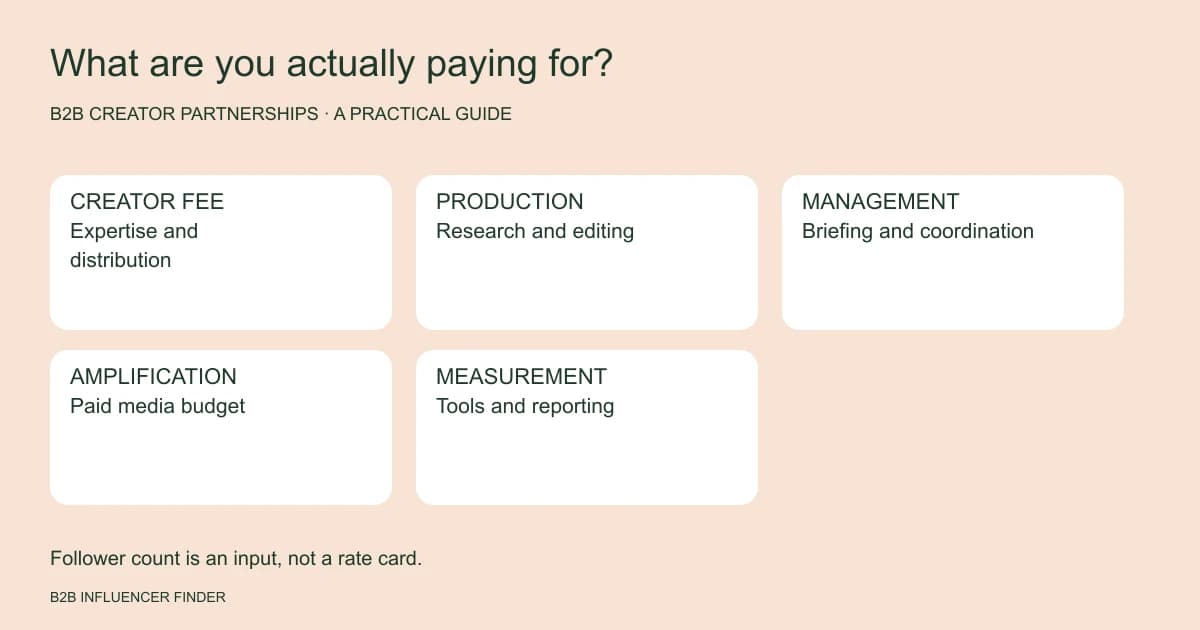
If you have $10,000 and spend all $10,000 on creator fees, you have left nothing for discovery, management, production support, paid amplification or measurement.
A practical budget can contain five separate lines: creator fees, campaign management, production or editing, paid amplification, and measurement or tooling.Further reading: What's a Good Monthly Budget for B2B Creator Marketing?
You may not need all five. A simple founder-led test could involve only creator fees plus internal time. A larger program might need every one.
What would i budget for a first B2B creator test?
I would rather fund several relevant experiments than spend the entire budget on one large name.
For example, if you have $5,000 to $10,000 available, you could shortlist a group of highly relevant niche creators, learn their actual rates, then build a small mix of collaborations around the best fits. You might discover that your category supports five modest partnerships or only two expensive ones. That information is more valuable than pretending a benchmark knows your market.
The first campaign should teach you your category's response rates, creator expectations, typical fees, formats and performance. Those numbers become your real benchmark.
Should you pay per post, per campaign or on a retainer?
All three can work.
A one-off fee is easiest for testing. A campaign package makes sense when you want several deliverables from the same creator. A retainer can make sense once you know a creator genuinely fits and you want repeated exposure or a longer-term ambassador relationship.
I would avoid locking into a long retainer before you have worked together. Creator fit looks different once you have gone through briefing, revisions, publishing and measurement.
Can you do B2B influencer marketing without paying creators?
Sometimes.
A creator may cover genuinely useful research, invite your expert onto a podcast, reference a strong dataset or discuss a product they already use without a sponsorship fee. But that is editorial interest, not something the brand can demand.
If you want a guaranteed deliverable, deadline, talking points or approval process, expect the conversation to become commercial.
Paying is not inherently a problem. The content just needs to be honest and properly disclosed.
Do sponsored B2B creator posts need disclosure?
Yes, material commercial relationships need appropriate disclosure where applicable.
The US Federal Trade Commission says endorsements should make a material connection with the brand obvious. A material connection can include payment, free or discounted products, employment or other relationships that could affect how people interpret the endorsement. The FTC also says disclosures should be hard to miss and placed with the endorsement itself.Sources: FTC - Disclosures 101 for Social Media Influencers
Other countries have their own advertising and influencer rules, so international campaigns should check the jurisdictions they reach.
Do not pay for fake enthusiasm
A sponsorship buys a commercial collaboration. It should not buy an opinion the creator does not hold.
The FTC's guidance is explicit that a creator cannot claim an experience they have not had or say a product is terrific if they thought it was terrible.Sources: FTC - Disclosures 101 for Social Media Influencers
This also matters strategically. The whole point of using credible B2B voices is credibility. Over-script the creator and you can pay a premium to produce something that feels exactly like an ad from your own company.
How should you compare creator quotes?
Normalize the quotes before you choose.Further reading: How Much Should You Pay a B2B Influencer?
For each creator, write down the deliverables, platform, expected publication date, audience evidence, usage rights, exclusivity, revision allowance, paid amplification rights and total fee.Further reading: Estimate a creator collaboration budget
Then add your own fit score: topic fit, buyer fit, credibility, content quality and collaboration fit.
A $500 creator with poor buyer fit is not cheaper than a $1,500 creator who reaches the exact people you need. Price only makes sense next to relevance.
What should you measure?
Decide before you buy the collaboration.Further reading: What ROI Can You Expect From B2B Influencer Marketing?
For awareness you might track relevant reach, video views, newsletter readership, engagement quality and branded search. For traffic you can use tagged links and landing pages. For demand you might track signups, influenced opportunities or sales conversations.
For Creator AEO, you can also record what third-party content gets published, where your brand is mentioned, what topics it is associated with, and how your AI visibility changes over time. Treat that as observational measurement. Do not promise that one creator mention will cause ChatGPT or another AI system to recommend the brand.Further reading: How Do You Measure the ROI of Creator AEO?
The budget should follow the fit
The most expensive creator is not automatically the best creator. The cheapest creator is not automatically efficient either.
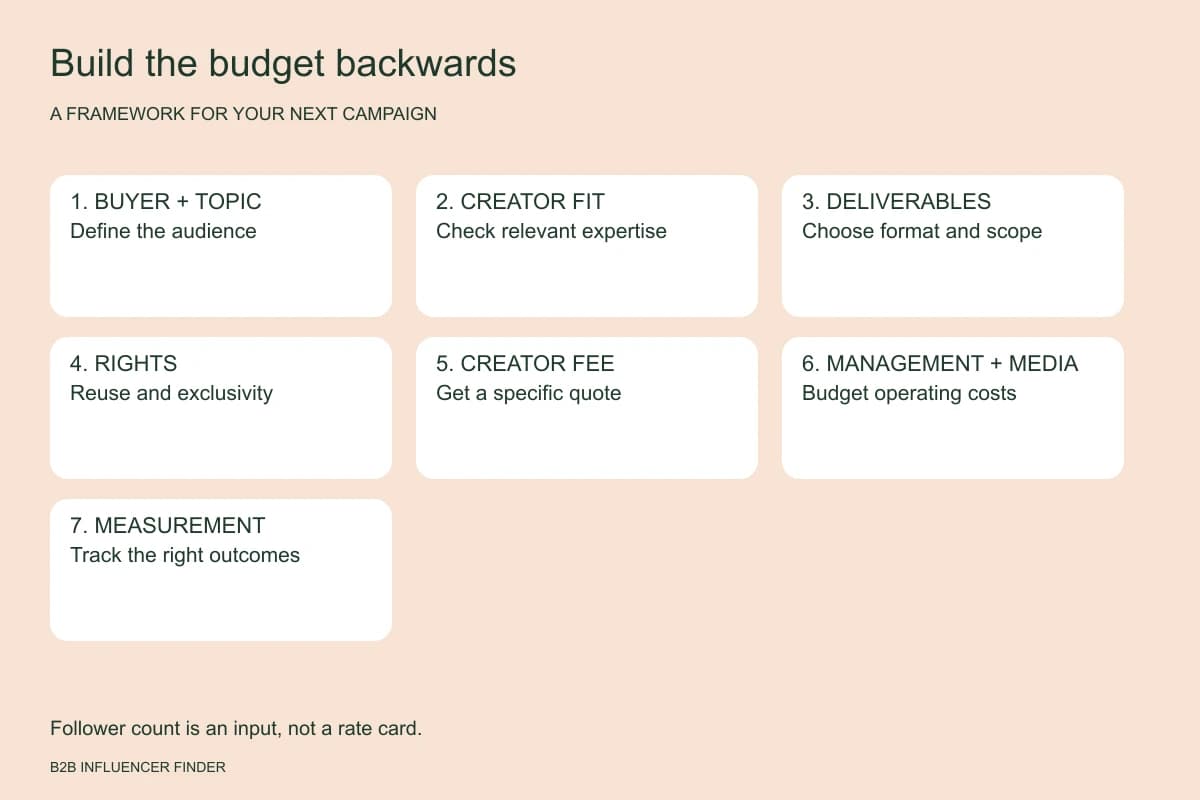
Start with the buyer and the topic. Find credible people who already speak to that market. Work out what useful collaboration you could create together. Then ask what it costs.
That order sounds obvious, but it prevents a lot of bad B2B influencer spending.
Sources
LinkedIn + Ipsos - 2025 B2B Marketing Benchmark: Trust Is the New KPISources: LinkedIn + Ipsos - 2025 B2B Marketing Benchmark: Trust Is the New KPI
Margo Laz - 2025 B2B LinkedIn collaboration pricing datasetSources: Margo Laz - 2025 B2B LinkedIn collaboration pricing dataset
Jamie Pitt - B2B creator pricing benchmarkSources: Jamie Pitt - B2B creator pricing benchmark
Naano - B2B Influencer Marketing Cost in 2026Sources: Naano - B2B Influencer Marketing Cost in 2026
David Walsh / Limelight - 2026 B2B Influencer Pricing Benchmarks announcementSources: David Walsh / Limelight - 2026 B2B Influencer Pricing Benchmarks announcement
FTC - Disclosures 101 for Social Media InfluencersSources: FTC - Disclosures 101 for Social Media Influencers