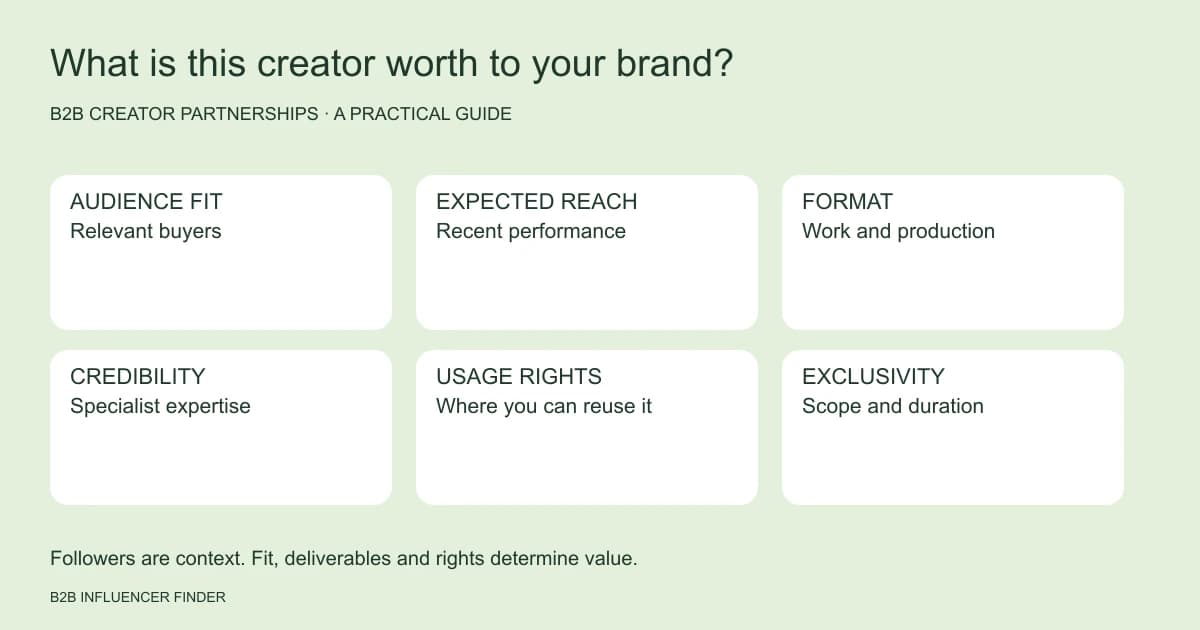
There is no standard B2B influencer rate. A specialist creator might charge a few hundred dollars for a straightforward LinkedIn post, while an established industry voice can quote several thousand dollars or more for a deeper collaboration. Video, newsletters, podcasts, usage rights, exclusivity and production can push the number higher again.
The useful question is not 'what does a creator with 20,000 followers cost?' It is 'what is this specific collaboration worth to us, and what is the creator actually being asked to do?'
Follower count is a clue. It is not a price list.
There is finally some real B2B pricing data
B2B creator pricing has historically been frustratingly opaque. Most public rate guides mix B2C Instagram, TikTok and celebrity pricing with professional creators. That is not especially useful if you are trying to sponsor a cybersecurity expert on LinkedIn.
One useful 2026 dataset comes from Naano, a B2B LinkedIn creator marketplace. Its price index analyzed 300 completed sponsored LinkedIn bookings between June and August 2026. Median transaction prices rose from EUR84 for creators below 5,000 followers to EUR180 at 5,000 to 10,000, EUR300 at 10,000 to 25,000, EUR588 at 25,000 to 50,000 and EUR720 above 50,000 followers.Sources: Naano, LinkedIn sponsored post price index 2026
That does not mean those are the correct prices for every B2B creator. It is one marketplace, one platform and a relatively small dataset. But it is useful because these are reported transactions rather than theoretical rate cards. It also shows how dangerous generic influencer pricing tables can be. Naano notes that published rate-card guides can be dramatically higher than the prices actually transacting in its marketplace.
Start with the deliverable, not the creator tier
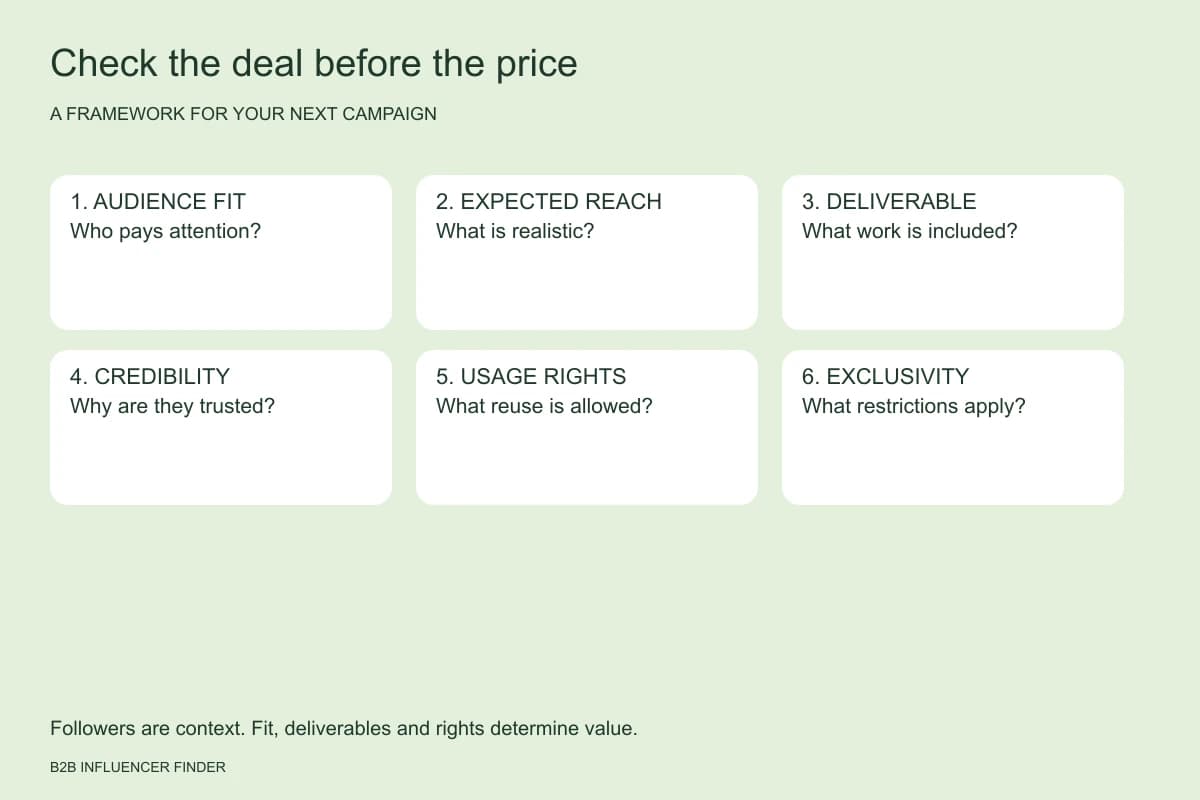
Before you evaluate a quote, define what you are buying. A short LinkedIn post, a detailed article, a newsletter feature, a YouTube integration and a webinar appearance are different jobs.
Ask what the creator needs to research, write, film, edit and distribute. A creator who spends six hours understanding your product and producing a useful technical video should not be priced like someone adding a short mention to a post they were already writing.
The six things that should move the price
I would evaluate a B2B creator quote against six things.
1. Audience fit
How much of the creator's audience overlaps with the people you actually want to reach? A creator with 8,000 finance leaders can be more commercially useful to a fintech company than a general business creator with 100,000 followers.
2. Expected reach
Follower count is not the same as reach. Look at recent content performance where public data exists and ask for first-party audience or performance information when the spend justifies it. For YouTube especially, sponsorship pricing is commonly discussed in relation to expected views rather than subscriber count alone.Sources: CreatorsJet, How Much Do Brands Pay for YouTube Sponsorships?
3. Format and workload
Writing a LinkedIn post is not the same workload as producing a ten-minute YouTube video, conducting an interview or building a research-led newsletter feature. Production effort belongs in the price.
4. Credibility and scarcity
A recognized expert in a narrow B2B field may command a premium because there are not many credible people who can speak to that audience. This is one reason B2B pricing does not map neatly to follower tiers.
5. Usage rights
If you want to reuse the creator's content in ads, on your website, in sales materials or across your own social channels, agree that separately. You are no longer paying only for publication to the creator's audience. You are also buying the right to reuse an asset.
6. Exclusivity
Asking a creator not to work with competitors reduces the work they can accept. That has value. The broader and longer the exclusivity period, the more reasonable it is for the creator to charge for it.
A practical way to evaluate a quote
Imagine a creator asks for $1,500 for a LinkedIn post. Do not immediately ask whether $1,500 is 'expensive.'
Check whether the creator consistently talks about your subject, whether the right buyers appear to follow and engage with them, what similar posts tend to reach, how much work the post requires, whether you receive any reuse rights and whether the creator is restricting competitor work.
A $1,500 post that reaches exactly the people you need and produces a durable piece of expert content can be better value than a $300 post nobody relevant sees. The reverse is also true. Expensive does not mean good.
Do not calculate the rate from followers alone
A simple dollars-per-follower formula is tempting because it gives you a number. It also ignores most of what makes B2B influence valuable.Further reading: How Many Followers Should a B2B Influencer Have?
Two creators can each have 20,000 followers and have completely different audiences, engagement patterns, expertise, content quality and commercial value. One may reach procurement leaders in your exact market. The other may have accumulated a broad audience from career advice. Those are not equivalent media assets.
What about CPM?
CPM can be useful when you have credible expected-reach data, particularly for video or repeatable sponsorship inventory. It gives you a way to compare the media component of different deals.
But B2B creator collaborations are often doing more than buying impressions. You may also be paying for expert credibility, content production, distribution, access to a niche community and an asset that remains public after the initial reach has passed. Treat CPM as one input rather than the whole valuation model.
Ask for the rate before you negotiate against yourself
When possible, ask the creator what they charge for the collaboration you have in mind. You do not need to open with your maximum budget.
If they have a rate card, ask what is included. If they quote a package, separate the deliverables. You want to know what you are paying for, not just whether the final number fits your budget.Further reading: Estimate a creator collaboration budget
If the quote is too high, reduce scope before trying to crush the rate. One post instead of three, no exclusivity, shorter usage rights or a simpler format can make the deal work without treating the creator's price as arbitrary.
Paying more can make sense for the right expert
In B2B, the creator's professional reputation can be part of the product. A respected operator, analyst, consultant or practitioner may have spent years building trust with a small audience.
That is why i would not automatically reject a creator because their cost per thousand followers looks high. If their audience contains the exact people you sell to, the comparison should be against other ways of reaching and influencing those buyers, not against a lifestyle creator's Instagram CPM.
But do not pay a premium for a famous name with weak fit
The opposite mistake is paying for status. A large creator can look impressive in a campaign report while having almost no connection to the problem your company solves.
If you cannot explain why this creator's audience should care about the collaboration, the creator is probably not worth a premium to your brand.
What should be in the agreement?
At minimum, put the deliverable, publication channel, timing, fee, payment terms, approval process, disclosure requirements, usage rights and any exclusivity in writing.
If the creator is being paid or receiving something of value to endorse the brand, disclosure matters. The U.S. Federal Trade Commission says material connections between brands and endorsers should be disclosed clearly and conspicuously. Other jurisdictions have their own rules too, so do not treat disclosure as an optional hashtag added at the end.Sources: FTC, Disclosures 101 for Social Media Influencers
Never pay for a guaranteed positive opinion
Pay for the creator's work, expertise, production and distribution. Do not require them to pretend they love something they do not.Further reading: Should B2B Brands Pay Influencers to Talk About Them?
The FTC's endorsement guidance says endorsements should be truthful and not misleading, and endorsers should not talk about an experience they have not actually had. Apart from the legal issue, forced praise destroys the reason B2B creator marketing works in the first place: the audience trusts the person speaking.Sources: FTC, Endorsements, Influencers, and Reviews
How i would handle a first collaboration
For a creator you have never worked with, keep the first deal reasonably contained. Agree one useful deliverable, make the brief clear, give them enough information to form a real view and see how the relationship works.Further reading: How Do You Reach Out to B2B Influencers for a Collaboration?
If the creator understands your market, communicates well and produces something genuinely useful, the second collaboration is easier to justify. Over time you will build your own pricing dataset for your niche, which is much more useful than a generic influencer rate chart.
Where B2B Influencer Finder fits
B2B Influencer Finder helps with the part that should happen before the price negotiation: deciding whether the creator is actually relevant. It searches for B2B creators and matches their existing content with the topics, evidence and expertise your brand already has.Further reading: Explore B2B Influencer Finder
That means you can shortlist creators because there is a real collaboration fit, then compare quotes inside a much smaller group of people you would genuinely want to work with.
The number matters after the fit
A fair B2B influencer fee is the price where the creator is properly compensated for their work and audience, and the brand can justify the collaboration based on relevance, expected reach, format and rights.
So yes, use benchmarks. Ask for rates. Compare quotes. Negotiate scope.
Just do not let follower count make the decision for you. The cheapest creator is not automatically good value, and the biggest creator is not automatically worth the most to your brand.
Sources
Naano, LinkedIn sponsored post price index 2026Sources: Naano, LinkedIn sponsored post price index 2026
CreatorsJet, How Much Do Brands Pay for YouTube Sponsorships?Sources: CreatorsJet, How Much Do Brands Pay for YouTube Sponsorships?
FTC, Disclosures 101 for Social Media InfluencersSources: FTC, Disclosures 101 for Social Media Influencers
FTC, Endorsements, Influencers, and ReviewsSources: FTC, Endorsements, Influencers, and Reviews