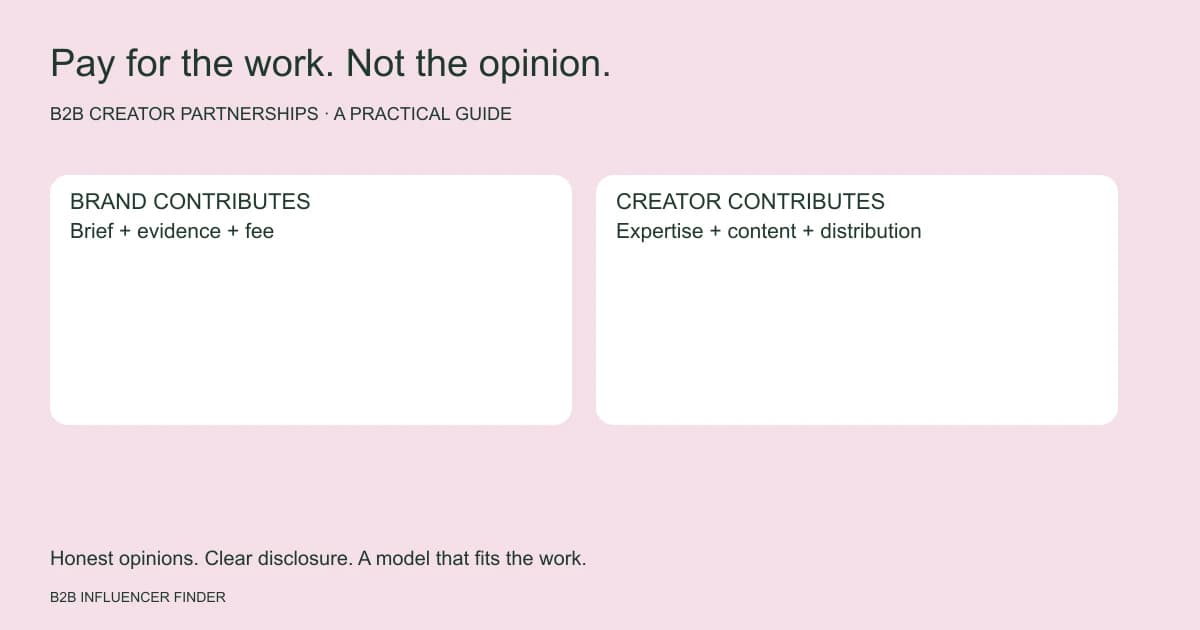
Yes, B2B brands should usually expect to pay influencers when they are asking for real work, access to an audience or a defined commercial deliverable. But payment should buy the creator's time and contribution, not a positive opinion.
There are exceptions. A creator may cover genuinely useful research, invite your expert onto a podcast or mention a product they already use without charging you. That is earned attention. The mistake is building a repeatable creator program around the assumption that relevant experts should work for free.
B2B creators are often consultants, operators, founders, analysts or specialists. Their audience may be smaller than a consumer influencer's, but the people inside it can be unusually valuable. If you want them to research your company, create content and distribute it to that audience, compensation is a normal part of the exchange.
Paid does not mean fake
This is the distinction that matters most. Paying a creator does not mean buying praise.
You can pay someone to spend three hours understanding your research, write a thoughtful LinkedIn article, record a video, interview your subject-matter expert or produce a newsletter edition. You can agree the subject, format, deadlines, disclosures and factual claims.
You should not require them to pretend they love a product they dislike or make claims they cannot support. In the US, the FTC says endorsements must reflect honest opinions and material connections such as payment should be disclosed clearly and conspicuously. Other markets have their own advertising rules too.Sources: FTC's Endorsement Guides: What People Are Asking
That separation is useful for Creator AEO as well. The objective is not to manufacture fake independent approval. It is to create credible third-party content around real evidence, expertise and useful ideas.
Most B2B influencer programs already use compensation
This is not an unusual edge case. TopRank Marketing's 2025 B2B Influencer Marketing Report found only 6% of surveyed teams said they were not compensating influencers.Sources: TopRank Marketing, 2025 B2B Influencer Marketing Statistics and Trends
The same research found teams using several different models: 53% performance-based compensation, 47% product or service compensation, 46% pay per deliverable, 38% compensation based on credibility or reach and 17% trade-out arrangements. These categories can overlap, so they should not be read as shares of one single payment pie.Sources: TopRank Marketing, 2025 B2B Influencer Marketing Statistics and Trends
The interesting part is not that one model has 'won'. It is that B2B creator compensation is already broader than simply paying a fixed amount for a social post.
When should you definitely expect to pay?
If the brand is specifying a deliverable, publication date, messaging requirements or campaign brief, assume there is a commercial job to be done.
Payment is especially reasonable when you want original content, video production, a dedicated newsletter, a sponsored podcast segment, multiple revisions, usage rights, exclusivity, event participation, paid-media rights or guaranteed distribution.
The more control the brand wants, the less credible it is to call the request an unpaid editorial opportunity.
When might a creator work with you without a fee?
Unpaid does not mean impossible. It just needs a different value exchange.
A creator may genuinely want access to proprietary research, a useful dataset, an interesting executive, an original case study, early product access or a strong expert point of view. A podcast host needs good guests. A journalist-style newsletter writer needs good material. A practitioner may want to discuss a tool they already use.
In those cases the creator is choosing the story because the material itself is useful to their audience. You are contributing evidence or expertise rather than buying inventory.
That is closer to PR, expert relations or editorial collaboration. You can pitch it. You cannot demand it.
Do not confuse a free product with free work
Giving someone access to software can reduce the creator's cost of evaluating it, but that does not automatically compensate them for researching, producing and distributing content.
For an inexpensive SaaS product, a free account may have almost no meaningful economic value to an established creator. For an expensive service or genuinely valuable product, it might be part of the deal. The creator gets to decide whether that exchange is worthwhile.
Also remember that non-cash value can still create a material connection that requires disclosure. The FTC explicitly includes free or discounted products and services in its guidance on material connections.Sources: FTC, Disclosures 101 for Social Media Influencers
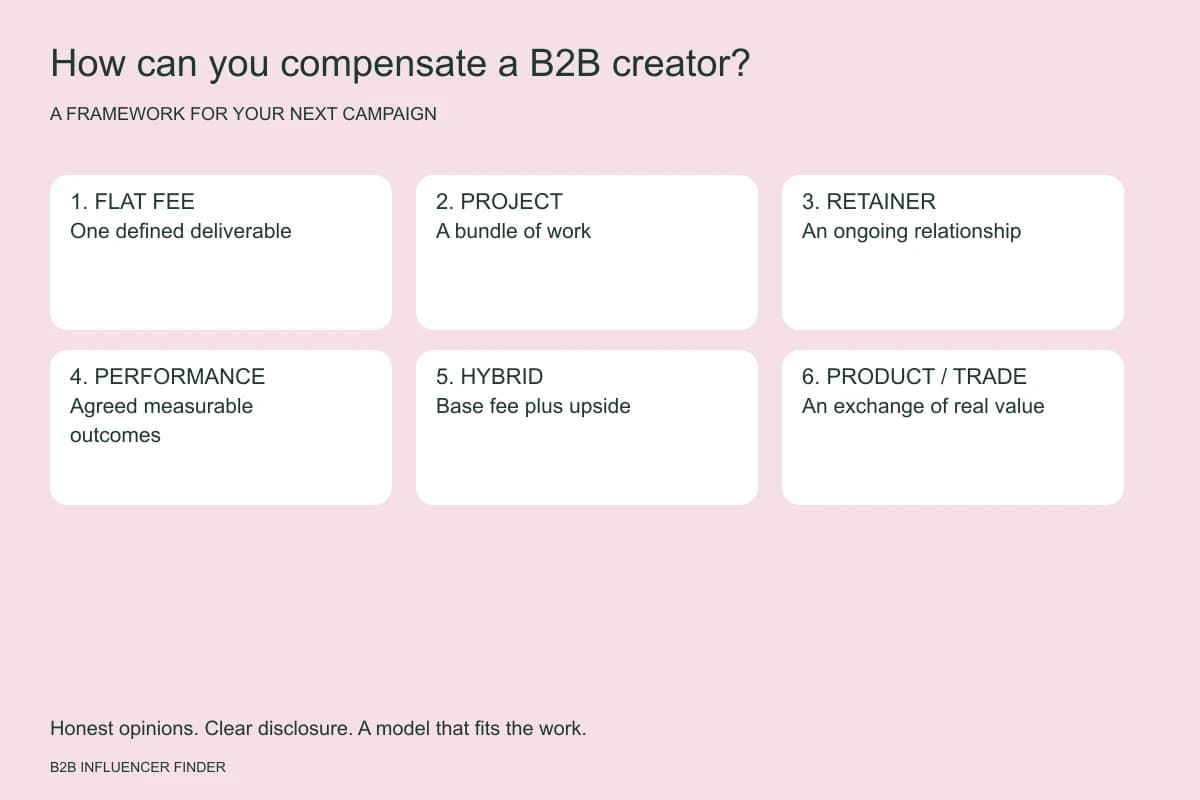
What are the main ways to compensate a B2B influencer?
There is no reason every collaboration needs the same structure.
Flat fee per deliverable
You agree a price for a defined output such as one LinkedIn post, article, video, newsletter placement or podcast segment. This is simple and gives both sides cost certainty.
Project fee
One fee covers a bundle: perhaps an interview, LinkedIn post and newsletter mention. This is useful when the creator is contributing to a campaign rather than selling isolated posts.
Retainer
A recurring fee supports an ongoing relationship. This can make sense when the creator becomes a regular industry voice around a category and both sides want continuity rather than one-off sponsorships.
Performance-based
Compensation is tied to agreed outcomes such as qualified signups, sales, leads or other measurable actions. This can work when attribution is realistic and the creator has meaningful control over the outcome.
Hybrid
A base fee pays for the creator's work and a performance component creates upside. For many B2B campaigns this is more balanced than asking a creator to take all the commercial risk.
Product, service or trade
The creator receives something of real value rather than only cash. This can work, but only when the exchange is genuinely attractive to them and the relationship is disclosed where required.
Performance-only sounds attractive, but be careful
Brands naturally like the idea of paying only for results. The problem is that a creator controls the content, not your entire funnel.
They do not control your landing page, pricing, sales team, product-market fit or whether a six-person buying committee approves the purchase. In B2B, a creator can influence demand without being the final click before revenue.
If you want performance compensation, define an outcome the creator can reasonably affect. A hybrid model can also protect the creator's production time while giving both sides upside if the campaign performs.
Do not pay by follower count alone
Follower count can help size potential distribution. It does not tell you whether the audience contains your buyers, whether the creator is trusted or whether their content is any good.
A specialist with 8,000 relevant followers may be commercially more useful than a general business creator with 300,000. B2B Influencer Finder therefore treats reach as one factor after topic fit, buyer fit, credibility and content fit.
This is also why a universal '$X per follower' rule is weak. The same follower count can represent completely different commercial value in cybersecurity, HR software, fintech, developer tools or general entrepreneurship.
What exactly are you paying for?
Before negotiating a fee, break the collaboration into its components.
You may be paying for research and preparation, production, access to the creator's audience, distribution, editing, revisions, usage rights, exclusivity, licensing, paid amplification rights, event time or ongoing availability.
Two creators can quote very different prices for what looks like 'one post' because the underlying deal is not actually the same.
Normalize the quotes before comparing them. Ask what is included, where the content will live, how long it stays live, whether you can reuse it, whether paid amplification is allowed and whether there are category restrictions.Further reading: How Much Should You Pay a B2B Influencer?
Should you pay for a positive review?
No. Pay for the work, not the verdict.
If you need a creator to test a product, the agreement can require them to actually test it and create a piece of content. It should not require them to say the product is excellent regardless of their experience.
The FTC's guidance is explicit that an endorser cannot claim an experience they did not have, and a paid endorser cannot say a product is terrific if they thought it was terrible.Sources: FTC's Endorsement Guides: What People Are Asking
This is not only a compliance issue. Forced praise destroys the thing you wanted from the creator in the first place: credibility.
Sponsored content can still create useful third-party evidence
For Creator AEO, the important question is not simply 'was money involved?' It is whether the resulting content is public, relevant, substantive and useful.Further reading: Does Sponsored Creator Content Help With AI Visibility?
A disclosed sponsored article that explains a real benchmark study can contain far more useful context than an unpaid social mention that says 'cool tool'. Payment does not magically make the information invisible to search engines or AI systems.
But do not overstate this. There is no evidence that paying creators makes AI systems more likely to recommend your brand, and a sponsored mention is not the same thing as independent editorial endorsement.
Paying creators does not guarantee distribution forever
Agree what happens to the content. A LinkedIn post can disappear. A newsletter archive can move behind a paywall. A YouTube video can be removed. A creator can leave a platform.
If durability matters, discuss it before the collaboration. Do not assume that payment buys a permanent public asset unless the contract actually says that.
How i would approach a first B2B creator campaign
I would not start by emailing 100 people asking for their rate card.
First find a small group of creators with strong subject and buyer fit. Then work out what each creator could genuinely talk about using material your brand already has: research, a case study, data, expert access or a useful point of view.
Pitch the collaboration. Ask for their preferred commercial structure. Compare the quote against the relevance of the audience, the quality of the proposed content and the rights included, not just follower count.Further reading: How Do You Reach Out to B2B Influencers for a Collaboration?
For creators you really want, expect to pay. For genuinely editorial opportunities, give them the freedom to decide whether the story is worth covering without payment.
Where B2B Influencer Finder fits
B2B Influencer Finder is designed to solve the part before negotiation. It searches for relevant B2B creators and matches them to the strongest content and expertise your company already has.Further reading: Explore B2B Influencer Finder
That makes the outreach more specific. Instead of 'would you post about our software?', you can approach someone because they already write about a problem your research, case study or expertise can add something to.
The Finder plan is $80 per month. The managed plan is $800 per month and adds outreach and collaboration support. Creator fees are separate, because the creator's compensation belongs to the creator.Further reading: Compare Finder and Managed plans
So, should B2B brands pay influencers?
Usually, yes, when you are asking for commercial work.
Pay for expertise, production, access and distribution. Use earned outreach when you genuinely have something editorially valuable. Be transparent about sponsorship. Give creators room to have a real opinion.
The goal is not to buy somebody saying your brand is brilliant. It is to make a fair exchange with a credible person who can create something useful for the audience you both care about.
Sources
TopRank Marketing, 2025 B2B Influencer Marketing Statistics and TrendsSources: TopRank Marketing, 2025 B2B Influencer Marketing Statistics and Trends
FTC, Disclosures 101 for Social Media InfluencersSources: FTC, Disclosures 101 for Social Media Influencers
FTC's Endorsement Guides: What People Are AskingSources: FTC's Endorsement Guides: What People Are Asking