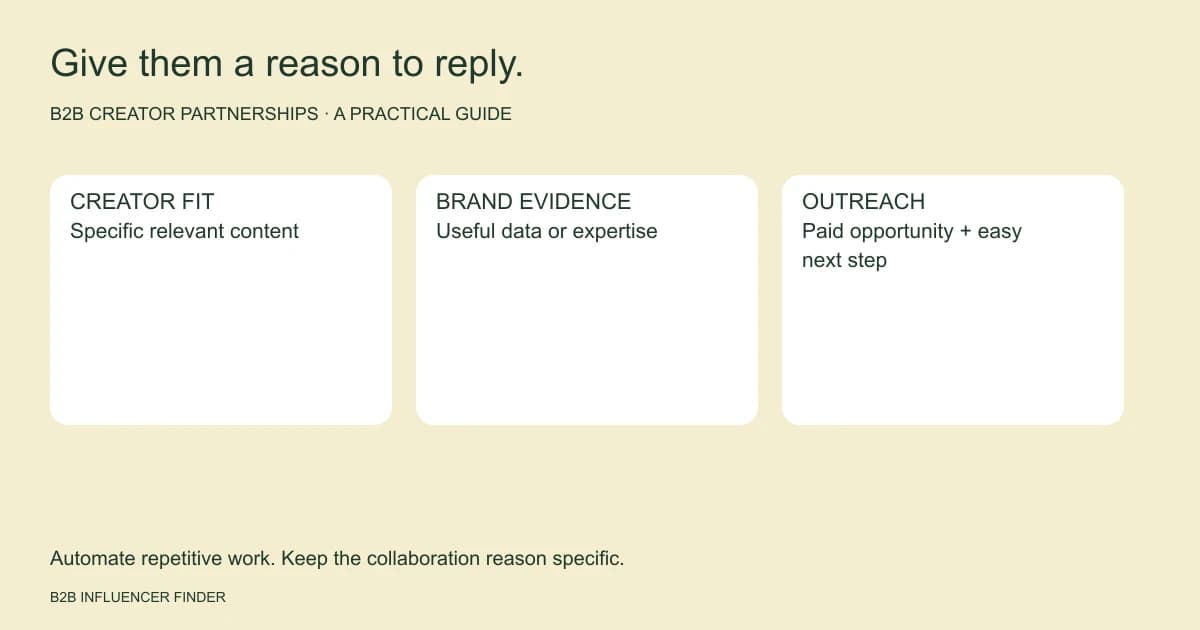
The best way to reach out to a B2B influencer is to make it immediately obvious why you chose them, what you want to collaborate on and why the idea could be useful to their audience.
That sounds simple. Most outreach still misses it.
A creator gets a message saying, 'We love your content and think you'd be a great fit for our brand.' There is no mention of which content, no actual idea and no reason the creator should care. It looks like the same message was sent to 200 people because it probably was.
Good B2B creator outreach should feel more like a relevant business introduction than influencer spam.
Do the matching before you write the message
The outreach message cannot rescue a bad match. Before contacting anyone, you should already know three things: why this creator is relevant, what your brand can contribute and what a plausible collaboration could look like.
If someone regularly writes about fraud prevention for fintech teams and your company has original data on referral fraud, there is a reason to talk. If they happen to have 80,000 LinkedIn followers but have never discussed anything close to your category, there probably isn't.
This is why i would not start creator outreach with a giant exported list. Start with a focused shortlist where you can explain the match in one sentence.Further reading: How Do I Find B2B Influencers in My Industry?
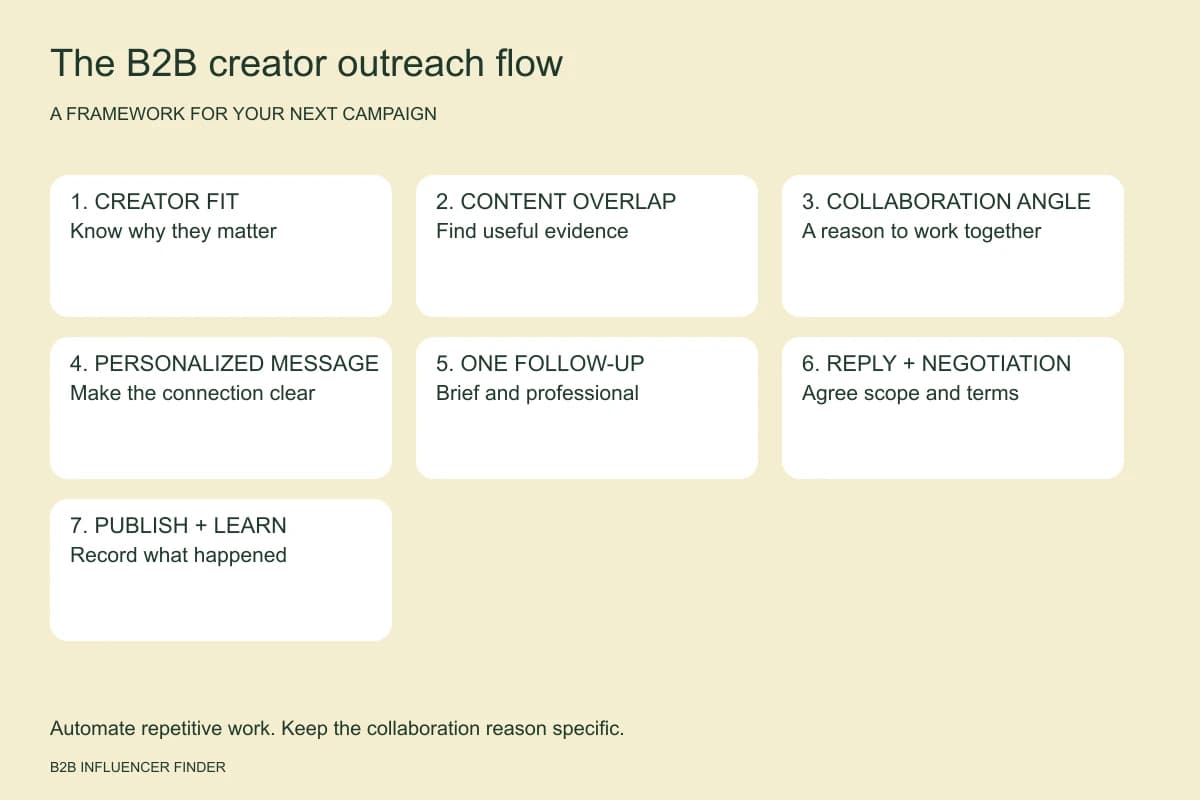
Find the creator's preferred contact route
Do not assume every creator wants a LinkedIn DM.
Some creators publish a business email. Some have an agency or manager. Some explicitly ask brands to use a form. Others are perfectly happy to receive a direct message.
Sprout Social recommends checking how each influencer prefers to be approached before outreach. That is a small detail but it signals that you actually looked at their profile.Sources: Sprout Social, Influencer Outreach: The 5-Step Strategy Guide
For B2B creators, email is often useful when the proposal needs context or attachments. LinkedIn DMs can work well for a short first contact. The best channel is usually the one the creator has made available for commercial enquiries.
Your first message has one job
Get the creator interested enough to continue the conversation.
It does not need to contain your company history, a 12-point campaign brief, your mission statement and three paragraphs explaining influencer marketing.
Later's 2026 creator outreach guidance recommends concise messages that explain why you are reaching out, why the creator fits, what the opportunity involves and what the next step is. That is a useful structure because it answers the questions the creator actually has.Sources: Later Influence Help Center, Creator Recruitment and Outreach Best Practices (updated June 2026)
A simple B2B influencer outreach structure
I would build the first message around five parts.
1. A real reason you chose them
Reference a specific topic, article, video, newsletter edition or recurring theme in their work. Not 'love your content'. Show the connection.
2. Who you are
One sentence is normally enough. Give the creator enough context to understand the company and category.
3. The collaboration idea
Connect something they already care about to something useful your company has. Research. Data. A case study. Expert access. A product they could genuinely test. A point of view worth debating.
4. The commercial context
If it is a paid opportunity, say so. You do not necessarily need to negotiate the full fee in message one, but hiding the fact that you expect commercial work wastes everyone's time.
5. An easy next step
Ask whether they are open to hearing more, whether the topic interests them or whether you can send the brief. Do not make the first step a 30-minute calendar booking unless a call is genuinely necessary.
What could the message actually say?
Something like this is enough:
Hi Sarah, i came across your recent posts on fraud controls in fintech referral programs, especially the one about balancing growth with abuse prevention. We work with B2B Influencer Finder and are helping [Brand] with creator partnerships. They have some original data on referral fraud patterns that looks very close to what you already cover. I thought there might be an interesting article or LinkedIn collaboration in it. This would be a paid collaboration. Open to me sending the data and a little more detail?
That message is not clever. It is just specific.
The creator can see why they were selected, what the raw material is, that payment is available and what they need to do next.
The collaboration angle matters more than the compliment
Personalization is often misunderstood as adding a creator's first name and mentioning their latest post.
That is better than nothing, but the strongest personalization is the idea itself.
Why does this brand have something useful for this creator? Why now? What could the creator make that fits naturally with the work they already do?
Later and Sprout both recommend personalized outreach rather than generic mass messages. For B2B, i would take that one step further: personalize the collaboration, not just the greeting.Sources: Later, Influencer Outreach: How to Effectively Reach Out to Creators (July 2025) · Sprout Social, Influencer Outreach: The 5-Step Strategy Guide
Lead with evidence the creator can use
B2B creators need material.
A beauty creator can sometimes build a piece of content around trying a lipstick. A B2B creator talking about procurement, cybersecurity or SaaS retention usually needs more substance.
Give them access to something: a benchmark, customer result, dataset, specialist interview, technical demonstration, strong case study or informed point of view.
This also makes the resulting content more useful as third-party evidence. Instead of paying someone to repeat your homepage claims, you are giving an expert something they can interpret, challenge or explain in their own voice.
Be clear about whether the opportunity is paid
If you want a guaranteed commercial deliverable, expect compensation to be part of the conversation.Further reading: Should B2B Brands Pay Influencers to Talk About Them?
You can ask for the creator's rate, share your budget or propose a structure. What you should not do is spend three emails pretending this is an editorial opportunity and then reveal that you need a dedicated post, two revisions and usage rights for free.Further reading: How Much Should You Pay a B2B Influencer?
If the opportunity really is editorial, say that too. Perhaps you are offering access to new research and asking whether they would like to cover it with no obligation. That is a different pitch.
Do not ask for fake enthusiasm
You can brief facts, format, deadlines, disclosures and the purpose of the campaign. You should not script an opinion the creator does not hold.
The FTC's US endorsement guidance says paid endorsements must reflect honest opinions and material connections such as payment should be disclosed clearly. Other jurisdictions have their own advertising rules, so campaigns need to follow the rules relevant to the audience and creator.Sources: FTC, Disclosures 101 for Social Media Influencers
This matters commercially too. The reason you wanted a credible industry voice was because people trust their judgment. Removing their judgment defeats the point.
Should you send a full brief in the first message?
Usually not unless the creator has explicitly asked for one.
The first contact should be easy to scan. Once the creator is interested, send the useful detail: campaign objective, proposed format, deliverables, timeline, compensation or budget range, approval process, usage rights, exclusivity if any, disclosure requirements and the evidence or product they will receive.
Clarity at that stage reduces negotiation friction later.
How many times should you follow up?
One thoughtful follow-up is a sensible default.
Later's 2026 outreach guidance recommends a single short professional follow-up after a few days and warns against repeated pressure-driven messages. That fits B2B particularly well.Sources: Later Influence Help Center, Creator Recruitment and Outreach Best Practices (updated June 2026)
Creators have clients, jobs, newsletters, podcasts and their own businesses. Silence does not necessarily mean the pitch is terrible. But seven automated nudges will not make the relationship better.
Follow up once with useful context. If there is still no reply, move on and keep the creator in your research database rather than turning the outreach into harassment.
Do not automate the part that proves you paid attention
Automation can help with research operations, reminders, follow-up timing and keeping track of replies. It is much less useful when it turns every creator into the same merge field.
At B2B Influencer Finder, our approach is to automate the repetitive work around discovery and matching while keeping the reason for the collaboration specific. The creator should be able to tell why the opportunity landed in their inbox.
If you eventually automate sending at scale, the quality bar should stay the same. A system that sends 1,000 irrelevant messages faster is not a better creator program.
What should you track?
Outreach is one of the first places where your own data becomes more useful than generic industry advice.
Track who you contacted, channel, date, collaboration angle, whether the opportunity was paid, reply or no reply, positive or negative response, quoted fee, negotiated fee, time to reply and whether the collaboration ultimately published.
Over time you can answer much better questions: which industries reply most often, which creator sizes respond, which content assets create interest, whether email or LinkedIn performs better and what a successful collaboration actually costs in your category.
Until you have enough of your own data, be careful with universal claims about 'average influencer response rates'. Creator demand, niche, compensation and brand recognition can change the result dramatically.
What happens after a creator replies?
Do not immediately turn the conversation into procurement.
Confirm the idea, ask what format they think would work, understand their commercial terms and make sure both sides agree on the audience value. The creator may improve the concept because they know their audience better than you do.
Then document the practical terms: deliverables, deadlines, compensation, payment timing, revisions, disclosures, usage rights, amplification rights, exclusivity and what happens if the concept changes.
The relationship starts with outreach. The collaboration gets good when both sides can shape it.
Where B2B Influencer Finder fits
B2B Influencer Finder is built around the step most outreach tools skip: figuring out why a creator and a brand should collaborate before sending the message.Further reading: Explore B2B Influencer Finder
The agent scans your brand's useful content and expertise, finds creators across LinkedIn, YouTube, newsletters, podcasts, blogs and X, then shows the overlap between what the creator already talks about and what your company can contribute.
That gives you a much better starting point than a follower list. Instead of 'we love your content', the outreach can begin with an actual reason.
The Finder plan is $80 per month if you want to handle outreach yourself. The managed plan is $800 per month and adds creator outreach and collaboration support. Creator fees are separate.Further reading: Compare Finder and Managed plans
After a creator replies, plan how the partnership fits into your wider program. Our guide to building a B2B creator program explains how to set a brief, run a pilot and develop an ongoing roster.Further reading: How to Build a Winning B2B Creator Program
The short version
Find fewer creators. Know exactly why each one fits. Give them something useful to work with. Keep the first message short. Be clear about the commercial opportunity. Follow up once. Then treat the reply like the beginning of a professional relationship, not the next step in an automated funnel.
The best outreach does not feel like outreach. It feels like somebody found the right person for an idea that actually makes sense.
Sources
Later Influence Help Center, Creator Recruitment and Outreach Best Practices (updated June 2026)Sources: Later Influence Help Center, Creator Recruitment and Outreach Best Practices (updated June 2026)
Later, Influencer Outreach: How to Effectively Reach Out to Creators (July 2025)Sources: Later, Influencer Outreach: How to Effectively Reach Out to Creators (July 2025)
Sprout Social, Influencer Outreach: The 5-Step Strategy GuideSources: Sprout Social, Influencer Outreach: The 5-Step Strategy Guide
FTC, Disclosures 101 for Social Media InfluencersSources: FTC, Disclosures 101 for Social Media Influencers