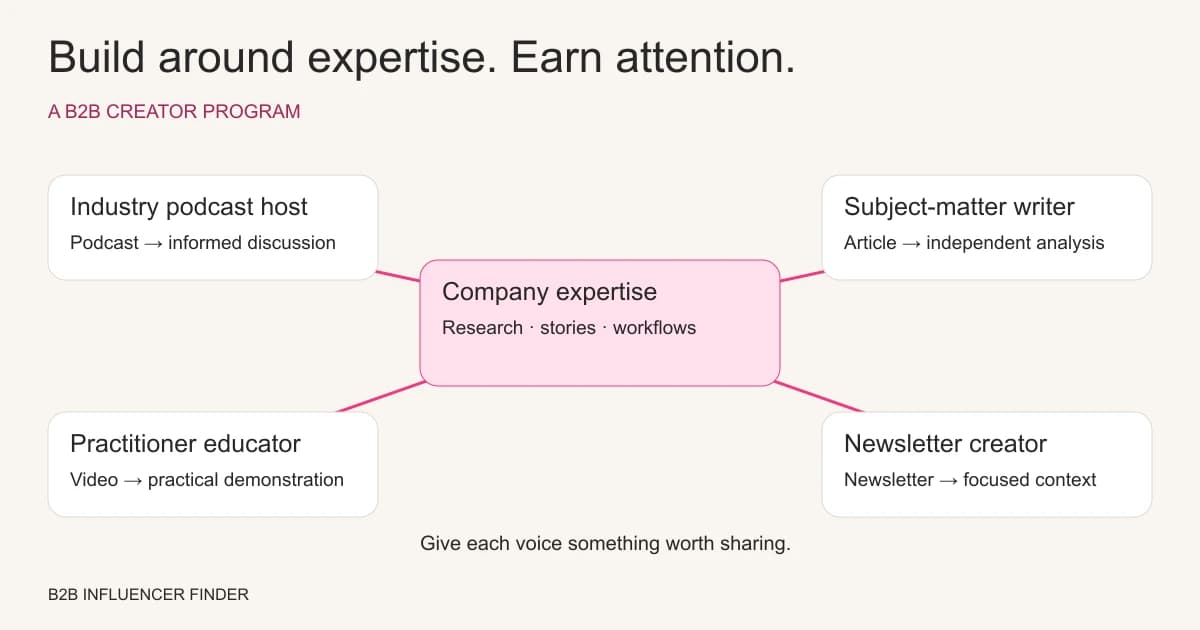
An actionable guide to finding credible industry creators, designing collaborations they actually want to make, and turning one-off posts into a repeatable marketing channel.
Editorial source: Daniel Murray’s interview with Vin Matano, founder of Creator Buzz, on The Marketing Millennials podcast. Timestamps identify the passages discussed. Our recommendations and AI-search perspective are clearly identified as our own.Sources: Watch the original Marketing Millennials interview
A B2B creator program is not a list of people with large followings
A creator with 80,000 followers can give you a busy analytics dashboard and very little else. Meanwhile, a practitioner with 4,000 followers might put your product in front of exactly the people who buy, recommend, or implement it. The difference is not simply audience size. It is whether the creator has earned attention from the people you need to reach, and whether the collaboration gives those people a reason to care.
In a conversation on The Marketing Millennials, Creator Buzz founder Vin Matano describes B2B creators as professionals whose audiences follow them for knowledge and practical experience. That distinction matters: an enterprise buyer rarely purchases software because of a single enthusiastic post. They may discover the brand through one creator, understand a use case through another, and encounter it again during their own research.Sources: The Marketing Millennials interview, 2:59–5:29
A winning program therefore needs more than sponsorship inventory. It needs an audience strategy, credible subject-matter voices, useful material for those voices to work with, and a way to learn which partnerships actually contribute.
1. Start with the buying journey, not the creator shortlist
Before searching LinkedIn, decide what kind of buying process you have. A self-serve tool that someone can try in five minutes needs a different creator program from enterprise software that requires demos, security review and procurement.
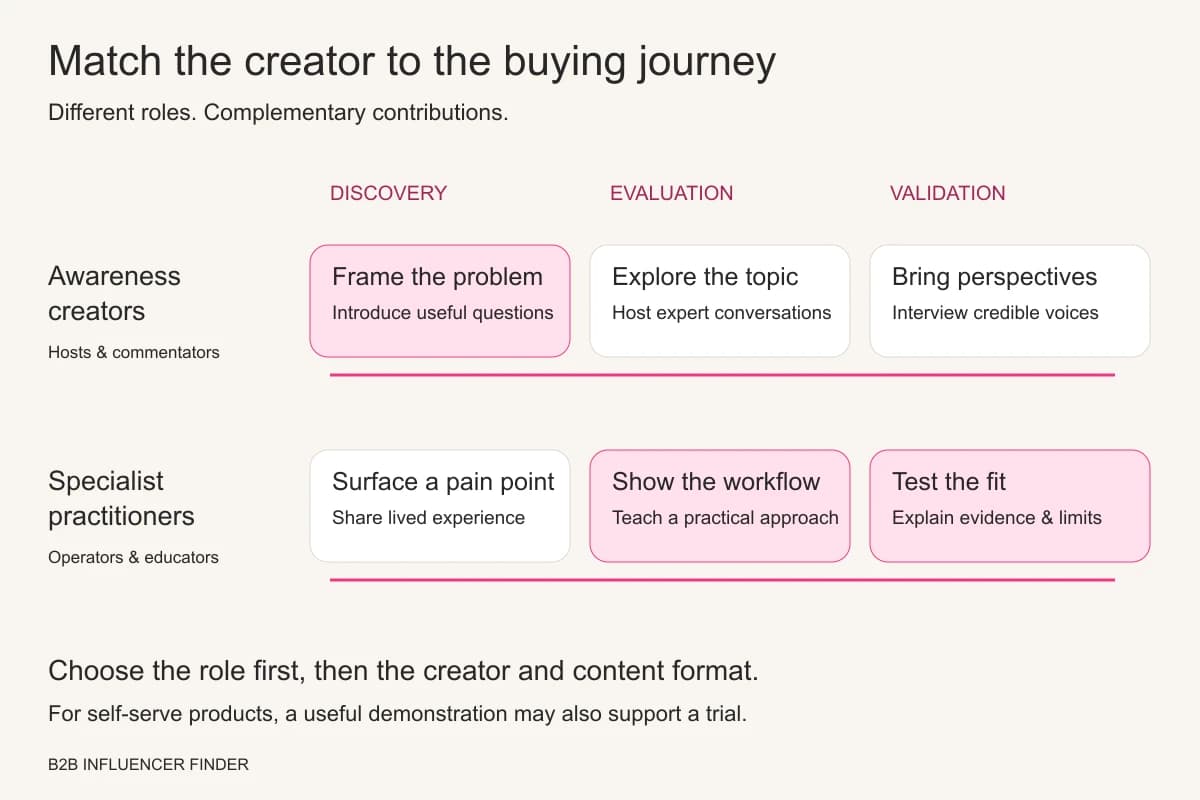
Matano makes this distinction explicitly: product-led growth and sales-led businesses should not run identical creator campaigns. He recommends combining broad attention with specialist, tactical content.Sources: The Marketing Millennials interview, 6:12–7:54
Give creators different jobs
- Discovery: industry commentators, podcast hosts and entertaining educators introduce the problem to a wider but relevant audience. Their job is not necessarily to close a deal.
- Consideration: practitioners show how the work is done, compare approaches, or interrogate a claim. Their audience may be smaller but more concentrated.
- Validation: respected specialists review your research, discuss a case study, interview a customer, or explain where a product fits. Their independence is part of the value.
- Conversion: product educators and implementation experts demonstrate workflows and answer objections. For a self-serve product, a useful tutorial may lead directly to a trial; for enterprise software, the same content may support a buying committee over time.
Practical example: a RevOps platform might sponsor a broad “what is broken in revenue operations?” discussion, then collaborate with a working RevOps manager on a real workflow. These are different assets with different success criteria.
2. Find creators with actual credibility in your niche
Follower count is easy to collect. Trust is harder to assess. Open the last ten or twenty posts from a potential partner and read the comments. Are relevant professionals asking detailed questions? Does the creator answer them? Are people disagreeing thoughtfully, sharing their own examples, or asking for advice? Or is it mostly generic applause?Further reading: Find niche creators who reach your target customers
Matano says his agency looks for genuine conversations in comment threads and is cautious about accounts built almost entirely on engagement bait or recycled memes. He is not arguing that humor is bad; the warning is against confusing viral reach with an audience that trusts the creator’s expertise.Sources: The Marketing Millennials interview, 27:20–30:16
A simple creator qualification scorecard
Assess each creator against five questions: (1) Does their subject matter overlap with our buyers’ real problems? (2) Do the right job titles and communities participate? (3) Do they publish original experience, analysis or useful demonstrations? (4) Is there evidence of genuine dialogue? (5) Can we imagine a specific piece of content they would credibly make with us?
That fifth question is the one teams often skip. “They post about marketing” is not a collaboration idea. “They have written repeatedly about lead quality, and we have original data on which lead sources become customers” is.
Have research, customer stories or practical expertise to share? Explore B2B Influencer Finder to identify creators with a relevant reason to collaborate.Further reading: Explore B2B Influencer Finder
3. Bring creators something worth talking about
Too many programs begin with a company announcement and end with a request to amplify it. The creator gets a script, the audience gets an ad, and the brand wonders why nobody responds.
A stronger approach begins with material the creator can challenge, interpret or build on: a useful customer story, a data set, an expert interview, a contrarian argument, a product workflow, or access to an event. Ask what the creator’s audience would learn, not merely what the brand wants mentioned.
For example, instead of asking a cybersecurity creator to announce your new report, invite them to identify the most surprising finding, explain what practitioners might disagree with, and interview your researcher. You gain a better piece of content precisely because it is not a copy of your landing page.
This is also where B2B Influencer Finder fits into the workflow. The tool is designed to match a company’s existing content and expertise with creators who already cover those specific subjects, rather than building a shortlist from follower counts alone. It helps identify a plausible angle; the creator should still own their independent perspective.
4. Choose a format that suits the idea
A sponsored LinkedIn post is only one option. In the interview, Matano describes newsletter and podcast sponsorships, creators joining webinars and research reports, conference panels, and creators attending events to capture interviews and other reusable content. He gives an example of a food creator attending a restaurant industry event on behalf of a point-of-sale technology company.Sources: The Marketing Millennials interview, 20:00–24:36
Use a LinkedIn post for a sharp observation or a specific workflow. Use a newsletter for a considered recommendation to a focused readership. Use a podcast or interview for nuance and credibility. Use a webinar for teaching. Use an event creator when access, conversations and on-the-ground reporting are the actual story.
The best format is the one that lets the creator say something worth publishing, not the format that happens to be easiest to buy.
5. Write a brief, not a script
The most useful creator brief may fit on a page. Matano, who has worked on both sides of brand deals, argues that long slide decks overwhelm creators. He wants the company context, reason for the collaboration, exact deliverables, call to action, any tracking link, brand guardrails and examples.Sources: The Marketing Millennials interview, 17:39–19:25Further reading: How to reach out to B2B influencers
One-page brief template
- Why this creator: What in their previous work makes this partnership relevant?
- Audience problem: What does their audience need help understanding or doing?
- Content opportunity: Which research, customer story, insight or product experience are we offering?
- Deliverables: Format, number of assets, channels, timeline and usage rights.
- Required facts and boundaries: Verified claims, disclosures, legal or compliance restrictions, and anything that must not be implied.
- Call to action: The optional next step, landing page and trackable link.
- Creative freedom: The creator chooses the angle, wording and storytelling, subject to factual accuracy and agreed approvals.
Disclosure matters. Paid relationships should be disclosed clearly in line with applicable advertising rules and platform policies. Do not ask a creator to disguise a paid endorsement as an independent recommendation.
6. Test small, then build an always-on roster
A single post is not a relationship, but it can be a useful experiment. Matano recommends starting with roughly one to three posts before deciding whether to extend the partnership. The longer-term ambition is a smaller group of creators who become familiar with the product and consistently useful to their audiences.Sources: The Marketing Millennials interview, 25:05–27:12
Start with a short pilot across different creator roles rather than buying ten similar sponsored posts. Give each creator a distinct angle and document what happened: Was the content accurate? Did the creator bring original thinking? Did relevant people engage? Was the working relationship easy? Did the audience ask questions that suggest actual interest?
Then renew the strongest fits. Long-term relationships let creators learn the product, notice new use cases and talk about it with more context. That is more convincing than a parade of unfamiliar paid endorsements.
7. Help creators make better content without taking over
For video, Matano describes three hooks: what the viewer sees, what they hear in the opening seconds, and the on-screen text. He also recommends starting a short-form story with its most interesting moment before explaining the context.Sources: The Marketing Millennials interview, 12:24–15:55
That is a useful production checklist, not a reason to dictate every cut. Give the creator access to compelling evidence, footage, experts or a product demo. Then let them shape it in a format their audience recognizes. If they are strongest as writers, do not force video merely because video is fashionable.
8. Measure more than impressions, without abandoning measurement
A B2B creator program should not escape accountability. But demanding immediate attributed revenue from every post will push teams toward shallow, easily measurable content. Matano argues for a testing period and room to try formats that may fail.Sources: The Marketing Millennials interview, 30:42–33:25
Measure at three levels. Distribution: relevant reach, engaged views, newsletter clicks and visits. Quality: substantive comments, target-account engagement, qualified conversations, demo interest and sales-team feedback. Commercial impact: trials, assisted pipeline, branded search, customer-reported discovery and eventual revenue where measurable.
Before the campaign, record a baseline. Use consistent links and landing pages where appropriate, but remember that B2B buyers may see content, return later, ask colleagues and convert through another channel. A “zero direct leads” report is not enough to conclude the partnership failed; nor is a high view count enough to declare it a success.
9. Add a second objective: credible third-party evidence for AI search
This is our perspective at B2B Influencer Finder, not a claim made by the podcast guests. Buyers increasingly research categories and vendors through AI-powered tools as well as conventional search. That creates another reason to collaborate with knowledgeable third parties: they can publish independent, substantive discussion of your company’s work across articles, videos, newsletters and podcasts.Further reading: How B2B creators improve AI visibility
The opportunity is not to manufacture mentions or buy praise. It is to give respected experts something real to examine and talk about. A thoughtful independent review, a useful technical tutorial or an informed discussion of your original research can create discoverable evidence beyond your own website.
There is no reliable formula that says a certain number of creator mentions will make ChatGPT or another AI assistant recommend a brand. Visibility depends on many factors, including what content is accessible, indexed, relevant and considered useful by each system. Treat AI visibility as a hypothesis to measure, not a guaranteed outcome of a sponsorship.
A practical experiment: choose five important category questions, record how major AI tools answer them before a campaign, publish a series of genuinely relevant third-party collaborations, then revisit those questions over time. Keep the prompts and methodology consistent. Observe changes without assuming the creator activity caused them.
A practical 90-day rollout
- Days 1–15: Map the buyer journey, identify three to five priority topics, audit your best existing research and customer stories, and define baseline metrics.
- Days 16–30: Shortlist 15–25 relevant creators, manually review their work and audience conversations, and develop a specific collaboration angle for each. Approach a small, varied set.
- Days 31–60: Run a pilot with a few creators across at least two formats. Keep briefs short, agree disclosures and rights, and capture qualitative feedback as well as performance.
- Days 61–90: Review outcomes, retain the creators who demonstrated audience fit and good collaboration, repurpose permitted assets, and plan the next set of content opportunities. Build a recurring program around learning, not just posting frequency.
The bottom line
The best B2B creator programs do not start by asking “Who has the biggest audience?” They ask “Who already has the trust of the people we need to reach, and what could we make together that those people would genuinely value?”
That approach can generate awareness, useful education, stronger market credibility and, potentially, more independent evidence for buyers and AI-powered discovery. But it only works if the content is worth making in the first place.
Start with one useful content opportunity and a small set of credible partners. B2B Influencer Finder can help you find the overlap between your expertise and the subjects creators already cover.Further reading: Explore B2B Influencer Finder
Source and attribution
Primary interview: The Marketing Millennials, Daniel Murray interviewing Vin Matano (Creator Buzz). The article synthesizes and attributes the interview’s ideas; all examples, the 90-day rollout, the creator qualification scorecard, and the AI-search section are original editorial additions.Sources: Watch the original Marketing Millennials interview