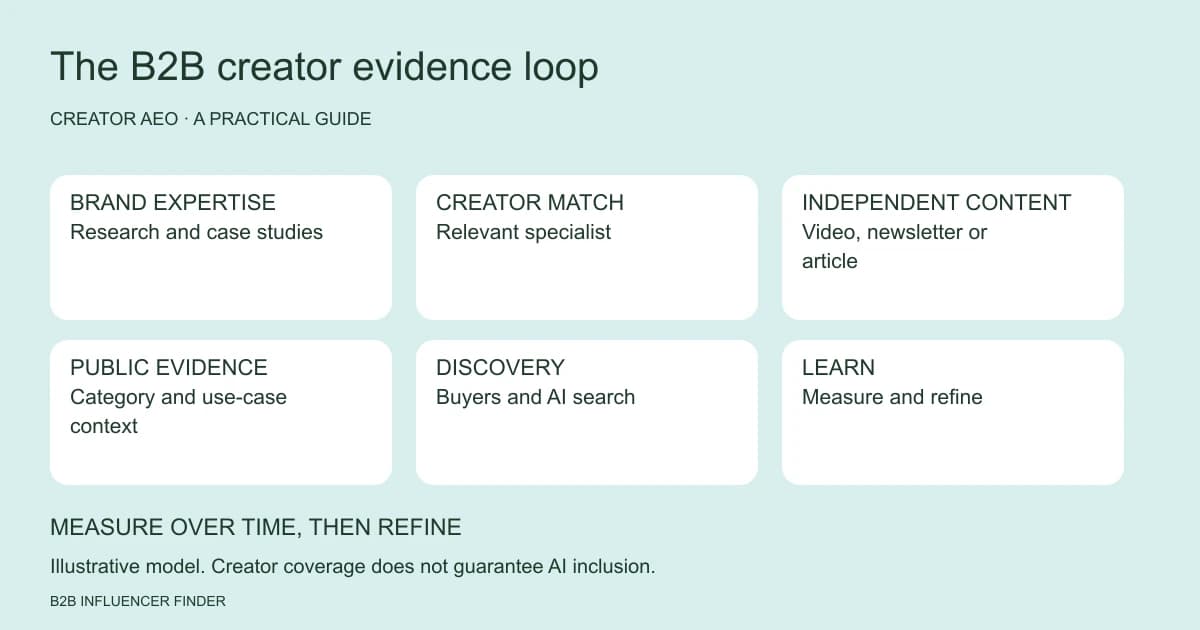
B2B creators can improve AI visibility by creating credible, third-party content that connects your brand with the topics you want to be known for. That content might be a YouTube video, newsletter, article, podcast discussion or LinkedIn post. It gives AI systems more public evidence about who you are, what you do and where you fit in the market.Further reading: What Is Creator AEO?
That does not mean hiring ten influencers will suddenly make ChatGPT recommend you. AI systems are too opaque and too variable for that kind of promise. But the evidence we do have points in a useful direction: brands that are mentioned more widely across the web, and particularly on YouTube, tend to have stronger visibility in AI answers.
For B2B marketers, creators are one practical way to build more of those relevant mentions without trying to manufacture them on your own website.
The useful part of creator marketing is not just reach
Traditional influencer marketing is usually framed around distribution. A creator has an audience. You pay or persuade them to talk about you. Their audience sees the post.
That still matters. But AI search adds another possible layer of value.
A useful creator collaboration leaves something behind on the public web. A video transcript. An article. A newsletter archive. A podcast page. A comparison. An expert opinion that includes your brand in the context of a real problem.
Those pieces of content can become part of the wider evidence AI systems encounter when they search, retrieve or learn about a market.
This is why i think B2B creator marketing becomes more interesting in an AI-search world. The campaign does not necessarily stop being useful when the impressions stop.
There is already a strong relationship between brand mentions and AI visibility
Ahrefs analyzed 75,000 brands across ChatGPT, Google AI Mode and AI Overviews. In that study, YouTube mentions had the strongest correlation with AI visibility of all the factors tested, at roughly 0.737. Branded web mentions also showed strong correlations, around 0.66 to 0.71 depending on the AI surface.Sources: Ahrefs - Top Brand Visibility Factors in ChatGPT, AI Mode, and AI Overviews (75k brands): · Ahrefs - How to Rank on ChatGPT: What Actually Works (Based on Data): · Ahrefs - How to Track AI Visibility:
The same research found much weaker relationships for things marketers traditionally obsess over, such as the number of pages on a site or classic domain authority metrics.
That is correlation, not causation. Brands that are already popular are naturally more likely to be discussed online and more likely to appear in AI answers. We cannot look at this data and say a creator mention caused an AI mention.
But it does support a broader idea: the footprint around your brand matters. AI visibility appears to be connected to what the wider web says about you, not only what you publish about yourself.
Creators can help build that footprint in context
The word context is important here.
Imagine you sell fraud detection software for fintech companies. You could pay a generic business creator with 500,000 followers to mention your company in a sponsored post. You would get a mention.
Or a fraud and payments specialist with 18,000 highly relevant followers could make a video about reducing account-opening fraud and include your product as one example.
For AI visibility, the second piece is potentially much more interesting. It connects your brand to a specific problem, category and audience. It also gives a future AI answer more useful information to work with than a random brand shoutout.
This is also why i would not measure a creator AEO strategy by the number of creators you pay. I would measure the quality and relevance of the evidence they create.Further reading: What Is AI Share of Voice and How Do You Improve It? · What Types of Creator Content Can Appear in AI Search?
What can B2B creators actually create?
The best format depends on what the creator already does well. Trying to turn every creator into every content format usually produces bad content.
- YouTube videos that explain a problem, compare approaches or demonstrate a workflow.
- Newsletter articles that introduce your research, case study or point of view to a specialist audience.
- Independent blog posts or guides where your brand is a relevant example or source.
- Podcast conversations where your expertise is discussed in depth and supported by a useful episode page or transcript.
- LinkedIn posts that introduce an idea to the right professional audience, especially when the creator already owns that subject.
- Expert commentary on your original research, benchmark data or case studies.
The goal is not to force the brand into every paragraph. It is to give the creator a genuinely useful reason to include you.
Give creators something worth talking about
This is where a lot of B2B influencer campaigns become painfully boring. The brand finds a creator and then asks: can you post about our product?
There is often nothing interesting in that request for the creator or their audience.
A better starting point is your existing expertise. Maybe you have a case study showing an unusual result. A dataset nobody else has. A strong opinion based on hundreds of customer conversations. A useful framework. A surprising pattern from your product data.
Then find creators who already cover that exact subject.
The collaboration becomes less like 'please advertise us' and more like 'we have something your audience might genuinely find useful'.
That is the matching problem B2B Influencer Finder is being built around. It looks at what a company already knows and has published, then looks for creators whose existing work overlaps with those ideas. The creator match comes with a reason for the collaboration, not just a follower count.Further reading: B2B Influencer Finder
A smaller specialist creator may be more useful than a famous one
In B2B, reach can be a misleading shortcut.
A cybersecurity practitioner followed by 12,000 security leaders may have more value to a cybersecurity company than a general tech influencer followed by half a million people. The smaller creator may understand the terminology better, ask better questions and already be associated with the topic you care about.
That matters to the human audience first. It may also make the resulting content more semantically useful when an AI system is trying to understand which companies belong in a specific category or answer a specialist question.
We do not yet have evidence for a universal follower threshold that improves AI visibility. I would be suspicious of anyone claiming one.
YouTube deserves special attention
If i had to prioritize one creator channel specifically for AI visibility right now, YouTube would be difficult to ignore.
Ahrefs' 75,000-brand study found YouTube mentions had the strongest correlation with AI visibility among the factors it tested. Its current AI visibility index also shows YouTube as one of the most heavily cited sources across AI systems.Sources: Ahrefs - AI Visibility Index:
That does not mean every B2B company should suddenly spend its entire budget on YouTubers. Some markets barely have a meaningful YouTube creator ecosystem. A niche newsletter or respected industry podcast may be far more sensible for your buyers.
But if good creators already make videos about your category, getting your brand discussed naturally in those videos is worth testing.
Do creators need to link to you?
A link is useful. It helps people find you, can send referral traffic and gives the creator's audience a clear next step.
But for AI visibility, the brand mention itself may also matter. Ahrefs' research found branded web mentions correlated more strongly with AI visibility than traditional backlink metrics in the dataset it studied.Sources: Ahrefs - AI Visibility Metrics:
So i would not reject a high-quality creator collaboration just because the format does not allow a conventional backlink. A spoken brand mention in a relevant YouTube video, for example, can still exist in the transcript and surrounding metadata.
Again, none of this gives us a simple formula where one mention equals one extra ChatGPT recommendation. It is evidence-building, not link-building with a new name.
The creator should have editorial freedom
There is an uncomfortable tension here. Brands want the creator to say the right things. But the more tightly you script independent voices, the less independent they become.
Give creators accurate information, access to your research and clear disclosure requirements. Correct factual mistakes. But let them add their own perspective.
A credible article that says where your product fits, who it is for and where it has limitations is more useful than 800 words of marketing copy pretending to be an independent review.
It is also more likely to be useful to a human buyer, which should still be the standard.
How i would run a B2B creator campaign for AI visibility
If the goal includes AI visibility, i would structure the campaign around evidence rather than raw reach.
1. Choose the topic you want to own.
Be specific. 'Marketing' is not a useful target. 'Customer referral software for fintech' is much closer.
2. Audit what useful evidence you already have.
Find research, case studies, customer results, expert opinions and original frameworks that creators could actually build something around.
3. Find creators who already cover that subject.
Look at their recent content, not just their bio. The strongest match is usually someone who has already demonstrated interest in the exact problem.
4. Match the creator to a specific asset or idea.
Do not send the same pitch to 100 people. Give each creator a reason the collaboration makes sense for their audience.
5. Let the content live somewhere discoverable.
A private webinar may be useful for leads but weak as public evidence. When possible, create something that remains accessible: a video, article, public newsletter, podcast page or social post.
6. Track both creator outcomes and AI outcomes.
Measure views, engagement, referral traffic and leads. Separately track whether your brand appears across a defined set of relevant AI prompts, whether it is cited, which sources are being cited and how your share of voice changes over time.
Do not pretend a movement in AI visibility proves the creator campaign caused it. Over time, though, you can start looking for patterns.
The evidence loop is more important than a one-off campaign
One creator article is unlikely to transform how AI systems understand your company.
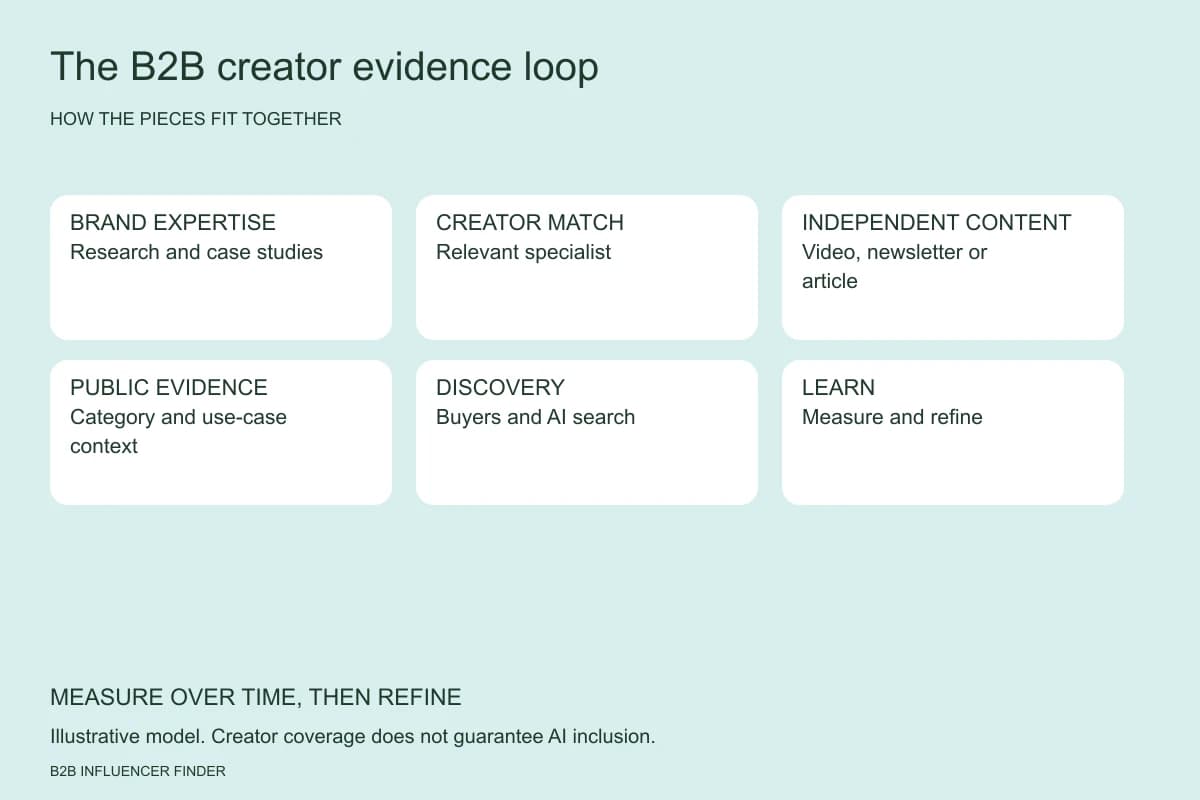
Twenty relevant pieces of independent content across the subjects you care about start to look different. Add customer reviews, comparison pages, community discussions, your own useful content and original research, and the public picture of your brand becomes much clearer.
That is the bigger idea behind Creator AEO. You are not trying to manipulate an LLM with influencer posts. You are trying to make the evidence around your company stronger, broader and more consistent.
Creators are useful because they can add independent voices to that evidence.
How should you measure whether it is working?
Start with a fixed set of prompts that represent how buyers actually research your category. Track them across the AI systems that matter to you.
- How often is your brand mentioned?
- How often are competitors mentioned?
- Which topics are you associated with?
- Which pages, videos and third-party sources are cited?
- Is your AI share of voice changing over several months?
- Are creator assets themselves appearing in cited or retrieved sources?
Keep creator metrics beside those numbers too. A collaboration can be commercially successful even if you cannot prove an AI-search effect. AI visibility should be an additional measurement layer, not an excuse to ignore actual marketing outcomes.
The goal is to create evidence worth finding
B2B creators are not a shortcut into ChatGPT. They are a way to get knowledgeable third parties discussing your company in places you do not control.
That distinction matters.
If the creator is relevant, the content is useful and the brand belongs naturally in the conversation, you end up with something valuable to buyers even if AI search disappeared tomorrow.
If AI systems also use that public evidence to better understand and surface your brand, that is a very useful second benefit.
Sources
Ahrefs - Top Brand Visibility Factors in ChatGPT, AI Mode, and AI Overviews (75k brands):Sources: Ahrefs - Top Brand Visibility Factors in ChatGPT, AI Mode, and AI Overviews (75k brands):
Ahrefs - How to Rank on ChatGPT: What Actually Works (Based on Data):Sources: Ahrefs - How to Rank on ChatGPT: What Actually Works (Based on Data):
Ahrefs - AI Visibility Index:Sources: Ahrefs - AI Visibility Index:
Ahrefs - How to Track AI Visibility:Sources: Ahrefs - How to Track AI Visibility:
Ahrefs - AI Visibility Metrics:Sources: Ahrefs - AI Visibility Metrics: