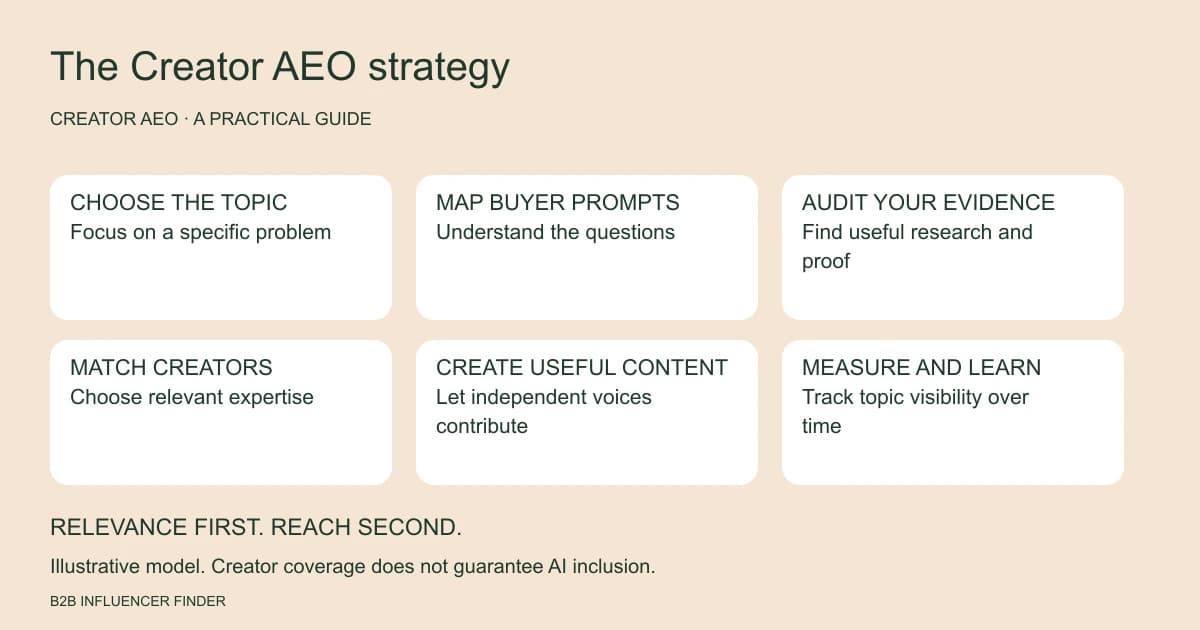
If i were building a Creator AEO strategy from zero, I would not start by making a list of influencers. I would start by deciding what i want the company to be known for, then work backwards from there.Further reading: What Is Creator AEO?
The practical job is to create more useful, accurate third-party evidence around the topics that matter to your business. Creators are the distribution layer. Your research, customer stories, expertise and original data are the raw material.
There is no proven formula where five creator mentions suddenly make ChatGPT recommend your company. Current research is much more useful than that: AI visibility varies by topic and prompt, branded web mentions and YouTube mentions are strongly correlated with AI visibility, and AI systems can retrieve and cite public web sources. That gives us a sensible strategy to test without pretending the algorithm is solved.
1. Pick the topic you actually want to own
Do not begin with “we want more AI visibility.” That is too vague to build a campaign around.
Choose a specific commercial topic, category, use case or problem you want buyers to associate with your company. For B2B Influencer Finder that might be B2B influencer discovery or Creator AEO. For another company it could be employee referral software, treasury automation or AI governance.Further reading: B2B Influencer Finder
Semrush studied 1,094 topic areas in ChatGPT in 2026 and found that visibility changed significantly across related prompts. Only 15.2% of the categories in its study had a clear topic owner. The useful lesson is that “does ChatGPT mention us?” is the wrong measurement question. You need to know whether the brand appears consistently across the cluster of questions buyers ask about the subject.Sources: Semrush - AI visibility is a topic-level game: A study of 50,000 brands in ChatGPT (July 20, 2026) · Semrush - How topical authority spreads in ChatGPT (Aug 3, 2026)Further reading: What Is AI Share of Voice and How Do You Improve It?
I would start with one or two topics, not twenty.
2. Build a prompt map before you build a creator list
For each target topic, write down the questions a real buyer might ask an AI system. Include definition questions, recommendations, comparisons, alternatives, use cases and buying questions.
A company selling employee referral software might track prompts such as “best employee referral software”, “how do employee referral programs work?”, “employee referral software for enterprises”, “alternatives to X” and “how do you automate employee referral rewards?”
You are not trying to stuff these exact prompts into creator content. The prompt map tells you what territory you are trying to become relevant in. It also gives you a stable baseline to measure later.
3. Audit the evidence you already have
This is the step i think most influencer campaigns skip.
Before asking anybody to talk about your company, work out what you have that is actually worth talking about. Look for original research, customer results, benchmarks, strong case studies, expert knowledge, useful product data, contrarian opinions, experiments and genuinely helpful guides.
A generic landing page saying your software is powerful is not much of a creator brief. A dataset showing how 500 companies structure referral rewards is. A customer story with real numbers is. A founder who has run thousands of campaigns and can explain what usually fails is.
This evidence audit also exposes gaps. If you want to be known for a topic but have no proof, examples or expertise around it yet, fix that before trying to distribute the claim.
4. Find creators by subject fit, not follower count
Now find people who already talk about the topic.
For B2B that can mean LinkedIn creators, YouTubers, newsletter writers, podcast hosts, specialist bloggers and people with relatively small but very specific professional audiences.
This is where i would score relevance before reach. Does the creator already cover the problem? Is the audience plausibly made up of your buyers? Have they published something recently? Can you point to a specific piece of their work that overlaps with your evidence?
Ahrefs analysed 75,000 brands and found YouTube mentions had the strongest correlation with AI visibility among the factors it tested, at roughly 0.737. Branded web mentions were also strongly correlated, around 0.66 to 0.71. That does not prove creator coverage causes AI visibility. It does make me much more interested in relevant, searchable third-party content than in a giant follower number on its own.Sources: Ahrefs - Top Brand Visibility Factors in ChatGPT, AI Mode, and AI Overviews
5. Match the creator to a specific piece of evidence
This is the part that became the core of B2B Influencer Finder.
I do not want the tool to say “here are 100 fintech influencers.” I want it to say “this person recently published about SME lending, you have a case study with unusual approval-rate data, and here is a credible angle they could explore.”
That changes outreach completely. You are no longer asking a stranger to promote your company. You are showing them something relevant to the work they already do.
A useful match has three parts: a topic the creator genuinely covers, evidence your company can contribute, and a reason the creator’s audience would care.
6. Let the creator add their own perspective
Creator AEO becomes pointless if every article and video sounds like it came from your PR team.
Give creators facts, access, data, examples and context. Let them decide what is interesting and add their own view. Paid collaborations should be disclosed where required, and sponsorship does not magically become independent evidence just because it appears on another domain.
The strongest output is usually useful even if the reader has never heard of your company. Your brand is part of the explanation, not the entire reason the content exists.
7. Think in formats, not just social posts
A LinkedIn post can be useful, but Creator AEO should not become a euphemism for buying LinkedIn posts.
A good evidence plan can include YouTube videos, newsletter articles, podcast episodes, expert roundups, independent blogs, research commentary, case-study analysis and social posts. Different formats create different kinds of discoverability and shelf life.
OpenAI says any public website can potentially appear in ChatGPT search if it is accessible, while placement is not guaranteed. That is another reason i prefer creator work that leaves a useful public artifact rather than disappearing into a private campaign report.Sources: OpenAI - Publishers and Developers FAQ · OpenAI - Searching the web with ChatGPT
8. Publish in clusters, not random one-off mentions
One brilliant creator collaboration can be valuable. But if the strategic goal is to strengthen the evidence around a topic, i would rather build a small cluster of independent voices around that topic over time.
That does not mean repeating the same talking points everywhere. One creator might analyse your research. Another could interview an expert. A YouTuber might test the workflow. A newsletter writer could compare the approach with alternatives.
The topic stays consistent while the perspectives stay independent.
9. Measure the evidence created as well as the AI outcome
I would measure Creator AEO in three layers.
First, campaign output: creators contacted, response rate, collaborations agreed, content published and cost.
Second, evidence quality: which topics the content covers, where it lives, whether the brand is accurately described, whether it is searchable or publicly accessible, and whether it earns engagement, referral traffic or secondary mentions.
Third, AI visibility: mention rate across the prompt set, citations, recommendations, topic association and share of voice versus competitors.
Keep the prompt set reasonably stable and look at trends over time. AI answers are probabilistic. Tiny week-to-week changes are not proof that a creator campaign worked or failed.
10. Feed the results back into the next campaign
The strategy should get smarter every month.
Which creators replied? Which evidence got them interested? Which formats were published fastest? Which pieces generated traffic or citations? Which topics still show a competitor evidence gap?
This is also where the data moat gets interesting. Over time, a Creator AEO platform should be able to learn what B2B creators charge, what they respond to, which brand assets get collaborations accepted and what types of third-party coverage coincide with changes in AI visibility.
That is much more defensible than another database of influencer profiles.
A simple 90-day Creator AEO plan
For the first month, pick the target topic, build the prompt baseline, audit your evidence and shortlist relevant creators. Do not rush into outreach just to say the campaign has started.
In month two, run a small number of highly tailored collaborations. Test different creator types and formats. Record every response, fee, objection and publication.
In month three, review what actually got published, update the AI visibility baseline and double down on the combinations of topic, evidence and creator that produced the strongest results.
Then repeat. Creator AEO should become a learning system, not a one-off influencer campaign.
What I would not do
I would not buy hundreds of generic brand mentions. I would not send the same brief to every creator. I would not measure success by follower count alone. I would not promise the CEO that ten sponsored posts will make ChatGPT recommend the company.
And i would not create a separate “AI content strategy” full of thin pages and awkward phrases written for a machine.
The better strategy is much less mysterious: know what you want to be known for, create evidence worth discussing, find credible people already interested in the subject, help them make something genuinely useful, then measure whether your brand becomes more visible across the conversations that matter.
The strategy in one sentence
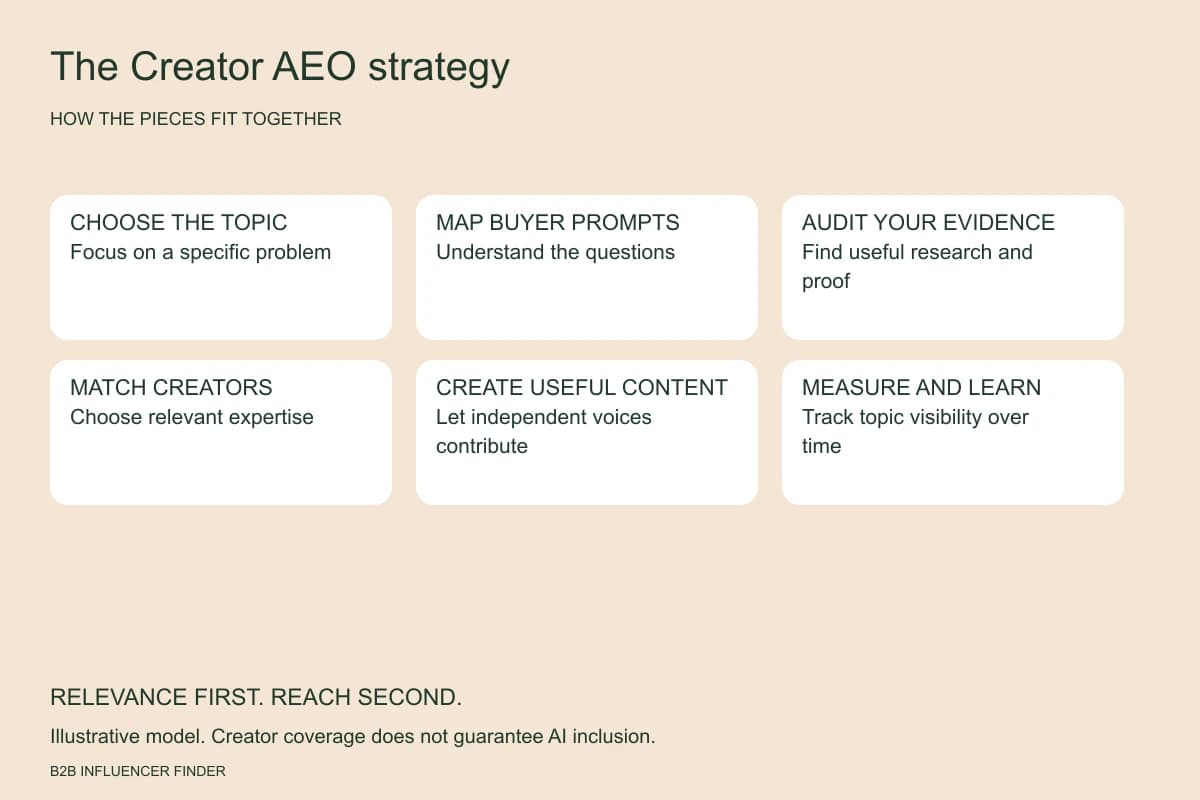
Pick the topic. Build the evidence. Match it to the right creators. Create useful third-party coverage. Measure the topic over time.
That is the Creator AEO strategy i would start with today. The mechanics will change as AI search changes, but the underlying idea is durable: if you want the market and AI systems to understand your brand, it helps when your company is not the only source explaining what it knows.
Sources
Semrush - AI visibility is a topic-level game: A study of 50,000 brands in ChatGPT (July 20, 2026)Sources: Semrush - AI visibility is a topic-level game: A study of 50,000 brands in ChatGPT (July 20, 2026)
Semrush - How topical authority spreads in ChatGPT (Aug 3, 2026)Sources: Semrush - How topical authority spreads in ChatGPT (Aug 3, 2026)
Ahrefs - Top Brand Visibility Factors in ChatGPT, AI Mode, and AI OverviewsSources: Ahrefs - Top Brand Visibility Factors in ChatGPT, AI Mode, and AI Overviews
OpenAI - Publishers and Developers FAQSources: OpenAI - Publishers and Developers FAQ
OpenAI - Searching the web with ChatGPTSources: OpenAI - Searching the web with ChatGPT