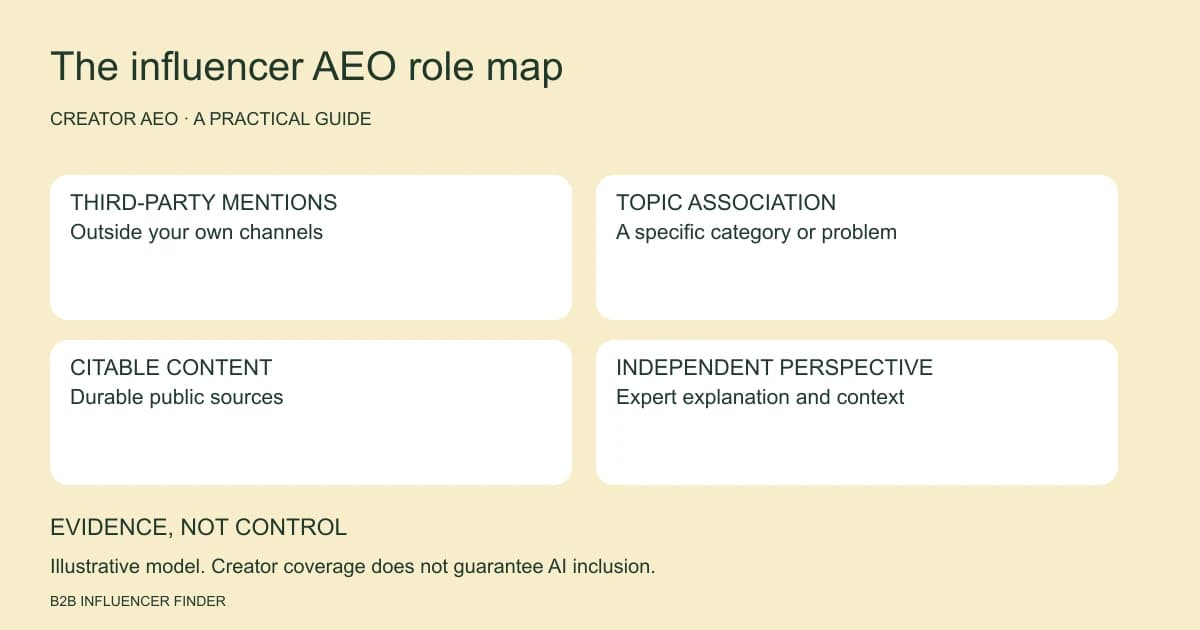
Influencers play a fairly simple role in AEO: they create independent content about the subjects your buyers care about, and sometimes your brand belongs in that content.
That matters because AI search is not built only from what a company says about itself. AI systems can retrieve, cite and summarize information from across the web. Videos, articles, newsletters, podcasts, community discussions and expert commentary can all become part of the public evidence around a company.
Influencers are one way to create more of that evidence. Not because they have a secret relationship with ChatGPT. Not because one sponsored post magically changes an LLM. Their value is that they can add relevant third-party voices to the conversation around your brand.
For me, that is the useful way to think about influencers in AEO.
AEO has a first-party problem
Most AEO advice starts with your own website. Make the site crawlable. Answer questions clearly. Publish useful information. Structure pages so an AI system can understand them. All sensible.
But there is an obvious limitation: every claim still comes from you.
If you say your software is the best referral platform for banks, that is marketing. If customers, fintech creators, banking publications and independent consultants repeatedly discuss your product in that context, that is a different kind of evidence.Further reading: What Is Creator AEO?
This is where influencers fit. They expand the information about your company beyond the domain you control.
The research points toward off-site brand evidence
We still do not have a public ranking formula for ChatGPT, Gemini, AI Overviews or other AI systems. Anyone presenting AEO as a deterministic checklist is getting ahead of the evidence.
What we do have are increasingly large observational studies.
Ahrefs analyzed 75,000 brands across ChatGPT, Google AI Mode and AI Overviews. YouTube mentions showed the strongest correlation with AI visibility among the factors tested, at roughly 0.737. Branded web mentions also correlated strongly, around 0.66 to 0.71 depending on the AI surface.Sources: Ahrefs - Top Brand Visibility Factors in ChatGPT, AI Mode, and AI Overviews (75k Brands Studied): · Ahrefs - How to Track AI Visibility: · Ahrefs - How to Rank in AI Overviews: What Actually Works:
The same research found much weaker correlations for classic metrics such as domain rating and raw backlink counts. Ahrefs is explicit that correlation does not prove causation. Popular brands naturally get talked about more and may also appear more often in AI answers.
Still, the pattern is useful. The brands AI systems surface tend to have a broader footprint across the web, and creator content can be part of that footprint.
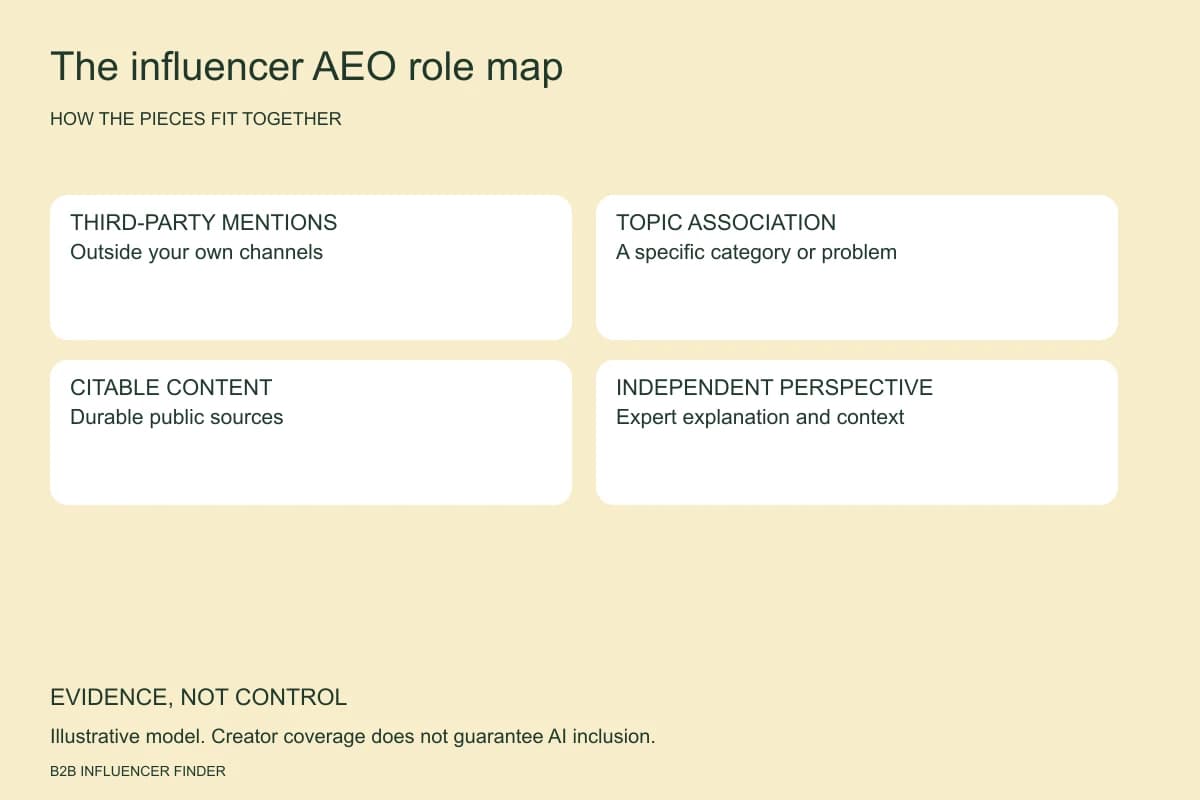
Influencers can do four useful jobs in AEO
I would not treat influencer marketing as a separate magic channel for AI. I would treat creators as a way to strengthen four parts of the evidence around a brand.
1. They create third-party mentions
The most obvious role is simply getting your brand discussed outside your own website.
A relevant mention might appear in a YouTube transcript, newsletter, industry article, podcast transcript or public social post. The creator is adding another document, voice and context in which your company exists.
This is more interesting when the mention is connected to a useful subject. "Acme sponsored this video" tells the world less than a payments expert explaining when Acme is useful for reducing chargeback fraud.
2. They connect your brand to specific topics
AEO is not only about whether an AI system knows your company name. It is about what the system associates you with.
If you want to be known for employee referral software, cybersecurity compliance or B2B payment orchestration, the surrounding context matters. Relevant creators can repeatedly place your company inside those conversations.
This is why creator relevance matters more than celebrity. A specialist with 15,000 followers who has published twenty pieces about your exact category may create more useful evidence than a general business influencer with a million followers.
3. They can create material AI systems actually cite
A creator mention and an AI citation are not the same thing. AI systems may know or mention a brand without linking to the creator content at all.
But creator assets can also become sources themselves. Ahrefs reports that YouTube is heavily represented among AI citations, and its research found YouTube mentions had the strongest relationship with brand visibility across the AI surfaces it studied.
That makes formats such as tutorials, comparisons, expert explainers and problem-focused videos especially interesting. The content has value to a human buyer first, but it also creates a durable public source that can potentially be retrieved later.
4. They add independent perspective
This part is easy to underestimate.
A creator can describe your company in language you would never use on your own homepage. They can compare you with competitors. Explain where you fit. Point out limitations. Connect your product to a real workflow. Use the category vocabulary their audience already understands.
That independent context can make the public picture of your company richer than a collection of perfectly controlled brand pages.
Not every influencer mention is useful for AEO
This is where the strategy can go wrong very quickly.
Paying fifty random creators to paste the same sentence about your company is not a serious AEO strategy. It is just low-quality distribution with a new label.
A useful creator collaboration usually has three things:
- The creator genuinely covers the topic you want to be associated with.
- Your company has something relevant to contribute, such as expertise, research, a case study, a useful product or original data.
- The resulting content is useful enough to exist independently of the sponsorship.
If you remove the brand name and the content becomes pointless, it was probably an advertisement rather than useful third-party evidence.
Reach is not the main AEO metric
Traditional influencer campaigns often begin with follower count, impressions and engagement. Those numbers still matter if distribution is one of your goals.
But they are incomplete for AEO.
Ahrefs found the volume of YouTube mentions correlated slightly more strongly with AI visibility than YouTube mention impressions. That does not prove small creators are better, but it is another reason not to reduce the strategy to raw reach.
For AEO, i would care about relevance, topical fit, discoverability, content quality and whether the creator produces something durable enough to remain part of the public web.
The creator should have something worth talking about
This is probably the biggest practical point.
Do not start with a spreadsheet of influencers and ask all of them to "talk about our brand". Start with what your company actually knows.
Maybe you have an unusual case study. A benchmark from 10,000 customers. A useful framework. A strong expert opinion. A new dataset. A product that solves a problem the creator has already discussed.
Then match that asset to a creator who already cares about the subject.
That is the core idea behind B2B Influencer Finder. The product starts with the useful content and expertise a company already has, then looks for creators whose existing work overlaps with it. The match is the important part. The follower count comes later.Further reading: B2B Influencer Finder
Influencers do not replace the rest of AEO
Creator content is one layer, not the entire strategy.
You still need a technically accessible website. Clear positioning. Useful first-party content. Customer evidence. Reviews. Digital PR. Community presence. Accurate information across important third-party profiles. In many categories you will also need traditional SEO because AI search and conventional search still overlap heavily.
Influencers are useful because they solve a specific gap: brands cannot create independent evidence about themselves.
You need other people for that.
Sponsored content can still be useful
There is sometimes an assumption that paid creator content must be worthless for AI because it is sponsored. I do not think that is a useful way to frame it.
The more important questions are whether the content is transparent, relevant and genuinely useful. A sponsored YouTube tutorial can still explain a problem well. A paid newsletter placement can still contain original analysis. A creator can be compensated and still have editorial independence.
Disclosure rules still apply, and brands should not ask creators to disguise advertising as independent opinion. Credibility matters to the human audience long before we get to AI systems.
How i would use influencers in an AEO strategy
If i were building this from zero, i would keep the process fairly simple.
Choose the topic first
Decide what you want your company to be associated with. Not "marketing". Something specific enough that a buyer might actually ask an AI system about it.
Map the questions around that topic
Build a set of real prompts covering recommendations, comparisons, problems, use cases and buying questions. This becomes the baseline you track over time.Further reading: What Is AI Share of Voice and How Do You Improve It?
Audit your strongest brand assets
Find the things creators could build useful content around: research, customer results, data, expertise, product workflows and contrarian opinions.
Find creators already discussing those questions
Look at their actual recent content. A bio saying "fintech creator" is less useful than seeing ten recent pieces about payments infrastructure, fraud or neobanking.
Pitch the idea, not the brand
Give the creator a useful angle. The collaboration should make sense to their audience before it makes sense to your marketing team.
Let the creator add their own perspective
Provide facts and access. Correct inaccuracies. But do not turn independent content into a press release written in somebody else's voice.
Measure creator outcomes and AI outcomes separately
Track the collaboration itself: publication, reach, engagement, traffic, leads and cost. Separately track AI mentions, citations, share of voice, topic associations and the third-party sources appearing in relevant answers.
If both improve over time, that is interesting. It still does not prove one caused the other. AEO measurement is not mature enough for that kind of certainty yet.
What should you measure?
Ahrefs currently separates AI visibility into metrics such as mentions, citations, impressions and AI share of voice. That distinction is useful because a brand can be mentioned without its own site being cited, and a third-party source can influence an answer without giving the brand a conventional backlink.Sources: Ahrefs - AI Visibility Metrics:
For an influencer AEO program, i would track:
- Brand mentions across a fixed set of relevant AI prompts.
- AI share of voice against named competitors.
- Topics and use cases the brand is associated with.
- Which creator pages, videos or third-party sources appear in citations.
- The number and quality of relevant creator mentions published over time.
- Normal campaign outcomes such as referral traffic, engagement and pipeline.
Do not judge the whole strategy by asking ChatGPT one question once. AI answers vary by platform, prompt, model, location, freshness and time.
The role of influencers is evidence, not control
Influencers cannot guarantee that an AI system will mention your company. Neither can an SEO agency, PR firm or AEO platform.
What creators can do is increase the amount of useful, independent material that exists about your brand in the context of the topics you care about.
That material can influence human buyers immediately. It can earn search visibility, referral traffic and brand recognition. And it can become part of the wider source environment AI systems retrieve, cite and summarize.
That is a much more defensible reason to include influencers in an AEO strategy than pretending they are a new ranking hack.
Sources
Ahrefs - Top Brand Visibility Factors in ChatGPT, AI Mode, and AI Overviews (75k Brands Studied):Sources: Ahrefs - Top Brand Visibility Factors in ChatGPT, AI Mode, and AI Overviews (75k Brands Studied):
Ahrefs - How to Track AI Visibility:Sources: Ahrefs - How to Track AI Visibility:
Ahrefs - AI Visibility Metrics:Sources: Ahrefs - AI Visibility Metrics:
Ahrefs - How to Rank in AI Overviews: What Actually Works:Sources: Ahrefs - How to Rank in AI Overviews: What Actually Works:
Semrush - Why 62% of AI citations do not lead to brand mentions:Sources: Semrush - Why 62% of AI citations do not lead to brand mentions:
Semrush - 2026 AI Visibility Index announcement:Sources: Semrush - 2026 AI Visibility Index announcement: