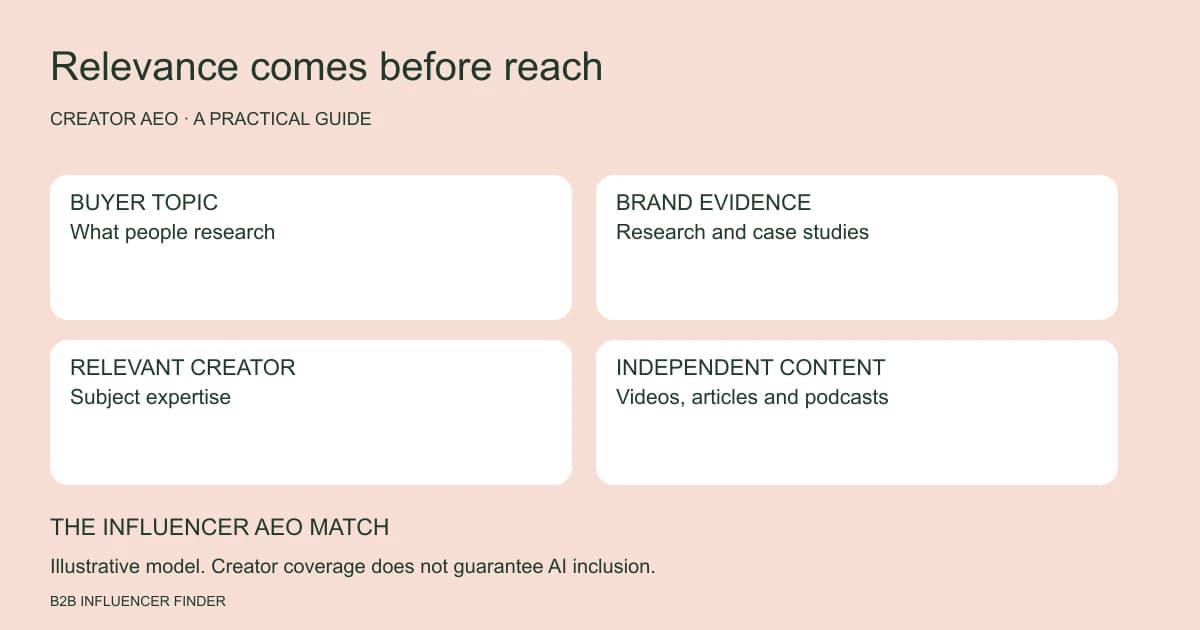
Influencer AEO is the practice of working with relevant influencers so credible third-party content about your brand, product or expertise exists in the places AI systems and buyers may encounter when researching a topic.
It sits between influencer marketing and answer engine optimization. Instead of asking only, 'How many people will this influencer reach?', you also ask, 'Could this collaboration add useful independent evidence around the topics we want our brand to be known for?'
That second question matters because AI search is not built from your website alone. Search results, videos, articles, communities, reviews and other third-party sources can all contribute to the information environment around a brand.
There is an important caveat from the start: influencer AEO is an emerging marketing practice, not a proven ranking formula. Nobody can guarantee that an influencer mention will make ChatGPT, Gemini or Google recommend your company. The useful idea is simpler. If independent people create genuinely relevant content about you, there is more external evidence for humans and machines to discover.
Is Influencer AEO the same as Creator AEO?
Almost. In practice, the two terms overlap heavily.
I use Creator AEO as the broader term because not every useful third-party voice thinks of themselves as an influencer. A niche newsletter writer, technical YouTuber, podcast host or industry analyst may have a small audience but enormous relevance inside one market.Further reading: What Is Creator AEO?
Influencer AEO is useful language when the person has recognizable influence over a specific audience or buying community. Creator AEO is useful when you want to emphasize the content itself and the expertise behind it.
For B2B brands, i would not get too hung up on the label. The strategic question is the same: who already has credibility around this subject, and what useful thing could they independently say about your company?
Why does influencer content matter to AI search?
Because AI-generated answers frequently rely on sources outside a brand's own website.
Search Engine Land reported in July 2026 that Tinuiti's Q1 2026 AI Citation Trends Report found roughly 82% of AI citations in its dataset pointed to earned media rather than brand-owned sites. The same article argues that reviews, community discussions, editorial content and creator content can all supply the opinions and context AI systems need for subjective questions.Sources: Search Engine Land - Why creator content belongs in your AI search strategy
The exact mix changes by category and platform. Search Engine Land also noted that social sources accounted for around 13% of AI citations on apparel prompts in Tinuiti's Q2 data, but only about 3% for over-the-counter health. So 'use influencers' is not a universal answer. The sources that matter depend on what people are asking and where credible information for that category actually lives.
The broader pattern is harder to ignore. Ahrefs' study of 75,000 brands found YouTube mentions had the strongest correlation with AI visibility among the factors it tested, at roughly 0.737, while branded web mentions also showed a strong correlation. Correlation is not causation, but it is a useful signal that brand presence outside your own domain deserves attention.Sources: Ahrefs - Top Brand Visibility Factors in ChatGPT, AI Mode, and AI Overviews
YouTube is especially interesting
YouTube keeps appearing in AI visibility research because it is both a creator platform and a huge searchable library of explanations, reviews, comparisons and demonstrations.
Ahrefs currently reports YouTube as the most-cited source across its AI Visibility Index, which covers hundreds of millions of modeled prompts across major AI platforms. In its separate 75,000-brand correlation study, YouTube mentions were also the strongest correlate with AI visibility.Sources: Ahrefs - AI Visibility Index
Google's own AI results make the platform relevant too. Ahrefs reported in October 2026 that YouTube was one of the most common external citations in branded Google AI Overviews, alongside Wikipedia and LinkedIn.Sources: Ahrefs - AI Overviews Currently Appear for 83% of Branded Searches
None of that means every company should immediately sponsor YouTubers. It means video creators should be part of the source analysis when your buyers use video to learn about your category.
Influencer AEO starts with the topic, not the influencer
This is where i think most influencer databases start in the wrong place for B2B.
You search 'fintech', sort by followers and get a list of people. Then somebody on the marketing team has to invent a reason each person should care about the brand.
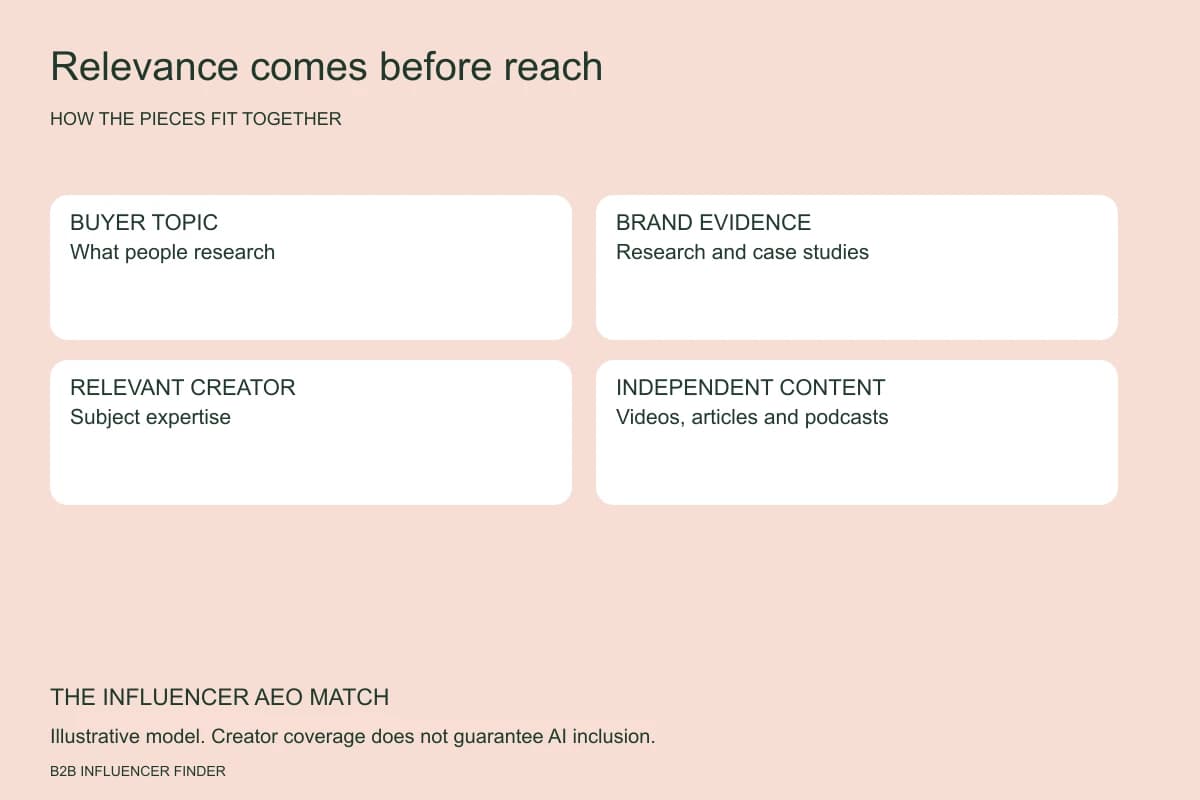
For Influencer AEO, reverse the process. Start with the topics and prompts where you want to be understood. Then identify the evidence your company already has. Only then find people whose existing work overlaps with it.
If you sell fraud prevention software and have original data on payment fraud, a creator who regularly analyses fraud trends has a natural reason to engage. A general 'future of fintech' influencer with a much larger audience may not.
Relevance is not a nice-to-have here. It is the mechanism that makes the collaboration useful rather than just promotional.
What should an influencer actually create?
Not a forced sentence saying your company is amazing.
The strongest collaboration usually gives the influencer something useful to work with: original research, customer results, a case study, benchmark data, access to an expert, a product they can genuinely test or a point of view worth challenging.
The format should fit what they already do. A newsletter writer might analyse your benchmark data. A YouTuber might compare approaches. A podcast host might interview your customer. A LinkedIn creator might turn one surprising finding into a discussion with their audience.
The brand can supply facts and context. The influencer should still have a perspective. That independence is part of what makes third-party content different from another page on your own website.
Does the influencer need a huge following?
No. For B2B, audience relevance can matter far more than raw audience size.
A cybersecurity practitioner followed by 15,000 security leaders may be more commercially useful than a general technology personality followed by 500,000 people. The smaller account can also be more relevant to the exact questions and language buyers use when researching the category.
This is why i prefer thinking in terms of specialist voices rather than celebrity influencers. Influence in B2B is often narrow. The person buyers trust on CRM implementation may be almost unknown outside revenue operations. That is fine.
Follower count is one signal. Subject expertise, audience fit, publishing consistency, platform, credibility and the match between their content and your evidence should all be considered alongside it.
Where B2B Influencer Finder fits
This matching problem is exactly why we built B2B Influencer Finder.Further reading: B2B Influencer Finder
The tool starts by analysing the useful content and expertise already on a company's site, such as research, case studies and industry insights. It then looks for relevant voices across LinkedIn, YouTube, newsletters, podcasts, blogs and X, and matches specific creators to specific brand assets.
So instead of getting '50 B2B influencers', you get the reason a creator is relevant and a possible collaboration angle based on what they already publish.
For Influencer AEO, that distinction matters. The objective is not to manufacture mentions at scale. It is to find credible people who have a legitimate reason to discuss the subject your brand wants to be associated with.
Paid influencer content can still be useful, but disclose it
Influencer AEO does not require pretending a paid collaboration is organic.
If a brand sponsors content, the commercial relationship should be disclosed according to the rules that apply to the creator and market. More importantly, payment should not require the creator to make claims they do not believe or hide material limitations.
Sponsored content can still contain real expertise, useful data and a genuine opinion. A paid industry analyst webinar does not become worthless simply because money changed hands. The same logic applies here.
What you should avoid is mass-producing thin advertorial content whose only purpose is to place a brand name next to a keyword. That is weak marketing for humans and a very shaky AI strategy too.
Can influencer marketing get you mentioned by ChatGPT?
Possibly, but that wording makes the relationship sound more direct than the evidence supports.
Ahrefs' research shows strong correlations between YouTube and web mentions and AI visibility. Search Engine Land's 2026 creator-content analysis argues that creator content increasingly informs AI answers. We also know from Ahrefs that YouTube, Reddit, Wikipedia and other third-party platforms appear heavily among cited sources across AI systems.Sources: Search Engine Land - AI search & LLM optimization tactics that influence AI visibility
What we do not have is a clean rule saying ten influencer posts create X more ChatGPT mentions. Models change, retrieval systems change, prompts vary and a brand's wider search presence changes at the same time.
So i would measure Influencer AEO as an experiment, not sell it as magic. Track your AI visibility before the campaign. Publish genuinely relevant creator coverage. Then monitor the same topic and prompt set over time alongside normal creator metrics.Further reading: What Is AI Share of Voice and How Do You Improve It?
How do you measure Influencer AEO?
Use two sets of metrics: creator outcomes and AI visibility outcomes.
On the creator side, track who published, the platform, topic, audience, engagement, referral traffic, branded search, leads where attributable, and how long the content remains discoverable.
On the AI side, track brand mentions, citations, recommendations, share of voice, competitor appearances and the sources AI systems use for a stable portfolio of prompts.
Ahrefs defines AI visibility metrics including mentions, citations, impressions and AI share of voice. Semrush's 2026 research also makes a useful point: AI visibility is topic-level. A brand can appear for one prompt and disappear for the next closely related question, so one screenshot tells you very little.Sources: Semrush - AI visibility is a topic-level game
The interesting measurement question is whether third-party creator evidence grows at the same time as visibility across the topic improves. That still does not automatically prove causation, but it is far better evidence than checking ChatGPT once after a campaign.
Influencer AEO is really an evidence strategy
The phrase sounds like another new marketing acronym. Underneath it is a fairly old idea.
People trust independent expertise differently from advertising. Search engines have always looked beyond what a company says about itself. PR has always tried to earn credible third-party coverage. Influencer marketing has always borrowed trust from people who already have an audience.
AI search brings those disciplines closer together because an AI answer can synthesize information from many parts of the web before a buyer ever visits your website.
That is why i think the useful version of Influencer AEO is not 'pay influencers so ChatGPT ranks you'. It is: build better third-party evidence around the subjects that matter to your business.
Find people who genuinely know those subjects. Give them something worth talking about. Let them add their own perspective. Then measure whether your brand becomes more visible, more accurately understood and more frequently included in the conversations that matter.
Sources
Search Engine Land - Why creator content belongs in your AI search strategySources: Search Engine Land - Why creator content belongs in your AI search strategy
Ahrefs - Top Brand Visibility Factors in ChatGPT, AI Mode, and AI OverviewsSources: Ahrefs - Top Brand Visibility Factors in ChatGPT, AI Mode, and AI Overviews
Ahrefs - AI Visibility IndexSources: Ahrefs - AI Visibility Index
Ahrefs - AI Overviews Currently Appear for 83% of Branded SearchesSources: Ahrefs - AI Overviews Currently Appear for 83% of Branded Searches
Ahrefs Help Center - AI Visibility MetricsSources: Ahrefs Help Center - AI Visibility Metrics
Semrush - AI visibility is a topic-level gameSources: Semrush - AI visibility is a topic-level game
Search Engine Land - AI search & LLM optimization tactics that influence AI visibilitySources: Search Engine Land - AI search & LLM optimization tactics that influence AI visibility