Creator AEO is the practice of using relevant creator content as part of your answer engine optimization strategy, so your brand has more credible third-party evidence around the topics you want to be known for.Further reading: B2B Influencers vs B2B Creators: What's the Difference?
In plain English: normal AEO asks how your brand becomes easier for AI systems to find, understand and cite. Creator AEO asks how independent creators can contribute to that picture.
The term is still new. There is no universal Creator AEO rulebook and nobody can promise that paying a creator to mention your company will make ChatGPT recommend you. What is becoming much clearer, though, is that AI answers are shaped by far more than the claims on your own website. Independent publishers, communities, reviews, videos, social platforms and other third-party sources are part of the information environment around a brand.
Why are people suddenly talking about Creator AEO?
Because the way people discover companies is changing, while creator marketing and search marketing are starting to overlap.
Semrush's 2026 AI Visibility Index analysed 126 million U.S. AI search prompts across ChatGPT, Gemini, Google AI Mode and AI Overviews. Its conclusion is useful here: brand narratives are being assembled from combinations of owned content, third-party sources, community discussions, publishers and reference platforms, not from one website or one ranking position.Sources: Semrush - 2026 AI Visibility Index: 126 Million AI Search Prompts · Semrush - Why AI Is Citing Third-Party Sources Instead of Your Site · Semrush - How to Find AI Visibility Gaps
Ahrefs found something similar from another angle. In October 2026 it reported AI Overviews on 83% of the branded queries it studied, with Wikipedia, YouTube and LinkedIn among the most common external citations in those branded answers.Sources: Ahrefs - AI Overviews Currently Appear for 83% of Branded Searches
That does not mean every LinkedIn post or YouTube video influences every model. It does mean the old separation between 'our SEO content' and 'what other people say about us' is becoming less useful.
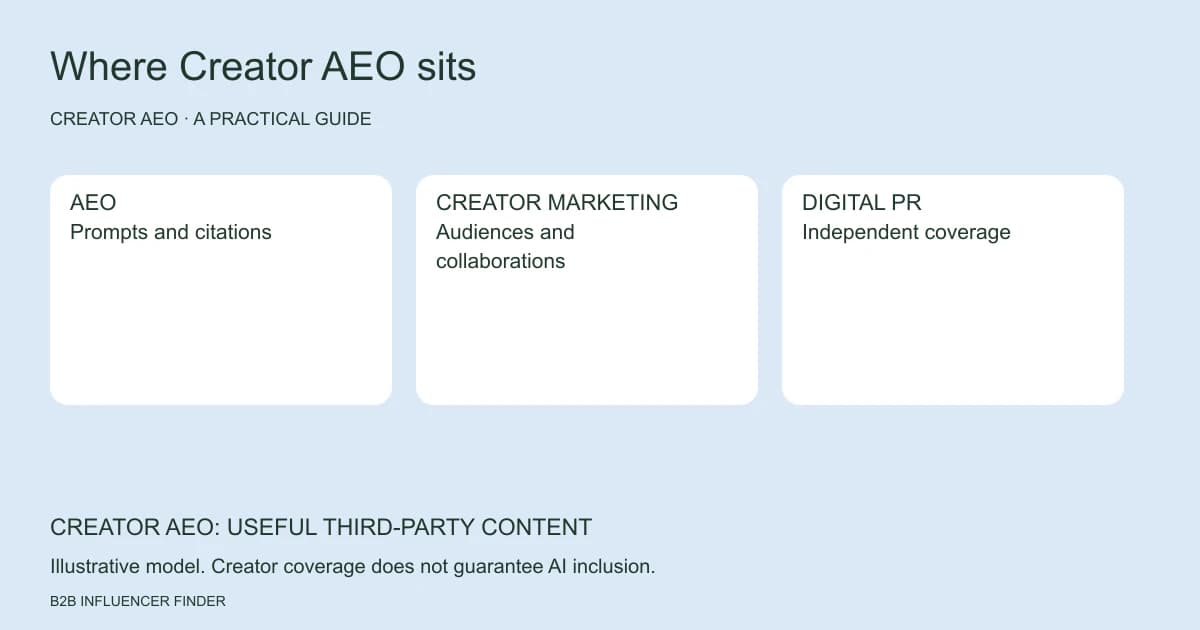
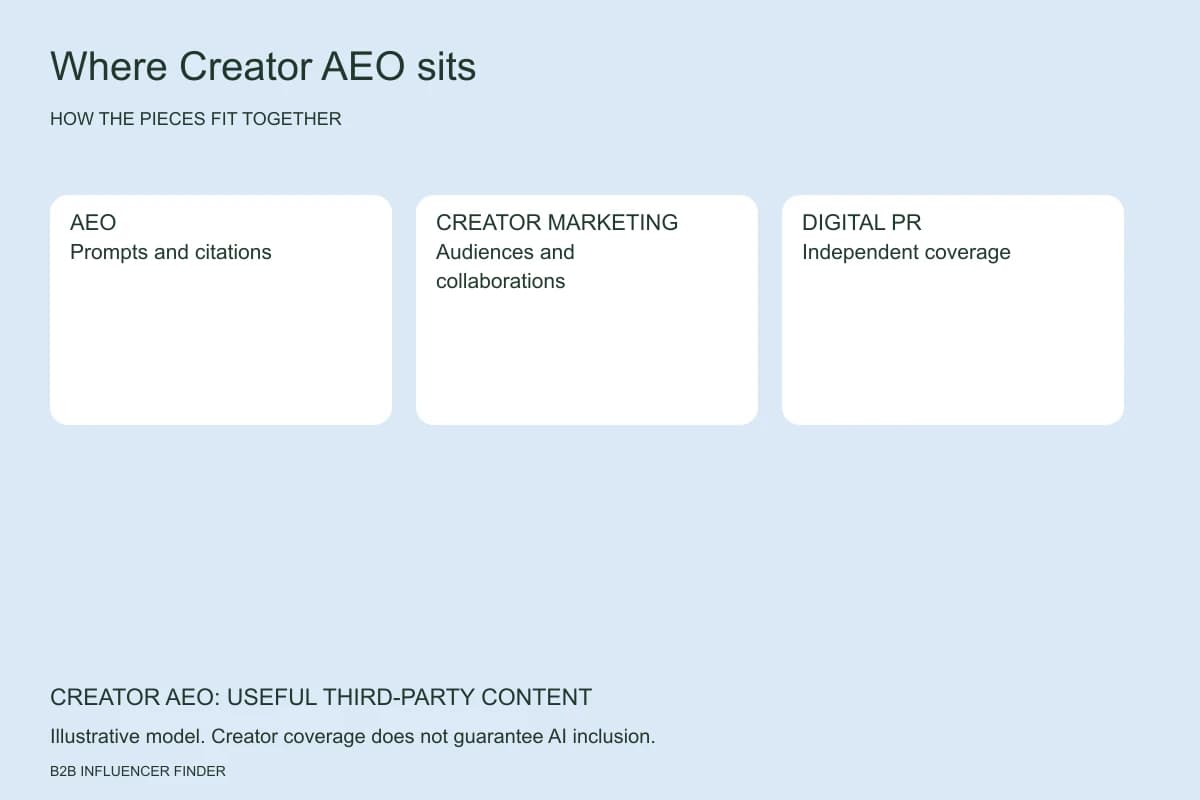
Creator AEO sits between three existing disciplines
The easiest way to understand Creator AEO is to see it as an overlap.
AEO focuses on how brands and information appear in AI-generated answers. Creator marketing focuses on working with people who have an audience, expertise or influence in a particular community. Digital PR focuses on earning independent coverage and authority outside your own domain.
Creator AEO borrows from all three. You identify the questions and topics where you want your brand to be understood, find credible creators already talking about those subjects, and give them something genuinely useful to work with.
The result might be a YouTube analysis, a newsletter article, a LinkedIn post, a podcast discussion, an independent blog article or another piece of creator-led content. The important bit is not the format. It is that somebody other than the brand is adding useful context around the subject.
This is not just influencer marketing with a new acronym
Traditional influencer marketing often starts with audience: who has the followers we want to reach?Further reading: What Is Influencer AEO?
Creator AEO starts with context: what do we want to be understood for, what evidence do we have, and who already creates useful content about that subject?
Reach still matters. But a specialist with 12,000 relevant followers may be more interesting than a general business creator with 500,000 if the smaller creator is the person consistently explaining the exact problem your buyers are researching.
There is also a different time horizon. A normal sponsored post might be judged mainly on immediate impressions, clicks or leads. Creator AEO also cares about whether useful third-party content remains discoverable and continues contributing to the wider body of information about the brand.
Third-party evidence is the central idea
Your website is first-party evidence. You control it. You decide how you describe the product, which benefits to highlight and which customer stories to publish.
Creator content can become third-party evidence. So can independent reviews, customer discussions, trade publications, podcasts, community threads and comparison articles.
Semrush's research on AI visibility increasingly treats this external evidence layer as important because AI systems can cite or rely on sources outside a company's own domain. Its 2026 analysis of third-party citations explicitly distinguishes first-party citations from external sources such as review pages, news articles and forums.
Ahrefs likewise advises brands to look at the sources shaping AI answers rather than treating AI visibility as an on-site content problem only.Sources: Ahrefs - AI Visibility Data Paralysis: How to Get Unstuck · Ahrefs - Complete AI Visibility Guide
I think this is the useful mental model for Creator AEO: you are not trying to manipulate an LLM. You are trying to make the internet's evidence about your company richer, more specific and more independent.
What does a Creator AEO campaign actually look like?
Start with the prompts and topics that matter to the business, not with a giant influencer database.
Imagine you sell referral software for banks. You might care about questions around bank referral programs, fintech customer acquisition, member-get-member campaigns and financial-services referral software.
Next, look at the useful things your company already knows. Maybe you have a case study showing thousands of monthly referrals from a bank. Maybe you have benchmark data. Maybe your team has learned something surprising about fraud, incentives or referral conversion rates.
Then find creators whose existing work overlaps with those subjects. A fintech newsletter writer who regularly covers customer acquisition is a logical match for the bank case study. A generic productivity influencer probably isn't, even if the audience is ten times larger.
The collaboration should come from that overlap. The creator might analyse the case study, interview the customer, challenge the findings, compare approaches or use the data inside a broader piece of content. They should keep their own perspective. If the brand dictates every sentence, you have created an advert, not independent evidence.
Where B2B Influencer Finder fits
This matching problem is why we built B2B Influencer Finder.Further reading: B2B Influencer Finder
Most creator discovery tools begin with the creator. Search an industry, filter follower counts, build a list, then figure out what to pitch them.
We wanted to reverse that. B2B Influencer Finder first looks at the useful content and expertise a brand already has, then searches LinkedIn, YouTube, newsletters, podcasts, blogs and X for creators whose existing work overlaps with it.
So the output is not just 'here are 50 fintech influencers'. It is closer to 'this creator regularly covers fintech acquisition, this case study is relevant to what they already talk about, and here is a sensible collaboration angle.'
That is a much better starting point for Creator AEO because relevance exists before the outreach begins.
Which creators are useful for Creator AEO?
There is no magic follower threshold.
For B2B, subject expertise and audience relevance can matter far more than celebrity-scale reach. Look for people who repeatedly publish around the category, have a real point of view, produce content that remains accessible, and have an audience that overlaps with the people you care about.
Different creators can play different roles. A YouTuber may produce a deep comparison that stays discoverable for years. A newsletter writer can put your research in front of a concentrated professional audience. A LinkedIn specialist can create discussion among practitioners. A podcast host can produce a long-form conversation with unusually rich context.
Don't assume all of those formats are equally accessible to every AI system. Indexing, retrieval and citation behaviour varies by platform and changes over time. Choose the creator because the content is valuable to humans first.
Does Creator AEO actually work?
There is enough evidence to take the idea seriously. There is not enough evidence to treat it like a guaranteed ranking formula.
Third-party sources clearly matter in AI-generated discovery. Semrush's 2026 index says customer reviews, community discussions, independent publishers, retailers and industry sources play a critical role in shaping brand narratives. Ahrefs also reports that most of its own AI brand mentions come from third-party websites rather than ahrefs.com.
Creator-specific AEO is now becoming an explicit marketing category too. Later has launched a Creator AEO offering and published a strategy built around aligning creator activity with AI-search prompts. Influencer and Profound announced a Creator-First AEO partnership in August 2026.Sources: Later - Creator AEO
Those developments show that marketers are experimenting seriously with the model. They do not prove causation. If AI visibility rises after a creator campaign, other things may have changed at the same time: search rankings, press coverage, product awareness, reviews, new content or model behaviour itself.
The sensible approach is to measure before and after, watch patterns across many prompts, and be careful about claiming why something moved.Further reading: What Is AI Share of Voice and How Do You Improve It?
How should you measure Creator AEO?
Do not measure it with one screenshot from ChatGPT.
Start with a stable group of prompts related to your category and buying journey. Track whether your brand is mentioned, cited or recommended, which competitors appear, how the brand is described and which sources are being used.
Then track the creator side too: collaborations published, creator reach, engagement, referral traffic, branded search, earned mentions, content longevity and any pipeline you can reasonably connect to the work.
AI answers are probabilistic, so repeated measurement matters. Semrush now explicitly recommends looking for patterns across large numbers of responses rather than drawing conclusions from one-off answers.
Creator AEO should add another layer to creator measurement, not erase the commercial metrics creator marketers already care about.
What Creator AEO is not
It is not paying 100 people to paste the same sentence about your company onto the internet.
It is not a loophole for manufacturing fake independent reviews. Paid collaborations should be disclosed where required, and creators should retain an authentic point of view.
It is not a replacement for having a good website, useful product documentation, customer proof, technical SEO or traditional PR.
And it is definitely not a promise that a creator mention today becomes a ChatGPT citation tomorrow.
The strongest version of Creator AEO is much less exciting than that promise, but much more defensible: create information worth discussing, help the right independent people discover it, and make your brand part of the real conversations that define your category.
The opportunity for B2B brands is bigger than follower counts
B2B companies often have useful information sitting quietly on their own websites: customer stories, benchmark data, product expertise, industry research, implementation lessons and strong opinions from people who know the market.
At the same time, thousands of specialist creators need useful things to talk about.
Creator AEO connects those two sides. Not because creators have a secret switch into ChatGPT, but because credible people creating useful third-party content can expand the evidence, language and context surrounding a brand online.
That is the part i think will matter. In AI search, what you say about yourself is only one piece of the story. What other credible people say about you is becoming harder to ignore.
Sources
Semrush - 2026 AI Visibility Index: 126 Million AI Search PromptsSources: Semrush - 2026 AI Visibility Index: 126 Million AI Search Prompts
Ahrefs - AI Overviews Currently Appear for 83% of Branded SearchesSources: Ahrefs - AI Overviews Currently Appear for 83% of Branded Searches
Semrush - Why AI Is Citing Third-Party Sources Instead of Your SiteSources: Semrush - Why AI Is Citing Third-Party Sources Instead of Your Site
Ahrefs - AI Visibility Data Paralysis: How to Get UnstuckSources: Ahrefs - AI Visibility Data Paralysis: How to Get Unstuck
Ahrefs - Complete AI Visibility GuideSources: Ahrefs - Complete AI Visibility Guide
Semrush - How to Find AI Visibility GapsSources: Semrush - How to Find AI Visibility Gaps
Later - Creator AEOSources: Later - Creator AEO
Influencer Marketing Hub - Influencer and Profound Bring Creator Campaigns Into AI Search VisibilitySources: Influencer Marketing Hub - Influencer and Profound Bring Creator Campaigns Into AI Search Visibility