Creator marketing can affect AI search visibility by creating more credible third-party content about your brand in places that AI systems may discover, retrieve or cite.Further reading: What Is Creator AEO? · Does Getting Mentioned on Other Websites Help With AI Visibility?
That does not mean hiring five creators will move you five positions in ChatGPT. AI answers do not work like a traditional ranking table, and there is no public formula connecting creator mentions to a guaranteed recommendation.
The more useful way to think about it is evidence. Your own website tells the web what you say about yourself. Creator content can add independent explanations, comparisons, opinions, demonstrations and references around the same topics.
Current research gives us good reasons to take that seriously, especially on platforms such as YouTube and LinkedIn. It still does not prove a simple cause-and-effect relationship.
AI search is already looking beyond your website
When somebody asks an AI system for a recommendation, comparison or explanation, the answer may draw on information from many different sources.
OpenAI says ChatGPT search can search the web and cite relevant sources. It also says any public website can potentially appear in ChatGPT search if it is accessible to OAI-SearchBot, although placement is not guaranteed.Sources: OpenAI - Overview of OpenAI Crawlers
Google's AI search experiences similarly synthesize information from the web. In practice, that means the information environment around your company matters, not only the pages you control.
This is the basic reason creator marketing becomes interesting for AI visibility. A creator gives your brand another independent place to exist in context.
The strongest evidence right now is correlation, not causation
One of the more useful studies comes from Ahrefs, which analysed 75,000 brands across ChatGPT, Google AI Mode and AI Overviews.Sources: Ahrefs - Top Brand Visibility Factors in ChatGPT, AI Mode, and AI Overviews · Ahrefs - Do AI Assistants Link When Mentioning Brands?
YouTube mentions showed the strongest correlation with AI visibility among the factors Ahrefs tested. In that study, a YouTube mention meant the brand appeared in a video title, transcript or description. Branded web mentions also correlated strongly with AI visibility.
That is notable because YouTube is full of creator-led content: reviews, tutorials, interviews, comparisons and expert commentary.
But this needs a big warning label. Correlation does not tell us that the YouTube mention caused the AI visibility. Well-known brands may simply earn more YouTube coverage and more AI visibility because they are already prominent. The study is a signal, not a ranking recipe.
Third-party sources are becoming part of the branded search result
The shift is visible even when people search directly for a brand.
Ahrefs reported in October 2026 that AI Overviews appeared for 83% of the branded queries in its study. Wikipedia, YouTube and LinkedIn were the most common external citations in those branded AI Overviews.Sources: Ahrefs - AI Overviews Currently Appear for 83% of Branded Searches
Think about what that changes. A buyer can search your company name and immediately see an AI-generated explanation influenced by sources you did not write.
Your website still matters. But the version of your brand a buyer encounters can increasingly include what independent platforms and people say about you too.
Creator marketing adds context, not just mentions
A raw brand mention is not the most interesting outcome.
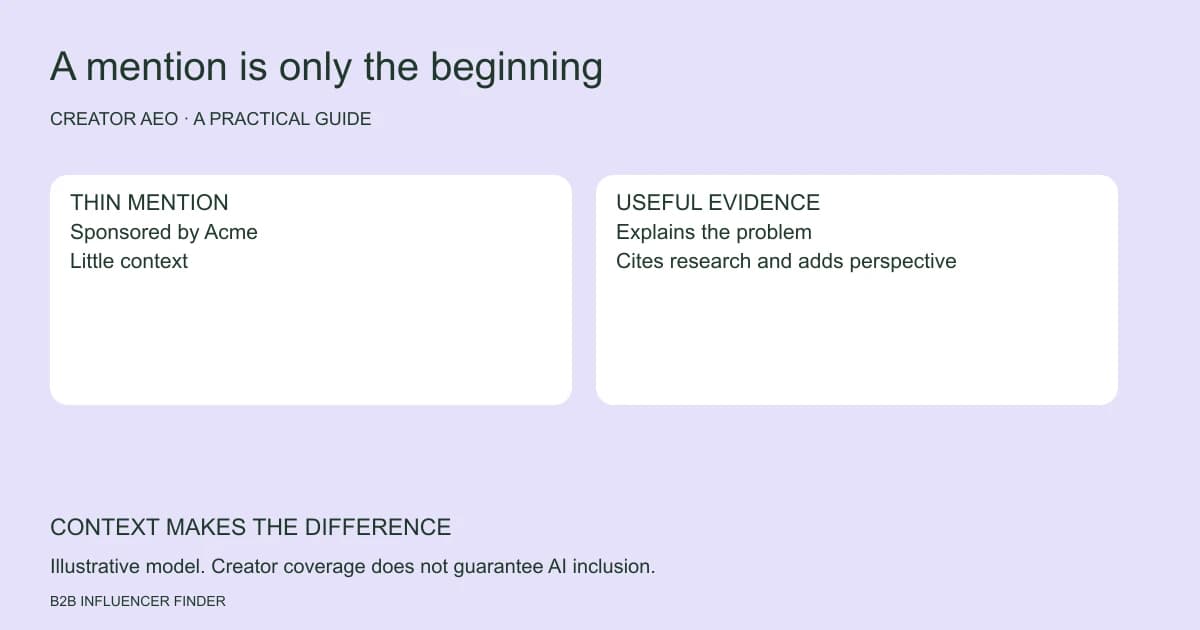
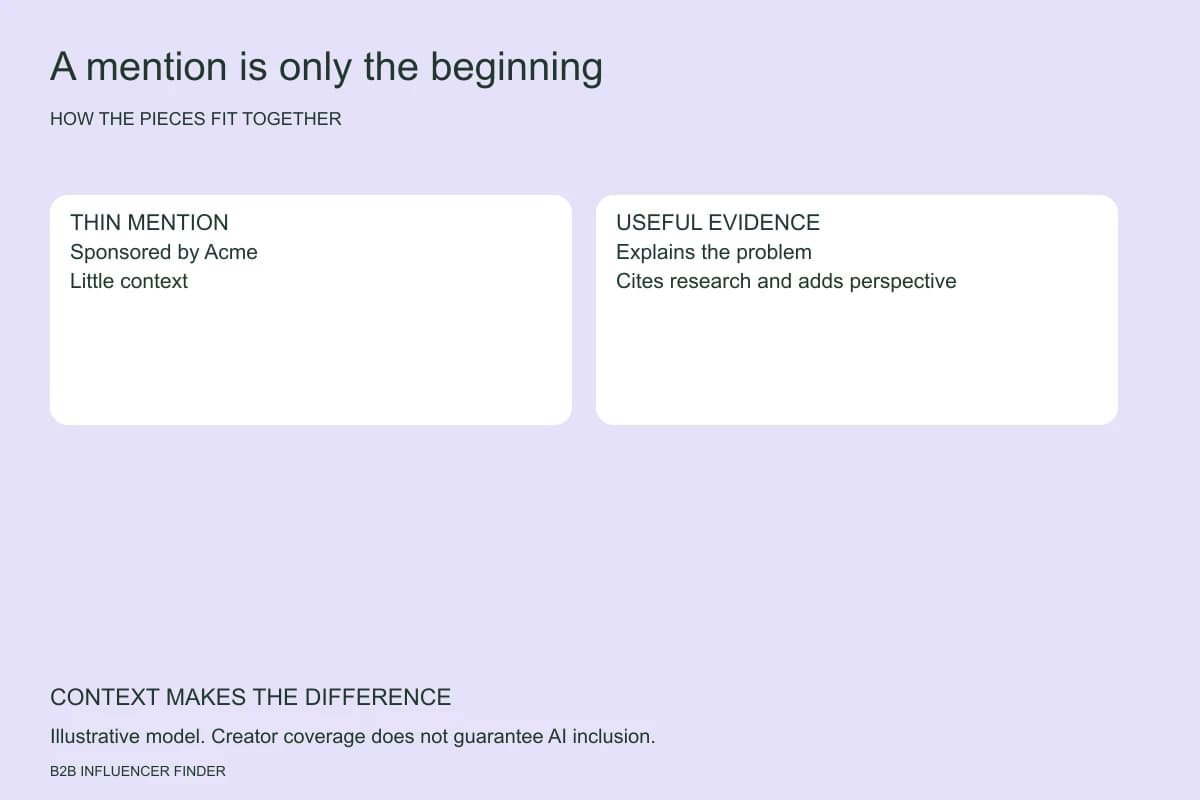
Imagine a creator writes, 'Acme sponsored this newsletter.' Your name exists on another page, but there is almost no useful context around what Acme does.
Now imagine a respected revenue operations creator publishes an article comparing referral-led acquisition with affiliate marketing and uses your customer data to explain when each approach works. Your brand appears next to a specific problem, category and point of view.
That second piece creates richer evidence. It gives humans and machines more information about what your company is associated with, who it is relevant to and why it might belong in a particular conversation.
For Creator AEO, context is the part i care about most.
AI visibility is topic-level, so creator relevance matters
Semrush's 2026 study of 50,000 brands makes another useful point: AI visibility changes across related prompts inside the same topic.Sources: Semrush - AI visibility is a topic-level game
A company might appear when somebody asks for 'best referral software for SaaS' and disappear when the prompt changes to 'tools for customer referral programs'. Winning one answer is not the same as being consistently associated with the category.
That makes random influencer coverage less compelling. If you want stronger visibility around a topic, the creators you work with should actually publish around that topic.
A B2B creator with 12,000 highly relevant followers can therefore be more interesting than a broad business personality with 500,000 followers. The smaller creator may produce far stronger contextual evidence around the exact subject you want to own.
YouTube deserves special attention
If i were testing creator marketing specifically for AI visibility, YouTube would be high on my list.
It is not because Google owns YouTube and therefore every YouTube mention gets a secret boost. We do not have evidence for that claim.
It is because YouTube content is searchable, transcripts contain substantial text, videos often answer specific questions, and the platform repeatedly appears in AI citation research. Ahrefs found YouTube mentions strongly correlated with AI visibility, and its October 2026 branded-search study found YouTube among the most common external citations in AI Overviews.
A detailed video where a credible specialist discusses your category can create much more information than a one-line social mention. That makes it useful even before we talk about AI.
LinkedIn can matter too, but do not oversimplify it
LinkedIn is especially relevant for B2B because so much specialist knowledge is published there by practitioners rather than media companies.
Ahrefs found LinkedIn among the most common external citations in branded AI Overviews in its October 2026 study. That is evidence that LinkedIn content can surface in at least some AI-generated search experiences.
What we should not do is turn that into 'post on LinkedIn and ChatGPT will learn your brand'. Different AI systems have different retrieval methods, access patterns and source preferences. Individual posts can also be ephemeral or poorly indexed.
Use LinkedIn because the right buyers and experts are there. Treat potential AI visibility as an additional reason for creating strong, public, useful content rather than the only reason.
Mentions and citations are different outcomes
This distinction trips marketers up constantly.
An AI answer can mention your company without linking to you. It can also cite a third-party page that discusses your company without naming your brand in the final answer.
Ahrefs tracked more than 31,000 mentions of its own brand across six AI platforms and found the percentage of mentions that included a link varied substantially by platform. For Google AI Overviews, only 10.7% of Ahrefs brand mentions in that analysis included a link to Ahrefs.Further reading: What Is AI Share of Voice and How Do You Improve It?
So creator marketing should not be judged only by whether an AI answer links to your domain. A creator article, video or newsletter can contribute to the broader evidence around the brand even when the eventual AI output behaves differently.
The creator needs something worth talking about
This is the bit brands often skip.
You cannot build a strong creator strategy by finding 100 people and asking all of them to 'talk about our product'. That usually produces either silence or advertising.
Start with what your company knows that is genuinely useful to the creator's audience. Customer results. Original research. Benchmark data. An unusual case study. A strong opinion. Product access. An expert who can explain something difficult.
Then match that asset to a creator who already talks about the subject.
That is also the logic behind B2B Influencer Finder. We analyse a brand's useful content and expertise, find relevant creators across channels such as LinkedIn, YouTube, newsletters, podcasts, blogs and X, and match the creator to a specific collaboration angle. The match matters more than simply producing a large list of names.Further reading: B2B Influencer Finder
What creator content is most useful for AI visibility?
There is no universal format, but i would prioritize content that has three qualities: it is public, it contains real information, and it is closely connected to the topic you want the brand associated with.
That could be a YouTube analysis, a specialist newsletter, an industry article, a podcast page or transcript, a detailed LinkedIn article, a case-study breakdown or an expert interview.
The creator should add something of their own. Their experience, analysis, criticism or explanation is what makes the content genuinely third party.
Ten near-identical sponsored posts repeating your landing-page copy may create more mentions. They do not necessarily create better evidence.
How i would run a creator campaign for AI visibility
First, choose a topic rather than a vanity keyword. Define the cluster of questions buyers ask around that topic and record which brands currently appear.
Second, identify the evidence you already have. Find the research, case studies, customer outcomes, data and expertise that could give an independent creator a reason to cover the subject.
Third, find creators based on subject fit. Look at what they have actually published, not only the category written in their bio.
Fourth, develop a collaboration angle that makes sense for that creator's existing format. Do not force everybody into the same brief.
Fifth, publish and measure. Track the creator outcomes normally, but also track the same AI prompt set over time. Look at brand mentions, recommendations, citations, share of voice and the sources being used.
Do not expect one article to change everything next Tuesday. You are building a body of external evidence, not flipping a ranking switch.
What should you measure?
I would separate the dashboard into creator performance and AI visibility.
For creator performance: collaborations published, relevant audience reached, engagement, referral traffic, branded search, leads where attribution is possible, and the longevity of the content.
For AI visibility: mentions across a stable prompt portfolio, citations, recommendation frequency, share of voice against competitors, topic associations and which third-party sources keep appearing.
Then add a third layer: evidence created. How many useful independent pieces now exist around the topics that matter to your company? Where are they published? Are they still live? Do they contain the context you actually wanted associated with the brand?
That evidence inventory may end up being one of the most useful assets from the campaign, even before you can prove any movement in an AI metric.
So, does creator marketing improve AI visibility?
It can plausibly contribute to it, and the current data makes creator content difficult to ignore.
We have evidence that YouTube and web mentions correlate with brand visibility across AI surfaces. We have evidence that external sources such as YouTube and LinkedIn are being cited in AI-generated branded search results. We know ChatGPT search can retrieve and cite public web sources.
What we do not have is a guaranteed formula connecting a creator campaign to a specific increase in ChatGPT recommendations.
That is why i would not run creator marketing as an AI hack. I would run it because credible third-party people can explain your brand to the market in ways your own website cannot. Then i would deliberately make those collaborations relevant to the topics where i want the company to be understood.
If that also gives AI systems a richer, more consistent set of independent evidence to work with, that is exactly the kind of overlap Creator AEO is trying to create.
Sources
OpenAI Help Center - Searching the web with ChatGPTSources: OpenAI Help Center - Searching the web with ChatGPT
OpenAI - Overview of OpenAI CrawlersSources: OpenAI - Overview of OpenAI Crawlers
Ahrefs - Top Brand Visibility Factors in ChatGPT, AI Mode, and AI OverviewsSources: Ahrefs - Top Brand Visibility Factors in ChatGPT, AI Mode, and AI Overviews
Ahrefs - AI Overviews Currently Appear for 83% of Branded SearchesSources: Ahrefs - AI Overviews Currently Appear for 83% of Branded Searches
Ahrefs - Do AI Assistants Link When Mentioning Brands?Sources: Ahrefs - Do AI Assistants Link When Mentioning Brands?
Semrush - AI visibility is a topic-level gameSources: Semrush - AI visibility is a topic-level game