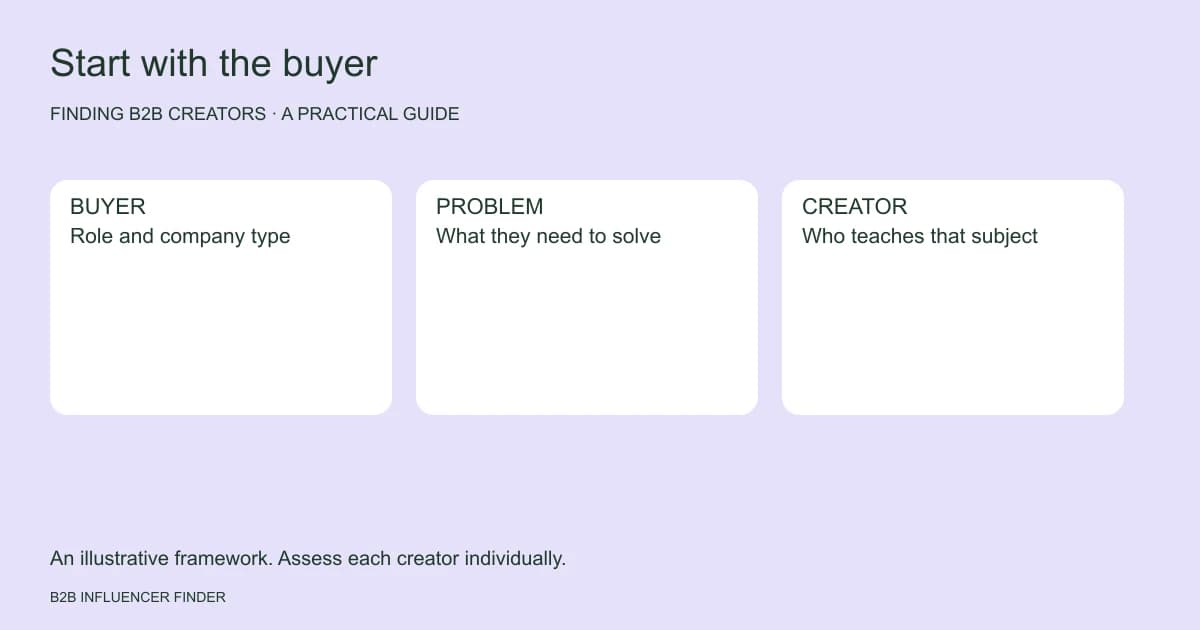
Start with your target customer, not with a list of influencers.
Write down the exact people you want to reach, the problems they care about and the places they go to learn. Then find the creators who repeatedly show up in those conversations.
That sounds obvious, but it changes the search completely. Instead of asking, “Who are the biggest creators in fintech?” you ask, “Who do heads of growth at European fintech companies read, watch and listen to when they are thinking about customer acquisition?”
The second question gives you a much smaller list. It is also a much better one.
Niche does not just mean a small audience
A niche creator is not simply a creator with fewer followers.
The useful definition is someone whose content, expertise and audience are concentrated around a specific subject, role, industry or problem.
A creator can have 80,000 followers and still be niche if most of their work is about one professional subject. Another person can have 8,000 followers and be too broad for your campaign.
What you are looking for is concentration. Does this person repeatedly talk about something your buyers care about, and are the right people paying attention?
Start by defining the buyer properly
“B2B marketers” is not a target audience. Neither is “SaaS companies.”
Get more specific. A useful audience definition might be: demand generation leaders at B2B SaaS companies with 50 to 500 employees in the US and UK. Or customer growth teams at European fintechs. Or security leaders evaluating AI governance tools inside large enterprises.
You do not need perfect firmographic data on every creator follower. You do need enough specificity to recognize a good audience when you see one.
I would write down four things before searching:
- Role: who inside the company cares about the problem?
- Company: what kind of business do they work for?
- Problem: what are they actively trying to solve?
- Context: which industries, geographies or technologies make the problem specific?
This becomes your creator search brief.
Search for the problem, not the creator category
The easiest way to miss good niche creators is to search only for phrases like “B2B influencer” or “fintech creator.”
Many of the most credible people will never call themselves influencers.
They call themselves consultants, operators, analysts, founders, researchers, practitioners, newsletter writers, podcast hosts or just people doing the job.
Search the questions and subjects your buyer follows instead. If your customer is a RevOps leader, search pipeline forecasting, CRM hygiene, attribution, territory planning and sales capacity. If your buyer works in banking growth, search customer acquisition, referrals, loyalty, deposits, onboarding and retention.
The people who keep appearing around those specific problems are usually more interesting than the people who rank for the broad label.
Look across formats, not just social networks
A niche audience can gather around a person in several places.
- LinkedIn: practitioners, consultants, founders and subject-matter experts publishing posts, articles and newsletters.
- YouTube: specialist educators and reviewers answering detailed buyer questions.
- Newsletters and Substack: writers with concentrated professional readerships.
- Podcasts: hosts and recurring guests who own a narrow conversation over time.
- Blogs and trade publications: authors whose names repeatedly appear on useful industry content.
- Communities and events: speakers, moderators and active contributors who may have influence without a huge public following.
Our guide to finding B2B influencers in your industry covers the broader multi-platform discovery process. Here the goal is narrower: prove that a creator is connected to your actual customer, not simply your industry.Further reading: How Do I Find B2B Influencers in My Industry?
Use your buyers as a discovery engine
If you already have customers, prospects or a sales team, you have a shortcut.
Ask which newsletters they read. Which LinkedIn people they follow. Which YouTube channels they trust. Which podcasts they send to colleagues. Which experts they quote internally.
You can also look at the public behavior around people in your market. Who comments intelligently on posts from your customers? Who gets invited onto the same podcasts? Who appears at the events your buyers attend? Who is repeatedly cited by practitioners in the category?
This is not statistically perfect audience research. It is a way to generate better hypotheses than starting with follower count.
Then verify audience fit manually
This is the part people skip.
A creator can look perfect by topic and still reach the wrong crowd. A cybersecurity creator might mostly reach junior engineers when you need CISOs. A marketing creator might reach freelancers when you sell enterprise software.
Open the recent content and inspect who is engaging. Look at job titles, companies and the substance of the comments. Check guests, collaborators and brands they mention. Read the newsletter positioning. Scan the YouTube comments. Look at the creator’s own description of who the content is for.
You are not trying to prove that 63.4% of their audience matches your ICP. Usually you cannot. You are looking for multiple signals pointing in the same direction.
Relevance is a real selection criterion in B2B
This is not just a preference for smaller creators.
LinkedIn and Ipsos research from 2025 found that B2B marketers selected authenticity and credibility most often when choosing creators at 58%, followed by industry relevance at 49%. Brand alignment and subject-matter expertise were each selected by 47%, while audience engagement was selected by 45%.Sources: LinkedIn + Ipsos, 2025 B2B Marketing Benchmark: Trust Is the New KPI
That is a useful order of operations. The creator needs to make sense in the market before reach becomes interesting.
LinkedIn’s 2026 research makes the same broader point: B2B creator marketing is built around expertise, audience relevance and credibility, not simply entertainment or views.Sources: LinkedIn, How B2B Creator Marketing Builds Buyer Trust on LinkedIn
Do not confuse audience size with audience access
Follower count is easy to measure, which is why it gets too much attention.Further reading: How Many Followers Should a B2B Influencer Have?
But a creator with 12,000 followers who reaches 500 people you would genuinely like in your pipeline can be more valuable than someone with 150,000 followers whose audience is mostly outside your market.
Sprout Social’s 2026 research also found that follower count is becoming a weaker proxy for attention. In its consumer research, only 17% said they check a creator’s follower count before deciding to engage, while subject matter and content quality mattered more. That is not B2B campaign-performance proof, but it reinforces the practical point: size alone tells you very little about fit.Sources: Sprout Social, 2026 Influencer Marketing Report
For B2B, i would rather know who the audience is than how large it is.
Follow the network around a good creator
Once you find one genuinely relevant creator, stop searching from zero.
Look at their guests, collaborators, comments, citations and recommendations. Search who they follow or interact with around the subject. Look at the people appearing on the same podcasts and events.
Professional niches form networks. The strongest creator discovery often happens by moving sideways through that network.
One credible RevOps creator can lead you to ten more. A specialist fintech newsletter can reveal analysts, founders, podcast hosts and practitioners you would never find in a generic influencer database.
Look for repeated topic ownership
Do not shortlist someone because they posted about your subject once.
Review enough recent work to understand what they are known for. A good niche creator usually has recurring themes. Their audience has learned what kind of expertise to expect from them.
That repeated context matters because a collaboration should feel normal in their body of work. If your brand appears in a creator’s content about a subject they have discussed for years, the association makes sense. If they suddenly publish a random sponsored post about something unrelated, it feels like an ad.
For Creator AEO, that contextual fit is also the useful part. The objective is not merely to get your brand name onto another URL. It is to create accurate third-party evidence around the topic you want your company associated with.
Give the creator something relevant to work with
Finding the right audience is only half of the match.
Now ask whether your company has anything useful for this creator.
Original data, a case study, customer results, an expert interview, a product they can genuinely test, a benchmark, a useful contrarian view or a pattern from your market can all create a reason to collaborate.
This is why B2B Influencer Finder starts with the brand’s content and expertise as well as the creator. The product looks for overlap between what your company actually knows and what a creator already talks about.
A good match is not “this person reaches CMOs.” It is “this person writes about B2B attribution for CMOs, and we have original data about how attribution changes when referral traffic is involved.”Further reading: How Do You Reach Out to B2B Influencers for a Collaboration?
Now there is an audience fit and a content fit.
Use a five-part niche creator scorecard
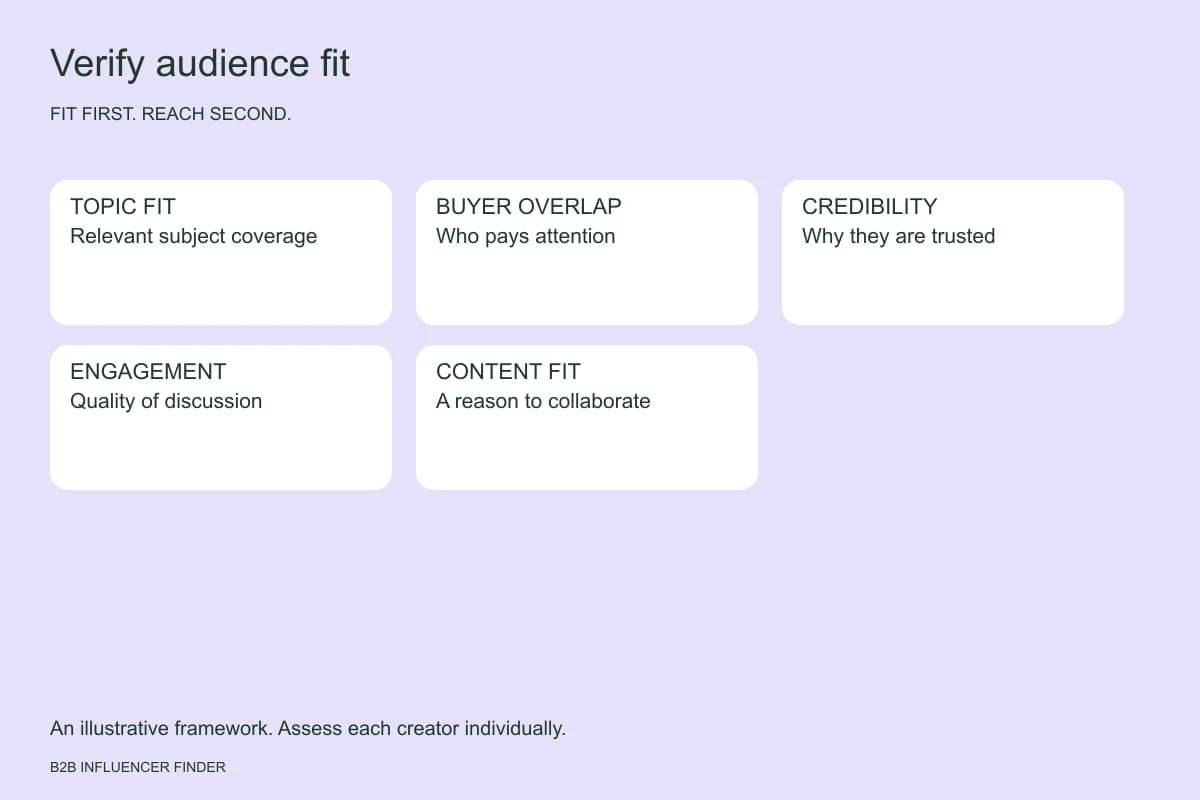
When you have a longlist, score each creator from 1 to 5 on these five things:Further reading: What Makes a Good B2B Influencer for Your Brand?
- Topic fit: how consistently do they cover the exact subject?
- Buyer overlap: how much evidence is there that the right roles and companies pay attention?
- Credibility: do they demonstrate genuine experience, expertise or trusted curation?
- Engagement quality: are relevant professionals having useful conversations around the content?
- Content fit: can your evidence naturally contribute to something they already create?
Then record platform, audience size, geography, activity level and likely cost as practical fields.
The scoring is not science. Its job is to stop follower count from quietly becoming the decision.
What audience evidence should you trust?
Treat audience evidence in layers.
First-party creator analytics are strongest when you can get them. A creator may be able to share platform demographics, newsletter subscriber information or media-kit data. Ask for it when the campaign spend justifies it.
Before that, use observable signals: who comments, who shares, who appears in the creator’s community, which companies sponsor them, what questions the audience asks and how the creator describes their readership.
Third-party influencer tools can add estimates, but estimates are not ground truth. Use them as another signal, not as a reason to ignore what the content and community are telling you.
A narrow creator can be useful even without huge reach
This is especially true when the buying market itself is small.
If there are only a few thousand people globally who influence purchases in your category, reaching a meaningful fraction of them through one trusted specialist can be valuable.
LinkedIn’s 2026 Global B2B Marketing Outlook found that 56% of B2B buyers who use creators rely on creator input during the final stage of the buying process to confirm recommendations. That does not mean any niche creator will move a deal. It does show why credibility inside a professional community can matter well beyond top-of-funnel impressions.Sources: LinkedIn, How LinkedIn is helping B2B marketers reach audiences at scale with creators and video
Do not build one giant creator list
Build lists around buyer problems.
You might have one group of creators around customer acquisition, another around retention, another around AI governance, another around finance operations. The same company can legitimately need several creator niches because different products, use cases and buying roles live in different conversations.
This also makes outreach better. You can match each creator to a specific asset or insight instead of sending everyone the same campaign brief.
What not to do
- Do not search only for people who call themselves influencers. Many of the best B2B creators are practitioners and experts.
- Do not use follower count as proof of buyer fit.
- Do not assume someone reaches your ICP because they work in the same broad industry.
- Do not trust a single audience-estimation tool as ground truth.
- Do not shortlist creators without reading their actual recent content.
- Do not force the same collaboration angle onto every creator.
- Do not treat a brand mention as useful third-party evidence if the surrounding context is vague or unrelated.
Once you have qualified your shortlist, turn those individual matches into a repeatable program. Our guide to building a B2B creator program covers buyer-journey roles, pilot partnerships, briefs and a practical 90-day rollout.Further reading: How to Build a Winning B2B Creator Program
The short version
To find niche creators who reach your target customers, define the buyer first, search the problems they care about, identify the people who repeatedly own those conversations, and then verify who is actually paying attention.
After that, look for a content match between the creator and something your company genuinely knows.
The best creator is not necessarily the biggest person in your industry.
It is the person whose expertise, audience and content create the shortest distance between your brand and the exact buyers you want to influence.
Sources
LinkedIn + Ipsos, 2025 B2B Marketing Benchmark: Trust Is the New KPISources: LinkedIn + Ipsos, 2025 B2B Marketing Benchmark: Trust Is the New KPI
LinkedIn, How B2B Creator Marketing Builds Buyer Trust on LinkedInSources: LinkedIn, How B2B Creator Marketing Builds Buyer Trust on LinkedIn
LinkedIn, How LinkedIn is helping B2B marketers reach audiences at scale with creators and videoSources: LinkedIn, How LinkedIn is helping B2B marketers reach audiences at scale with creators and video
Sprout Social, 2026 Influencer Marketing ReportSources: Sprout Social, 2026 Influencer Marketing Report