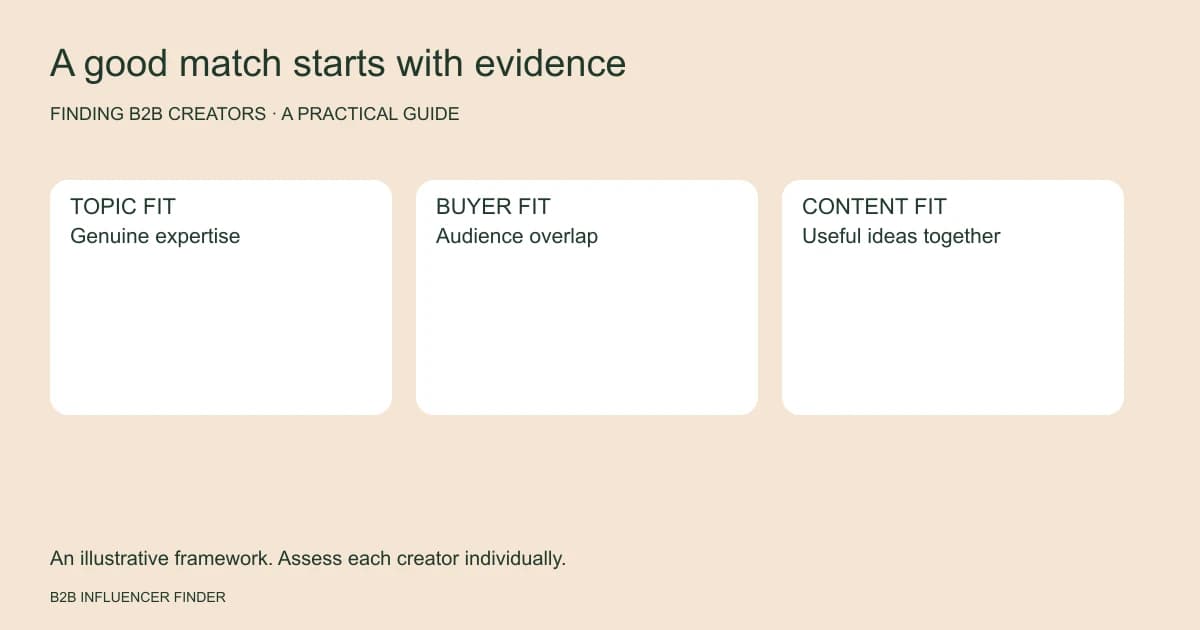
A good B2B influencer is not simply someone with a large professional audience. They are someone who is credible on the subject you care about, reaches people who matter to your business, publishes useful content consistently and has a believable reason to talk about your brand.
That sounds obvious. But creator shortlists still get built backwards all the time. Someone finds a person with 80,000 LinkedIn followers, sees a job title that looks roughly relevant and puts them on the list.
For B2B, i would start with fit and use reach later.
1. They have genuine topic fit
The first question is whether the creator actually talks about the problem, category or industry you want to be associated with.
Do not judge this from the bio alone. Read or watch their recent work. A creator might call themselves a fintech expert but spend most of their time discussing fundraising. That is a very different fit from someone who repeatedly covers customer acquisition, banking growth or loyalty if those are the subjects your company needs.
Look for repeated expertise. One relevant post is not a pattern.
2. Their audience overlaps with your buyers
Topic fit and audience fit are related, but they are not the same thing.Further reading: How Do I Find Niche Creators Who Reach My Target Customers?
A creator can publish about the right subject while attracting the wrong audience. A marketing creator might discuss enterprise software, for example, but their followers could mostly be other creators and freelancers rather than enterprise marketing leaders.
Perfect audience demographic data is rarely available. You can still look for signals. Read the comments. Look at the roles and companies of people who engage where that information is public. Check who appears on their podcast, who sponsors their newsletter, who they interview, which events they speak at and what kinds of people seem to share their work.
You are looking for evidence of buyer overlap, not mathematical certainty.
3. They are credible in the niche
Credibility matters more in B2B because the creator is often discussing expensive, technical or career-relevant decisions.
LinkedIn and Ipsos asked B2B marketing leaders what they consider when selecting creators in 2025. Authenticity and credibility was the most selected criterion at 58%. Industry relevance followed at 49%, while brand alignment and subject-matter expertise were each selected by 47%.Sources: LinkedIn + Ipsos, 2025 B2B Marketing Benchmark: Trust Is the New KPI
That is a useful order of operations. Before asking how many people a creator can reach, ask why those people would listen to them.
Credibility can come from operating experience, specialist knowledge, research, a respected newsletter, an analyst role, a strong practitioner community or years of consistently useful work. It does not require a celebrity profile.
4. Their content is actually good
A creator can be relevant and credible but still be a poor content partner.
Look at whether their work teaches something. Do they explain ideas clearly? Do they use evidence? Do they have a point of view? Can they make a technical subject understandable without flattening it into generic advice?
This matters because B2B buyers consume thought leadership as part of how they evaluate companies and ideas. In the 2025 Edelman-LinkedIn research, 64% of target decision-makers and 63% of hidden decision-makers said they spend more than an hour a week consuming thought leadership. More than half in each group said they use it as part of vendor evaluation.Sources: Edelman + LinkedIn, 2025 B2B Thought Leadership Impact Report
The creator is not just a distribution channel. The quality of what they make is part of the value.
5. They have a point of view, not just a posting habit
Posting every day does not automatically make someone influential.
The strongest B2B creators usually have some kind of recognizable perspective. They know what they believe about their field. They can challenge a common assumption, explain why something works, or connect ideas in a way their audience finds useful.
The 2025 Edelman-LinkedIn thought leadership research found that hidden buyers value ideas that inform or challenge their perspectives. That is a better model for B2B influence than simply producing a high volume of feed content.Sources: Edelman + LinkedIn, 2025 B2B Thought Leadership Impact Report
6. They are active enough for the collaboration to make sense
A brilliant creator who has not published in nine months may still be respected, but they are a different partnership prospect from someone actively publishing every week.
Check recent activity on the channel you actually want to use. Do not assume a creator is active because their profile has a large historical following.
Activity also helps you understand their current interests. Their recent content tells you what they care about now, which makes it much easier to pitch something relevant.
7. Your brand has something useful to contribute to their work
This is the criterion most creator databases miss.
Finding a relevant creator is only half the job. You also need a reason for that person to care about your company.
Maybe you have original research they can interpret. A customer case study that adds evidence to a subject they already cover. Product data. Access to an expert. A useful benchmark. A strong opinion. A product they genuinely want to test.
The better the overlap between what they publish and what your company knows, the easier the collaboration becomes.
Instead of saying “Would you like to post about our software?”, you can say “You recently covered why fintech referral loops break at scale. We have data from 40 programs showing where the drop-off happens. Want to dig into it?”Further reading: How Do You Reach Out to B2B Influencers for a Collaboration?
That is a collaboration idea. The first version is an ad request.
8. Their style can accommodate your brand without sounding fake
Brand alignment does not mean the creator has to sound like your marketing team. In fact, they probably should not.
You want enough alignment that the partnership makes sense, but enough independence that the content still sounds like the creator. If every sentence has to pass through brand messaging until it reads like a press release, you lose much of the reason to work with a third party.
For paid collaborations, disclosure should be clear and the creator should still have room for a real perspective. Paying someone does not require pretending the relationship is organic.
9. Their audience size is appropriate for the job
Follower count matters. It just belongs much later in the evaluation.
A creator with 5,000 highly concentrated followers can be a better fit for a specialist B2B company than someone with 200,000 broad followers. A larger creator can be the better choice when the objective genuinely requires scale.
There is no universal minimum. Use audience size to answer a reach question, not a credibility question.
If you want the detailed version, see our guide to how many followers a B2B influencer should have.Further reading: How Many Followers Should a B2B Influencer Have?
10. They can create the right kind of evidence
Think beyond the initial impression or click.
A LinkedIn post can create a conversation. A YouTube video can keep being discovered through search. A newsletter article can give your brand detailed context. A podcast can create a long-form discussion and, when the episode has public show notes or a transcript, a durable web surface too.
The right creator depends partly on what you want to exist after the collaboration.
What does a bad B2B influencer fit look like?
The warning signs are usually easier to spot once you stop looking at follower count first.Further reading: How Do I Find B2B Influencers in My Industry?
They mention your topic occasionally but do not really own it. Their audience appears to be mostly peers rather than buyers. Their recent content is generic. Their engagement is large but unrelated to the market you need. They have not published recently. Or there is simply no credible reason they would talk about your company beyond being paid.
None of those automatically makes them a bad creator. It makes them a weak fit for your brand.
A simple B2B influencer scorecard
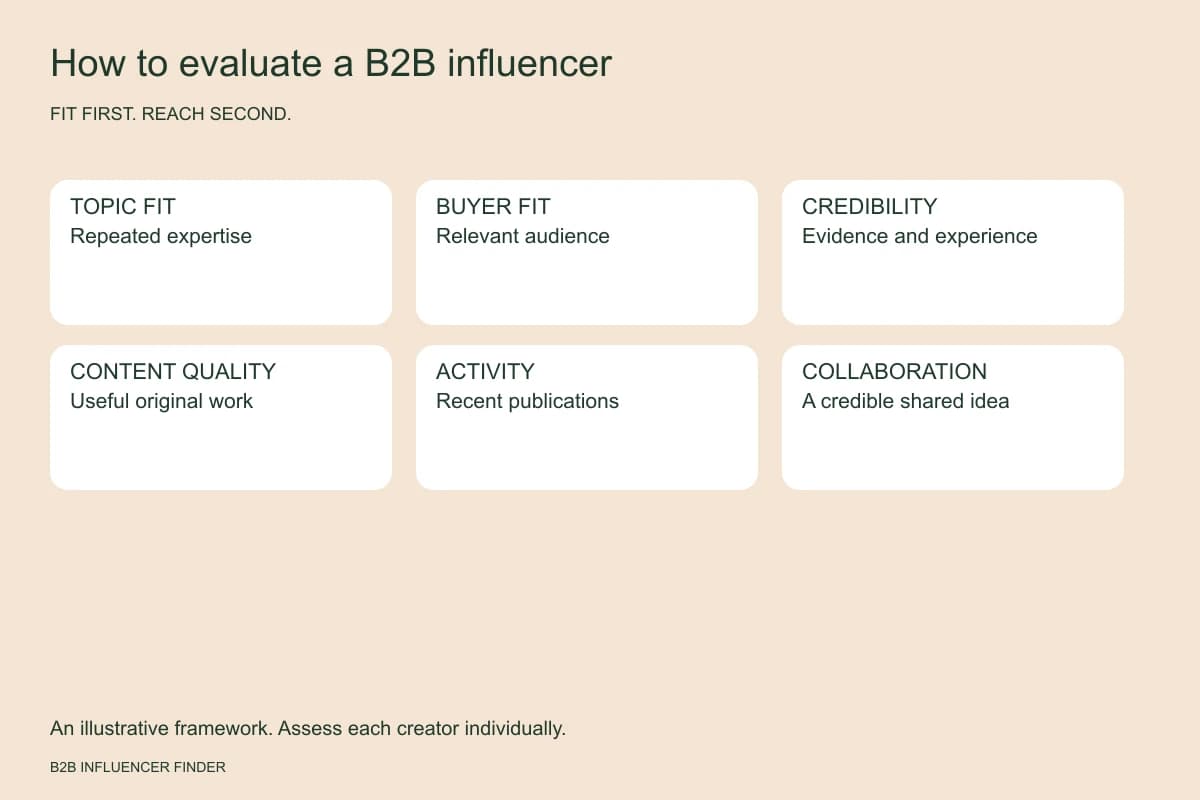
When we evaluate a creator, i would score six areas before getting excited about reach:
Topic fit: how closely does their actual recent content match your subject?
Buyer fit: is there evidence their audience overlaps with the people you need?
Credibility: why would someone trust this person on the topic?
Content quality: do they produce work worth reading, watching or listening to?
Activity: are they publishing consistently enough to be a realistic partner?
Collaboration fit: do you have something genuinely useful to add to their work?
Then add practical fields such as audience size, geography, channel, estimated cost and availability.
You can score each fit dimension from one to five. The point is not to create fake precision. It is to stop one impressive follower number from overriding everything else.
For Creator AEO, context is part of creator quality
If you also care about how your brand is understood in AI search, creator selection becomes even more contextual.
There is no credible evidence that an AI system rewards a brand because the person mentioning it has a certain follower count. What matters for your evidence strategy is whether useful, public third-party content exists around the topics you want your brand associated with.
A niche expert who writes a detailed article explaining your research in the right category may create more useful context than a huge creator who drops your company name into a generic list.
That does not guarantee an AI citation or recommendation. It does create clearer third-party evidence for buyers and systems to encounter.
How B2B Influencer Finder approaches creator fit
B2B Influencer Finder starts with the collaboration rather than the audience number.Further reading: See how creator matching works
The product analyses useful content and expertise on your website, then searches LinkedIn, YouTube, newsletters, podcasts, blogs and X for creators already publishing around overlapping subjects. It shows why the match exists and suggests what the creator could credibly talk about.
You can then approve the creators that make sense and reject the ones that do not.
The idea is simple: the best B2B influencer is not the biggest person in your category. It is the person with the strongest combination of relevance, credibility, buyer fit and something worthwhile to say with you.
The short version
A good B2B influencer reaches the right people, has earned credibility on the right subject and produces content people actually value.
Start with topic fit, buyer fit, credibility, content quality, activity and collaboration fit. Check reach after that.
If you cannot explain in one sentence why this particular creator should talk about this particular piece of your expertise, the match probably is not strong enough yet.
Sources
LinkedIn + Ipsos, 2025 B2B Marketing Benchmark: Trust Is the New KPISources: LinkedIn + Ipsos, 2025 B2B Marketing Benchmark: Trust Is the New KPI
Edelman + LinkedIn, 2025 B2B Thought Leadership Impact ReportSources: Edelman + LinkedIn, 2025 B2B Thought Leadership Impact Report