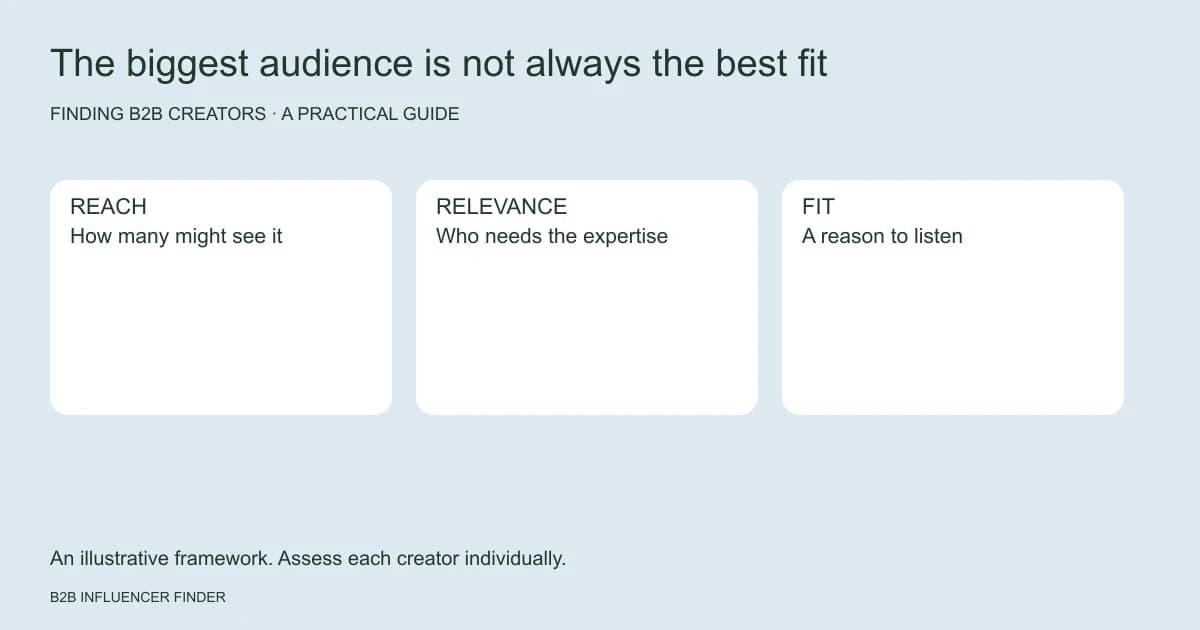
There is no minimum follower count that makes someone a useful B2B influencer. A creator with 4,000 highly relevant followers can be more valuable to a specialist B2B brand than someone with 400,000 people who mostly sit outside the market.
Follower count is useful. It tells you something about potential reach. It does not tell you whether the right people are in that audience, whether they trust the creator, or whether the creator actually knows your subject.
For B2B, i would treat follower count as a sizing metric, not a quality score.
So what counts as nano, micro or macro?
Influencer marketing uses follower tiers as shorthand. The boundaries are not official and different sources draw them slightly differently.Sources: DHPB, Standard Influencer Tier Classification System 2024
A useful rough convention is nano at around 1,000 to 10,000 followers, micro at around 10,000 to 100,000, mid-tier around 100,000 to 500,000, macro around 500,000 to one million, and mega above one million.
Those labels can help with planning reach and budget. They should not decide who makes your shortlist.
B2B changes what a “big audience” means
In consumer marketing, a creator can talk to millions of potential buyers. B2B markets are often much smaller.
Imagine you sell compliance software to heads of risk at European fintech companies. There may only be a relatively small number of people who can influence or approve that purchase. A creator followed by 6,000 people from that exact professional community can have extraordinary concentration.
Now compare that with a general entrepreneurship creator followed by 250,000 people. The second number looks much better in a spreadsheet. It may contain far fewer of the people you actually need.
This is why B2B audience size needs context. Ten thousand followers in a tiny technical niche can represent a very different kind of influence from ten thousand followers in a broad consumer category.
The best current B2B research does not put follower count first
LinkedIn and Ipsos surveyed B2B marketing leaders in 2025 about how they select creators. The leading criteria were authenticity and credibility at 58%, industry relevance at 49%, brand alignment and subject-matter expertise at 47% each, and audience engagement at 45%.Sources: LinkedIn + Ipsos, 2025 B2B Marketing Benchmark: Trust Is the New KPI
That list is useful because it reflects how B2B influence actually works. The creator has to be believable in the subject before their audience size becomes interesting.
The same LinkedIn research found thought leaders and industry analysts were the influencer type most often ranked first for effectiveness, ahead of company customers, independent creators, partners and employees. Again, expertise and position in the market matter.Sources: LinkedIn + Ipsos, 2025 B2B Marketing Benchmark: Trust Is the New KPI
Start with the smallest audience that can do the job
There is no reason to buy reach you do not need.
If your goal is to get credible third-party discussion inside a narrow category, a nano or micro creator can be enough. If your goal is broad category awareness across several markets, a larger creator may make more sense. If you need both, a portfolio of different creator sizes can do different jobs.
The question is not “How many followers should our influencer have?” It is “How much relevant reach does this campaign actually need?”
Nano B2B creators can be extremely useful
A nano creator may have only a few thousand followers. In B2B that person could still be a respected operator, consultant, founder, analyst or specialist practitioner.
Do not reject them because the number looks small. Look at who engages with their work. Read the comments. Check the job titles and companies of people joining the conversation where that information is public. Look at whether other respected people in the niche reference them.
A small professional audience can be commercially meaningful if it is dense with the people you care about.
Micro creators are often a practical middle ground
The rough 10,000 to 100,000 micro range is useful vocabulary, not a recommendation.Further reading: How Do I Find Micro-Influencers for a B2B Brand?
In B2B, this band can contain creators who have built meaningful specialist audiences while still publishing around a fairly defined subject. They may also be easier to collaborate with than very large creators whose partnerships are managed like media inventory.
But do not assume every micro creator is more engaged, more authentic or better value. Recent creator-tier research shows substantial variation inside follower bands. Tier alone cannot tell you whether an individual creator performs well.Sources: Tokfluence, Influencer Tiers Explained 2026
Larger creators make sense when scale is part of the objective
There is nothing wrong with a 200,000-follower B2B creator if the audience and subject fit.
Larger creators can give you more absolute reach from one collaboration. That can matter for launches, category awareness, major research, events or campaigns where you genuinely want a broader professional audience.
The mistake is paying for a large audience before checking what proportion of it is useful.
Follower count is not the same as reach
A creator can have 80,000 followers and only a fraction see a particular post. Another can have 8,000 followers and repeatedly reach a large share of them.
Platform distribution, posting frequency, format, topic and audience behavior all affect actual reach. So when possible, ask for recent content performance rather than treating follower count as guaranteed impressions.
For newsletters, podcasts and blogs, follower count may not even be the main public metric. You may be looking at subscribers, downloads, website traffic, email opens, views or creator-supplied media-kit data instead.
Do not blindly use engagement rate either
Engagement rate is useful, but it can become another vanity metric if you strip away context.
A post with 100 comments from other marketers may look active but be useless if you sell to CFOs. Ten thoughtful comments from the exact practitioners you want could be more interesting.
Look at engagement quality. Who is responding? What are they saying? Does the conversation show that the creator has credibility with the market you want to reach?
A better B2B creator filter
Before follower count, i would check five things.Further reading: What Makes a Good B2B Influencer for Your Brand?
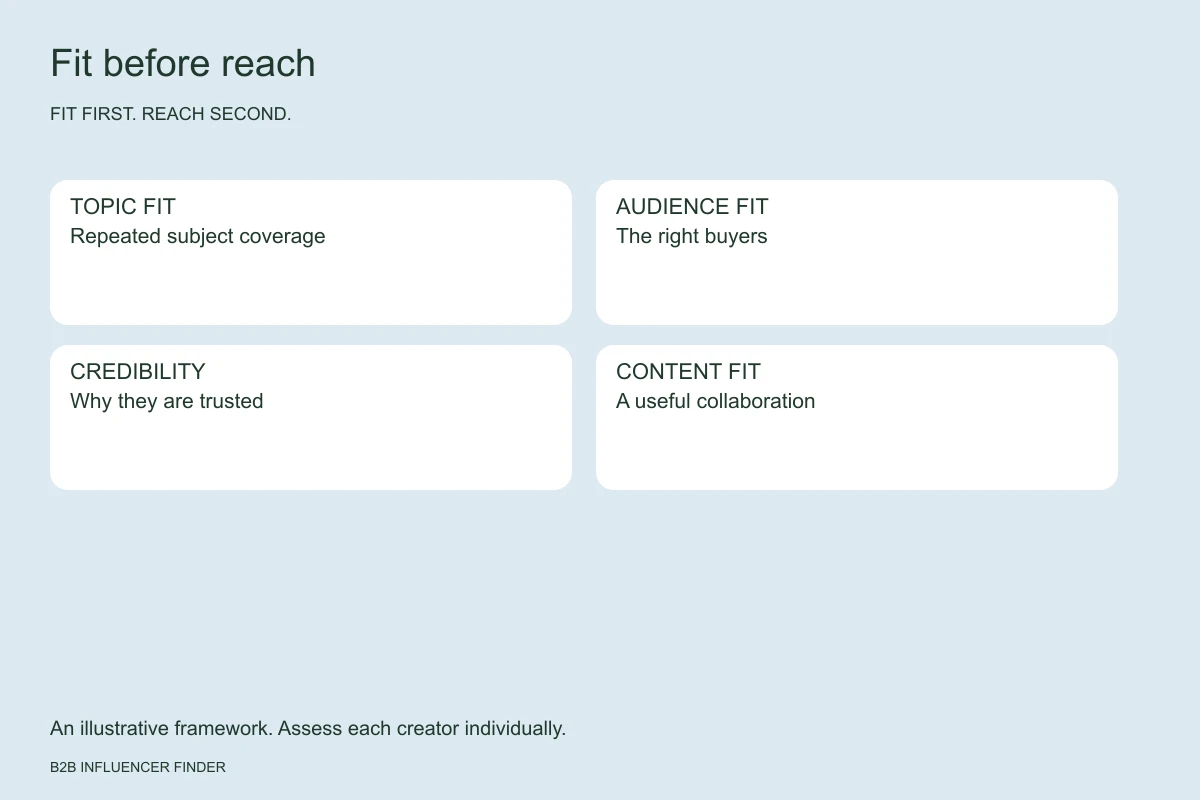
First, topic fit. Does this person repeatedly create content about the problem, category or industry you care about?
Second, audience fit. Is there evidence the people following and engaging are the kinds of people you need to reach?
Third, credibility. Does the creator have real experience, expertise or a trusted position in that conversation?
Fourth, content fit. Can they create the kind of article, video, newsletter, podcast discussion or post that makes sense for your objective?
Fifth, collaboration fit. Do you actually have something useful to add to their work? Research, data, a case study, access, expertise or a strong point of view?
Then look at reach.
For Creator AEO, relevance matters even more
If part of your goal is to create useful third-party evidence around your brand, raw audience size is an especially weak first filter.
A specialist creator can publish a detailed article or video that explains your company in the exact context you want to be understood. A much larger creator could mention you in a generic list with almost no useful context.
We do not have evidence that an AI system gives a brand more weight because the creator mentioning it has more followers. AI search and recommendation systems are opaque and differ by platform. What we can say is that useful, public, topic-relevant third-party content gives systems more contextual evidence to encounter than a follower number does.
So for Creator AEO, choose creators because of what they can credibly say and where that content will live. Do not choose them because 100,000 looks impressive.
What follower count should you put in your campaign brief?
If you need a number for discovery, use a broad range rather than a hard minimum.
For a narrow B2B campaign, i would happily research creators from a few thousand followers upward. I would only set a higher minimum if the campaign has a genuine reach requirement, not because someone decided that “real influencers” start at 10,000.
If a creator has fewer than 1,000 followers but is a known expert whose audience contains your exact buyers, i would not automatically exclude them either. They may function more like an industry voice than a conventional influencer.
The lower bound should come from your objective. The upper bound usually comes from relevance, budget and how broad you want the campaign to become.
Do not compare follower counts across platforms as if they mean the same thing
Twenty thousand LinkedIn followers, twenty thousand YouTube subscribers and twenty thousand newsletter subscribers are not equivalent audiences.Further reading: How Do I Find B2B Influencers in My Industry?
The platforms distribute content differently. The relationship with the audience is different. Public metrics are different. A newsletter subscriber has actively opted into an inbox relationship. A YouTube subscriber may discover a creator through search months later. A LinkedIn follower may see content through the feed and network effects.
Compare creators inside the context of their channel and actual content performance, not through one universal follower-count table.
How B2B Influencer Finder handles audience size
B2B Influencer Finder is built around relevance before reach.Further reading: See how creator matching works
The product searches creators across LinkedIn, YouTube, newsletters, podcasts, blogs and X, then looks at what those people actually publish and matches that against the strongest content, case studies, research and expertise on your website.
Audience size is still useful information. It just sits alongside subject relevance, activity and content fit rather than replacing them.
The goal is not to find the biggest person. It is to find the right person with something credible to talk about.
The short version
There is no magic follower count for a B2B influencer. Nano, micro and macro tiers are useful shorthand for reach, but they are not quality grades.
Start with topic relevance, buyer relevance, credibility, content fit and collaboration fit. Then use follower count to decide whether the creator gives you enough reach for the job.
In a specialist B2B market, a few thousand of the right people can be a very large audience.
A practical follower-count framework
- Under 10,000: do not dismiss. In a narrow B2B niche this can be a highly concentrated specialist audience.
- 10,000 to 100,000: commonly called micro. Often worth researching for specialist campaigns, but the label itself proves nothing.
- 100,000 to 500,000: broader reach can help when category awareness matters. Check audience dilution and cost.
- 500,000+: potentially useful for scale, but only if subject and buyer fit survive the larger audience.
- Any size: a known practitioner, analyst or operator can be influential without fitting a conventional creator tier.
What not to do
- Do not set 10,000 followers as a universal minimum for B2B creators.
- Do not assume smaller automatically means more engaged or more trustworthy.
- Do not assume larger automatically means more influential with your buyers.
- Do not compare follower counts across LinkedIn, YouTube, newsletters and podcasts as equivalent metrics.
- Do not treat follower count as guaranteed reach or impressions.
- Do not judge engagement from the percentage alone. Inspect who is engaging and what the conversation looks like.
- Do not claim a creator with more followers will create more AI visibility. There is no credible basis for that rule.
- Do not invent audience demographics or performance data when the creator or platform does not provide them.
Sources
LinkedIn + Ipsos, 2025 B2B Marketing Benchmark: Trust Is the New KPISources: LinkedIn + Ipsos, 2025 B2B Marketing Benchmark: Trust Is the New KPI
DHPB, Standard Influencer Tier Classification System 2024Sources: DHPB, Standard Influencer Tier Classification System 2024
Tokfluence, Influencer Tiers Explained 2026Sources: Tokfluence, Influencer Tiers Explained 2026