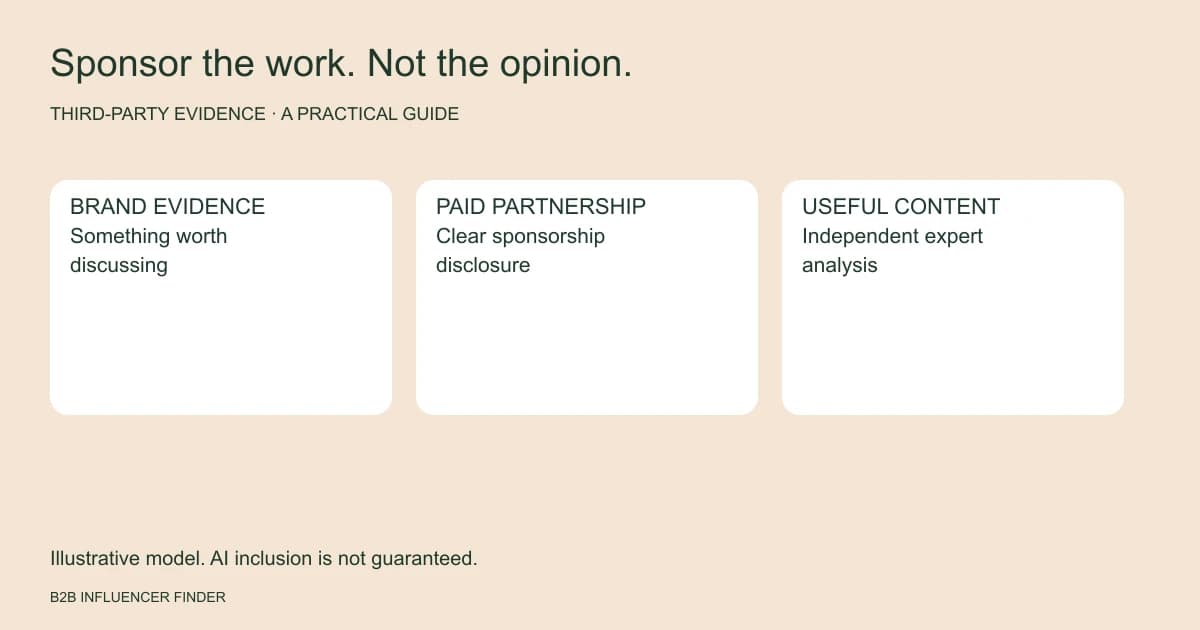
Potentially, yes. Paying a creator does not automatically make their content useless for AI visibility. It also does not make the content valuable. The useful question is whether the collaboration creates accurate, relevant, publicly discoverable third-party content around your brand.
There is currently no credible evidence that ChatGPT, Google AI Overviews or another AI system gives a brand visibility simply because it paid a creator. There is also no evidence that a properly disclosed sponsorship is automatically ignored. What we do have is growing evidence that brand mentions across the web, especially in relevant contexts, are associated with higher AI visibility.
So i would treat sponsored creator content as a way to create and distribute useful evidence, not as a way to buy an AI ranking.
The research is about mentions, not whether money changed hands
Ahrefs analysed 75,000 brands and found that branded web mentions correlated strongly with visibility across ChatGPT, Google AI Mode and AI Overviews, at roughly 0.66 to 0.71. YouTube mentions showed an even stronger correlation at about 0.737.Sources: Ahrefs - Top Brand Visibility Factors in ChatGPT, AI Mode, and AI OverviewsFurther reading: Does Getting Mentioned on Other Websites Help With AI Visibility?
That research does not tell us whether each mention was earned, sponsored, affiliate-driven or created through some other commercial relationship. It therefore cannot prove that sponsored content helps AI visibility specifically.
It does tell us something useful though: brands that are discussed more widely across the web tend to appear more often in AI answers. If a paid creator collaboration produces one of those useful discussions, it can become part of the wider evidence around the brand.
Disclosure does not make the content fake
There is sometimes a strange assumption in AEO conversations that a paid collaboration stops being third-party content. It does not. The creator is still an external publisher or voice. What changes is that the commercial relationship must be clear.
In the US, the FTC says influencers should disclose material connections with brands, including payment, free products and other things of value. The disclosure should be hard to miss and placed with the endorsement itself. If the endorsement is in a video, the FTC says the disclosure should be in the video, not only hidden in the description.Sources: FTC - Disclosures 101 for Social Media Influencers · FTC - Endorsements, Influencers, and Reviews
The rules differ by country, so brands running international campaigns need to check the requirements that apply to them. But strategically, hiding sponsorship is the wrong goal anyway. Transparent paid content can still be genuinely useful content.
The creator still needs to have something real to say
This is where bad influencer marketing and bad Creator AEO become the same thing. A brand pays someone, sends a rigid script and gets a thin post that basically says the product is amazing.
That may technically create a mention. It creates very little evidence.
A stronger collaboration gives the creator something substantive to work with: original research, customer results, a benchmark, product access, an expert interview, a useful dataset, a case study or a point of view worth challenging. The creator can then explain, test, compare or add perspective.
The fact that the collaboration was paid does not remove the information from the page, video or transcript. But payment should not be used to manufacture claims that are false or unsupported.
Sponsored links are a separate SEO question
If a paid article or creator page links to your website, Google says links that are advertisements or paid placements should be marked with rel="sponsored". Nofollow remains acceptable, although Google says sponsored is preferred for paid links.Sources: Google Search Central - Qualify your outbound links to GoogleFurther reading: Should Creators Link to Your Website or Just Mention Your Brand?
That means you should not buy creator collaborations as a disguised PageRank scheme. A sponsored link may still be useful to a human reader and send referral traffic. The content can still mention your brand in context. But the paid relationship should be represented correctly.
This distinction matters because Creator AEO is not just link building with a new name. The objective is useful third-party evidence around the subjects you want your company associated with.
What makes sponsored creator content more useful?
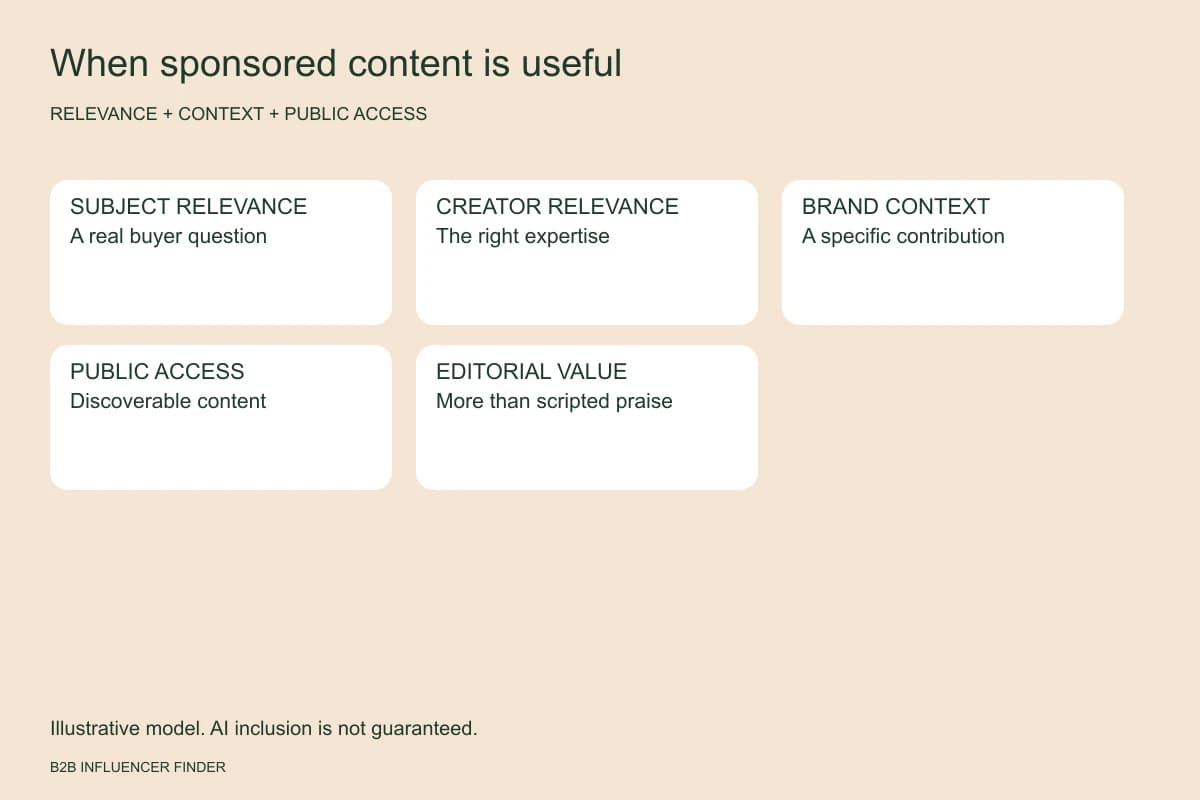
I would look at five things: subject relevance, source relevance, specificity, discoverability and editorial value.
Subject relevance means the content is actually about a problem or category your company belongs to. Source relevance means the creator has a credible reason to discuss that subject. Specificity means the brand is described in enough context for a reader to understand what it does. Discoverability means the content is public and can be found or retrieved. Editorial value means there is something useful beyond the sponsor message.
A specialist YouTube creator comparing fraud-detection approaches and testing your product has all five. A generic lifestyle account posting 'Thanks Acme for sponsoring this' probably does not, even if the second creator has ten times more followers.
Paid content can be especially useful when your niche is small
B2B markets often do not have hundreds of journalists waiting to cover a niche software category. The relevant voices may be consultants, operators, newsletter writers, YouTubers, podcast hosts or practitioners with relatively small audiences.
Sometimes those people will discuss your research or product organically. Sometimes they will reasonably expect to be paid for the time required to create a detailed video, article or newsletter. Paying for that work is not inherently a problem. Pretending the payment does not exist is.
This is also why follower count is a weak starting point. For AI visibility and B2B buying, the person with 15,000 highly relevant followers may create far more useful brand context than a broad creator with 500,000.
B2B Influencer Finder starts before the sponsorship
The difficult part is not deciding whether to pay. It is finding the right person and giving them a credible reason to care.
B2B Influencer Finder starts with the useful evidence a company already has, then matches it to creators whose existing work overlaps. Instead of 'we want to sponsor you to talk about our software', the collaboration can begin with something concrete: you recently covered SME lending, we have data on approval rates across 40,000 applications, would that be useful for a piece?
The commercial terms come after the relevance. That is a much healthier way to run creator partnerships, whether the final collaboration is paid or earned.
How i would measure sponsored Creator AEO
Do not measure it by sponsored posts purchased. Measure the evidence created.Further reading: What Is AI Share of Voice and How Do You Improve It?
Track the creator and channel, topic, format, exact brand context, disclosure, link if there is one, whether the content is public, engagement, referral traffic and whether the piece generates secondary discussion or citations.
Then track AI visibility separately across a stable set of prompts. Look at brand mention rate, citations, recommendation frequency, competitor share of voice and whether your brand becomes associated with the target topic over time.
Do not claim a before-and-after movement was caused by one sponsored article. AI answers change for many reasons. The useful question is whether your wider third-party evidence is becoming stronger while your visibility changes alongside it.
The goal is not to make paid content look earned
The goal is to make paid content worth reading.
A sponsorship can fund research, testing, production time and access to a specialist audience. That can create genuinely useful independent context around your brand. Disclose the relationship. Let the creator keep a real voice. Give them evidence rather than a script.
If the result is a useful article, video, newsletter or podcast that accurately explains something about your company in a topic that matters, it can contribute to the third-party evidence around your brand. Just do not confuse that with a guaranteed AI ranking signal.
Sources
Ahrefs - Top Brand Visibility Factors in ChatGPT, AI Mode, and AI OverviewsSources: Ahrefs - Top Brand Visibility Factors in ChatGPT, AI Mode, and AI Overviews
FTC - Disclosures 101 for Social Media InfluencersSources: FTC - Disclosures 101 for Social Media Influencers
FTC - Endorsements, Influencers, and ReviewsSources: FTC - Endorsements, Influencers, and Reviews
Google Search Central - Qualify your outbound links to GoogleSources: Google Search Central - Qualify your outbound links to Google
Ahrefs - An Analysis of AI Overview Brand Visibility FactorsSources: Ahrefs - An Analysis of AI Overview Brand Visibility Factors