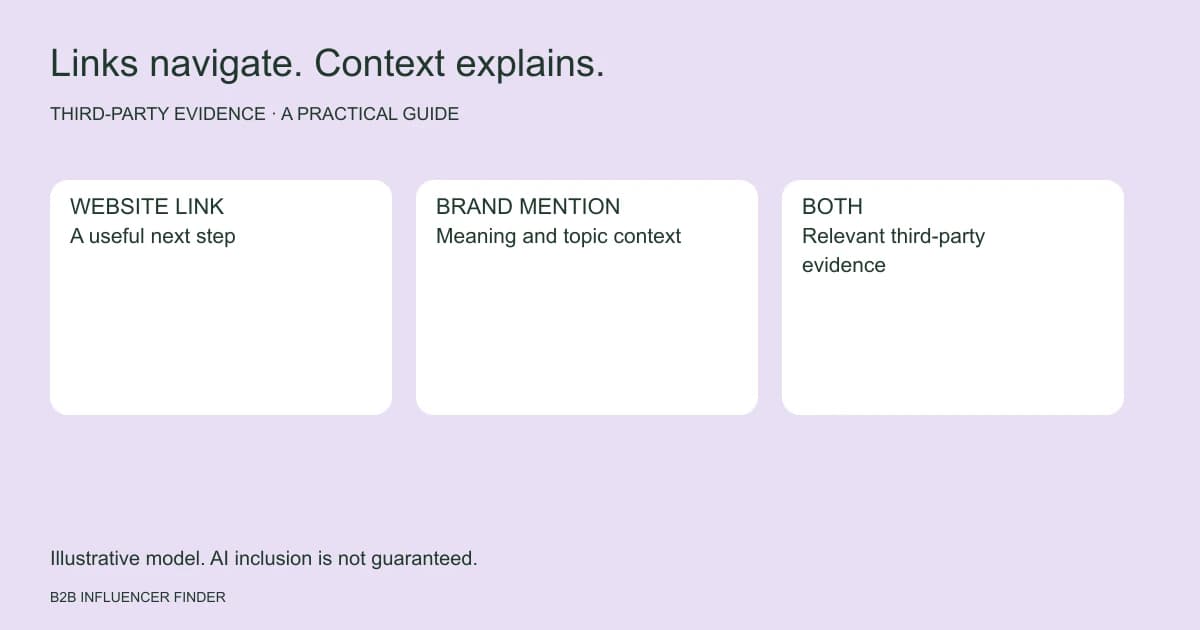
Ideally, both. But if a creator mentions your brand clearly and in the right context without linking to you, that is not a failed collaboration.
For traditional SEO, backlinks have obvious value because links help search engines discover pages and are part of Google's ranking systems. For AI visibility, the picture is broader. Recent research from Ahrefs has found branded web mentions, including unlinked mentions, correlate much more strongly with brand visibility in AI answers than raw backlink counts do.
So i would not brief a creator with one objective: get us a backlink. I would brief them to create useful, accurate content in which the brand makes sense. If a natural link helps the reader, ask for that too.
A link and a mention do different jobs
A backlink is a navigational and SEO object. It gives the reader somewhere to go and can help search engines understand relationships between pages. Depending on the link and the page, it may also contribute to traditional search authority.Further reading: Backlinks vs Brand Mentions: Which Matters More for AI Search?
A brand mention is language. It tells the reader what the company is, what topic it belongs to and why it is relevant in that piece of content.
For Creator AEO, that language matters because the objective is not only to send authority to your domain. It is to build third-party context around your company across the web.
The AI visibility data makes unlinked mentions hard to ignore
Ahrefs' study of 75,000 brands found branded web mentions had a 0.664 correlation with brand appearance in Google AI Overviews. The number of backlinks had a much weaker 0.218 correlation in the same study.Sources: Ahrefs - An Analysis of AI Overview Brand Visibility Factors (75K Brands Studied) · Ahrefs - Top Brand Visibility Factors in ChatGPT, AI Mode, and AI Overviews
A later Ahrefs analysis across ChatGPT, Google AI Mode and AI Overviews found branded web mentions continued to correlate strongly with AI visibility, roughly 0.66 to 0.71, while classic link metrics were much weaker.
That is correlation, not proof that adding an unlinked mention will cause an AI system to recommend you. Bigger and better-known brands naturally accumulate more mentions too. But the result is still strategically useful: the words other websites use around your brand appear to be worth paying attention to.
A naked backlink can actually tell you very little
Imagine a creator publishes a long article about customer referral programs. At the bottom is a resources section containing a link to Referral Factory. The link is useful, but there may be very little language explaining what Referral Factory is or why it belongs in the discussion.
Now imagine the creator writes: 'Referral Factory is a no-code referral program platform that lets companies track referrals and automate rewards', then explains where it fits and what they liked or disliked.
The second example creates much richer brand context even before we ask whether the words are linked.
For AI visibility, i would rather have the second paragraph unlinked than a random backlink on a page with almost no relevant context. Best case, of course, is the useful paragraph plus a natural link for readers who want to investigate.
Ask for the link when it genuinely helps the reader
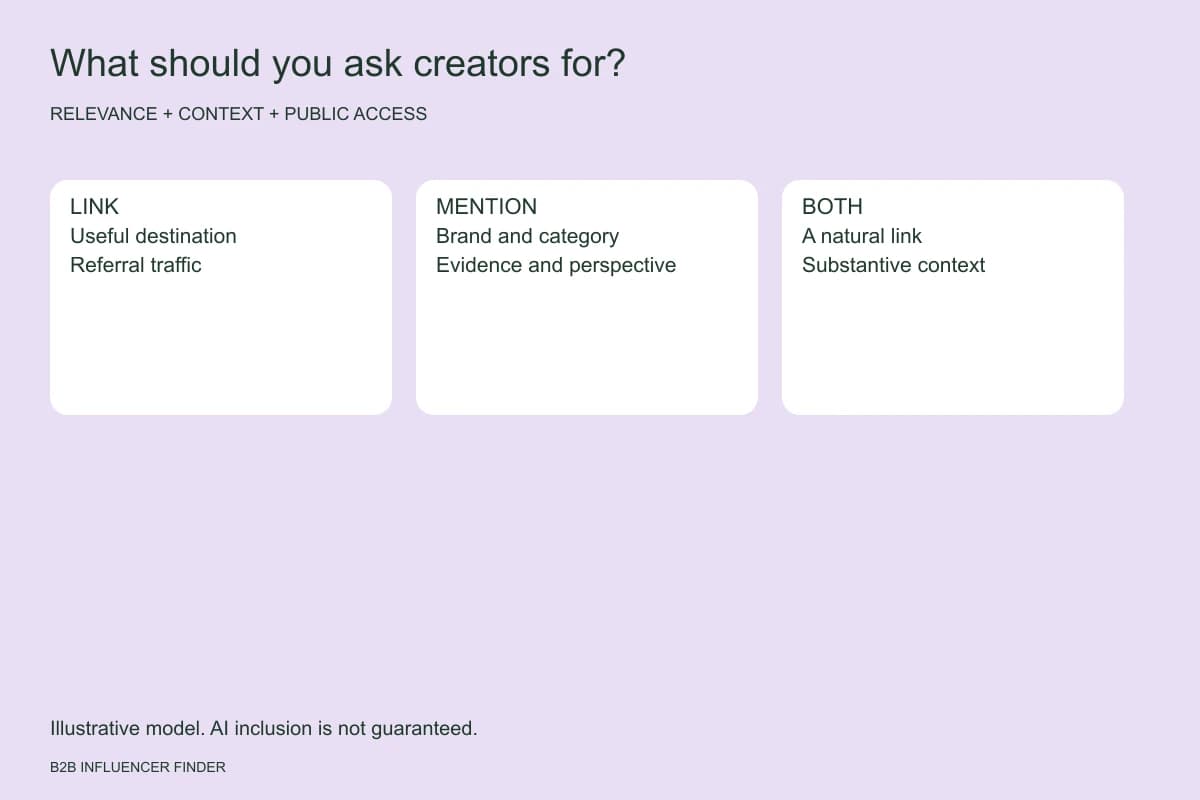
There are plenty of creator formats where a link is completely natural. A YouTube description can link to the product being demonstrated. A newsletter can link to the research being discussed. A blog comparison can link to each product. A podcast episode page can link to the guest's company or source material.
In those situations, ask for the link. It improves the user journey and gives you measurable referral traffic. It may also have traditional SEO value depending on how the link is implemented.
But do not contort the collaboration around forcing a followed backlink. If the creator's platform, editorial policy or sponsorship rules mean the link is nofollowed, sponsored or absent, the content can still have value.
Paid creator links need to be handled properly
If you pay for a placement that contains a link, Google says paid links should be qualified with rel="sponsored". Nofollow is still acceptable, although Google says sponsored is preferred for advertisements and paid placements.Sources: Google Search Central - Qualify your outbound links to GoogleFurther reading: Does Sponsored Creator Content Help With AI Visibility?
That is another reason not to treat Creator AEO as a paid-link scheme. If you are sponsoring a creator, the goal should be the useful content and relevant third-party context. The link is there to help the audience navigate, not to disguise a purchased SEO signal.
What should the creator actually say?
This matters more than whether the brand name is blue and clickable.
A useful mention normally contains some combination of the brand name, the category or problem it solves, the specific evidence being discussed and the creator's own perspective. It should be accurate enough that somebody encountering the content can understand why the company belongs in that topic.
That does not mean handing creators a paragraph and telling them to paste it. Over-scripted creator content is usually worse content. Give them the facts, product access, research, case study or expert input. Let them explain it in their own language.
Context also helps with topic association
One of the things brands want from AI visibility is not merely to be known. They want to be known for something.Further reading: How Do I Get AI to Associate My Brand With a Specific Topic?
If 30 unrelated pages mention your company name with no explanation, there is not much topic context. If relevant creators repeatedly discuss your company alongside B2B referral marketing, customer acquisition, advocacy and loyalty, there is a much clearer body of language connecting the brand with those subjects.
We cannot turn that into a guaranteed ranking formula. AI systems are opaque and retrieval systems change constantly. But it is a more sensible evidence strategy than collecting links from pages that have little to do with your market.
Different creator formats change what you should ask for
For an article or newsletter, i would usually want the brand named in the body, described in context and linked where useful. For YouTube, the spoken mention and surrounding discussion matter, while a description link makes it easier for viewers to act. For a podcast, the conversation itself can create rich context, while the episode page and transcript make that context easier to encounter on the web.
On LinkedIn or other social platforms, a direct website link may not always suit the format. A clear contextual mention from a relevant person can still be valuable even if there is no outbound link.
This is how B2B Influencer Finder approaches the match
We do not start with 'which creator can give us a backlink?' We start with what your company has that is worth discussing, then find creators who already publish around that subject.
That might be a case study a YouTuber can break down, original data a newsletter writer can analyse or a product workflow a specialist consultant can test. Once the match is good, the right format and link naturally follow from the collaboration.
The point is to create credible third-party evidence, not manufacture a footprint of identical anchor text.
How i would brief a creator
Keep it simple. Tell them what the useful asset is, why you thought it matched their work and what factual information needs to be correct. If a link would help their audience, provide the most relevant destination page. Do not insist on awkward keyword-rich anchor text.
If the collaboration is paid, make the commercial relationship clear and handle the link appropriately. If it is earned, do not make the link a condition that kills an otherwise useful piece of coverage.
Measure the mention and the link separately
Track whether the creator named the brand, what topic surrounded the mention, whether the description was accurate, where the content lives, whether it is public, whether there is a link, the destination URL and referral traffic.
Then measure AI visibility separately across a stable prompt set. Track mentions, citations, recommendation frequency, competitor share of voice and the topics with which your brand is associated.
A link is easy to count, which is one reason marketers have historically focused on it. Context is harder to put in a spreadsheet. That does not make it less important.
So, link or mention?
Ask for both when both make sense.
But do not dismiss a relevant creator mention because it lacks a backlink. In AI search, the evidence so far suggests that broad, contextual brand presence across the web deserves at least as much attention as the link graph.
The strongest creator collaboration is not the one that gives you the prettiest backlink report. It is the one that leaves a useful piece of content behind, accurately connects your brand to a subject you want to be known for and gives interested people a sensible next step.
Sources
Ahrefs - An Analysis of AI Overview Brand Visibility Factors (75K Brands Studied)Sources: Ahrefs - An Analysis of AI Overview Brand Visibility Factors (75K Brands Studied)
Ahrefs - Top Brand Visibility Factors in ChatGPT, AI Mode, and AI OverviewsSources: Ahrefs - Top Brand Visibility Factors in ChatGPT, AI Mode, and AI Overviews
Google Search Central - Qualify your outbound links to GoogleSources: Google Search Central - Qualify your outbound links to Google
Ahrefs - Brand Mentions for SEO: How to Get Cited by AISources: Ahrefs - Brand Mentions for SEO: How to Get Cited by AI