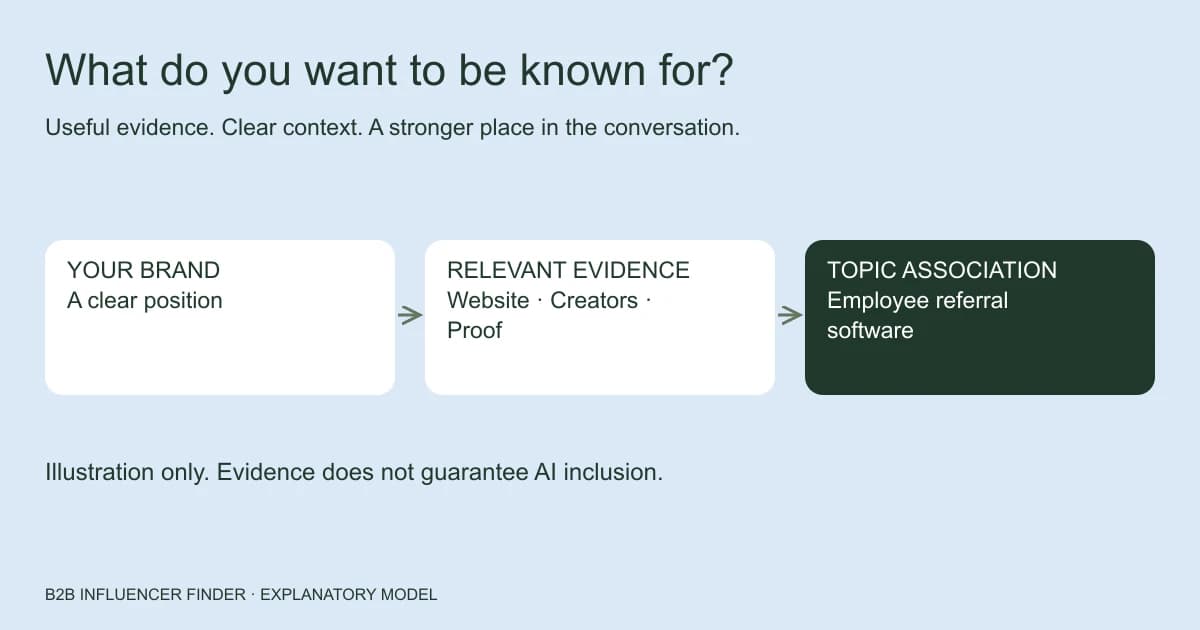
There’s a difference between AI knowing your company exists and AI knowing what your company should be known for.Further reading: Related guide: How Do I Get My Brand Mentioned by AI?
ChatGPT might recognise your brand name. It might even be able to describe your product reasonably well. But ask it for the best companies in the category you actually care about and suddenly you disappear.
That’s the harder problem.
If you want AI systems to associate your brand with a specific topic, you need to build a consistent body of evidence connecting your brand to that topic. That evidence should exist on your own website, but it should also exist in places you don’t control.
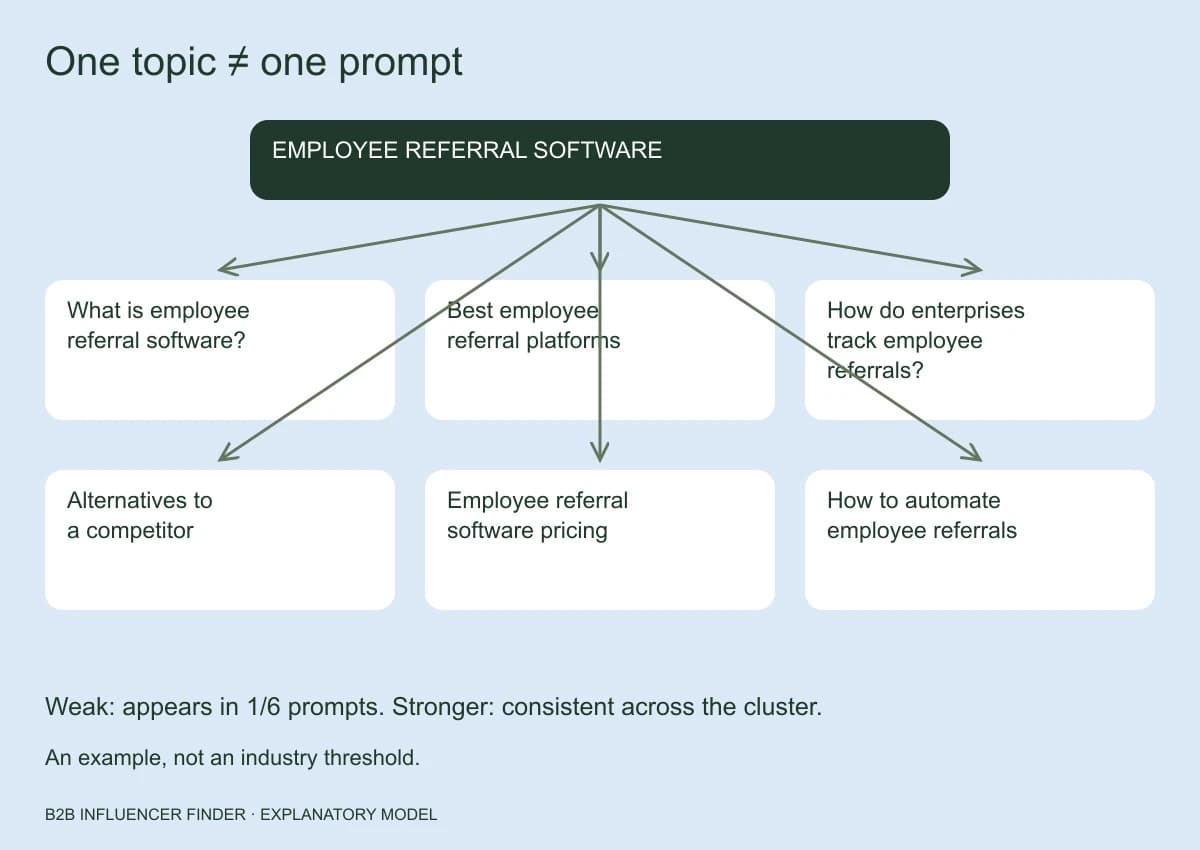
And importantly, you need to think at the level of a topic, not one magic prompt.
One prompt is not a category
Say you sell software for employee referral programs.
You test ChatGPT with: ‘What are the best employee referral software platforms?’ Your company appears. Great.
Then you try: ‘How should a 2,000-person company automate employee referrals?’ You’re gone. ‘What software can HR teams use to track employee referrals?’ Gone again. ‘Alternatives to [competitor] for employee referrals?’ Still gone.Further reading: What Is AI Share of Voice and How Do You Improve It?
That tells you something useful. You may have visibility for a prompt, but you don’t yet have consistent visibility across the topic.Further reading: Related guide: How Do I Increase My Brand's Visibility in LLMs?
Semrush published a 2026 study covering 1,094 subject areas in ChatGPT, more than 50,000 brands and over 600,000 citations. It treated each subject as a cluster of five representative prompts rather than judging visibility from one question. Only 15.2% of the categories in its study had what it defined as a clear topic owner. In other words, most of the categories it measured were still contested.Sources: Semrush — AI visibility is a topic-level game (July 2026)
That’s a much better mental model for this work. Don’t ask whether AI mentions you for one carefully chosen question. Ask whether your brand keeps appearing across the family of questions a buyer asks about the subject.
Decide exactly what you want to be associated with
Before you create more content, get specific.
‘Marketing’ is not a useful topic for most B2B companies. Neither is ‘AI’, ‘finance’ or ‘HR’.
A better target might be ‘employee referral software for enterprise HR teams’, ‘fraud prevention for European fintechs’ or ‘customer onboarding software for accounting firms’.
There’s a trade-off here. The broader the topic, the more companies, publishers and established brands you’re competing with. A narrower topic gives you a much clearer association to build.
I’d start with the sentence: ‘When someone asks AI about ________, we want our company to be one of the brands it understands and considers.’
If filling in that blank gives you six unrelated answers, your positioning problem comes before your AI visibility problem.
Map the whole topic, not just your favourite keyword
Once you know the association you want, map the questions around it.
For employee referral software, that might include definitions, how-to questions, comparisons, use cases, integrations, alternatives, pricing questions, implementation questions and buying questions.
Semrush’s topic-level research is useful here because it found that visibility changes prompt by prompt, even inside the same subject. Its later research also found that citations can travel into adjacent categories more easily than brand mentions. In plain English: being a useful source on a subject does not automatically mean the AI will start naming your company as a brand in every related category.Sources: Semrush — AI visibility is a topic-level game (July 2026) · Semrush topical focus study
So build a prompt set that represents the buyer journey rather than tracking one flattering prompt. Twenty thoughtful prompts are more informative than checking the same question every Friday.
Make the association painfully clear on your own website
Your site is the first place where the relationship between your brand and the topic should be obvious.
If you want to be associated with fintech referral programs, for example, I’d expect to find more than one page where ‘fintech’ happens to appear in a paragraph.
I’d expect useful material around fintech referral strategy, relevant customer examples, industry-specific product use cases, implementation guidance, benchmarks if you have them, and clear explanations of why your product is relevant to that market.
This doesn’t mean creating 100 thin pages with slightly different keywords. It means demonstrating actual depth.
The goal is that a human who lands on your site would independently conclude: ‘These people know this subject.’ If that conclusion requires a marketer to explain the connection on a sales call, the website probably isn’t doing enough.
Then build the same association away from your website
This is the part I think marketers are going to spend much more time on.
Your own website can repeatedly tell the world that your company is an expert in a topic. But it’s still your website.
Independent evidence is different.
An industry newsletter discussing your research, a YouTube creator explaining your approach, a customer describing how they use your product, a podcast conversation about the problem you solve, or an expert including you in a category comparison all connect your brand to the subject from somewhere outside your own domain.Further reading: What Is Creator AEO?
There’s growing research behind the broader importance of off-site brand presence. Ahrefs analysed 75,000 brands and found branded web mentions correlated strongly with AI visibility across the systems it studied. In its December 2025 analysis, web mentions correlated around 0.66–0.71 with AI visibility, while YouTube mentions showed an even stronger correlation of roughly 0.737.Sources: Ahrefs — Top Brand Visibility Factors in ChatGPT, AI Mode, and AI Overviews
That does not prove that creating a YouTube mention causes ChatGPT to recommend you. Ahrefs explicitly makes the same correlation-versus-causation warning.Sources: Ahrefs — Top Brand Visibility Factors in ChatGPT, AI Mode, and AI Overviews
But it does support a fairly sensible strategy: if you want your company to be understood as part of a topic, make sure the connection exists across the wider web, not only in your own copy.
Context matters more than collecting random mentions
Imagine you want your brand associated with B2B creator marketing.
You get mentioned 50 times in generic startup directories. Your brand name exists on more pages, but very little new information has been added about what you actually know.
Now imagine a respected B2B marketing creator publishes an article about finding niche industry creators and discusses your company’s matching methodology. Another creator makes a video about creator discovery and uses your tool as an example. A customer writes about how they found subject-matter experts for a campaign.
Those are fewer mentions, but the context is much richer.
This is why I wouldn’t build an AI visibility strategy around ‘get more mentions’ as a raw number. I’d build it around ‘create more credible evidence connecting our brand with the topic we want to own.’
Ahrefs makes a similar distinction in its AEO training: not all mentions are equal, and where the mention appears matters.Sources: Ahrefs — Brand Mentions for SEO: How to Get Cited by AI
Give third parties something specific to say
This is also where creator marketing gets more interesting than simply paying someone to say your company is great.
If you want to be associated with a topic, the collaboration itself should be about that topic.
Suppose you want to become known for referral marketing in fintech. You have a case study showing a bank generated 1,000 referrals a month. That is an asset.
Instead of finding a large marketing influencer and asking for a sponsored post, find someone who already talks about fintech growth, banking acquisition or customer advocacy. Give them the case study. Let them analyse it, question it, compare it or use it as an example in something they were already interested in discussing.
Now the creator’s content naturally connects your brand with fintech referral marketing.
That’s a much stronger collaboration than inserting your logo into an unrelated influencer post.
This is the problem B2B Influencer Finder is designed around
Most influencer discovery tools start with the person: find creators, filter by followers, export a list.
We built B2B Influencer Finder around the match instead.
The agent looks at the useful content and expertise already sitting on your website, then looks for creators whose existing work overlaps with it. The output isn’t only ‘here is a creator in fintech’. It’s closer to ‘this creator regularly discusses fintech customer acquisition, you have this relevant bank referral case study, and here’s why there could be a useful collaboration.’
That matters if the objective is topic association because the subject of the collaboration is part of the match from the beginning.
The creator still decides what they think. You still decide who is relevant. The point is to find credible intersections between what your company knows and what somebody else genuinely talks about.
Be consistent with the language around your category
Brands sometimes make this harder by describing themselves differently everywhere.
The homepage says ‘customer-led growth platform’. The LinkedIn page says ‘advocacy software’. Review sites classify the company as ‘affiliate software’. Customers call it ‘referral software’. The founder calls it ‘word-of-mouth infrastructure’ on podcasts.
Some variation is natural. But if you want a strong association with one category, give the web a reasonably consistent story.
That includes your page titles, product descriptions, author bios, profiles, PR boilerplate, partner listings and the language you use when briefing creators or publications.
You’re not trying to repeat an exact keyword like it’s 2012 SEO. You’re trying to make your positioning understandable.
Measure topic coverage, not a single AI ranking
AI answers are variable. There isn’t a permanent number-three position in ChatGPT that you can defend in the same way you might track a traditional search result.Further reading: Related guide: How Do I Get My Brand Mentioned Alongside Competitors in AI Answers?
So measure the association across a prompt set.
For your chosen topic, track questions covering awareness, problem-solving, comparisons, alternatives, use cases and buying intent. Record whether your brand is mentioned, how it is described, which competitors appear and which sources are cited.
Then look at the pattern over time.
Ahrefs, for example, separates mentions, citations, impressions and AI share of voice in Brand Radar. Semrush also now treats AI visibility as a topic-and-prompt measurement problem rather than a single ranking. You can use software for this, but a spreadsheet is perfectly adequate when you’re starting.Sources: Ahrefs — AI Visibility Metrics · Semrush — AI visibility is a topic-level game (July 2026)Further reading: Related guide: What Is AI Share of Voice and How Do You Improve It?
The important thing is that you establish the baseline before you start changing things. Otherwise six months later you’ll have no idea whether your visibility actually moved.
Don’t try to own 20 topics at once
This is probably the most practical advice in the whole article.
Pick one or two associations that genuinely matter commercially and build depth there first.
If you sell software to banks, restaurants and e-commerce companies, it’s tempting to produce a little content for every industry. But becoming consistently associated with ‘referral programs for banks’ may be much more achievable and valuable than being vaguely visible for ‘marketing software’.
Semrush’s 2026 topic study found that only a minority of the categories it analysed had a clear owner. That suggests there is still a lot of room in specific topics, especially outside the enormous generic categories.Sources: Semrush — AI visibility is a topic-level game (July 2026)
Build the association deliberately. Make your own expertise clear. Create useful evidence. Get that expertise discussed by credible third parties. Measure the cluster of prompts that matters.
Then expand.
The aim isn’t to tell AI what to think
You can’t send ChatGPT a positioning document and ask it to remember that you’re the leading company for a category.
What you can do is make the public evidence around your company much clearer.
If your website consistently demonstrates expertise in a subject, customers describe you in that context, creators discuss your work, publications include you in relevant conversations and the wider web repeatedly connects your name with the problem you solve, you’ve created a much stronger foundation for both people and AI systems to understand the association.
And even if the AI landscape changes again next year, that work still leaves you with something useful: a brand that is better known for the thing you actually sell.