Creator AEO ROI is not the number of times ChatGPT mentions your brand. That is one signal, and sometimes a useful one, but on its own it tells you almost nothing about whether the work created value.
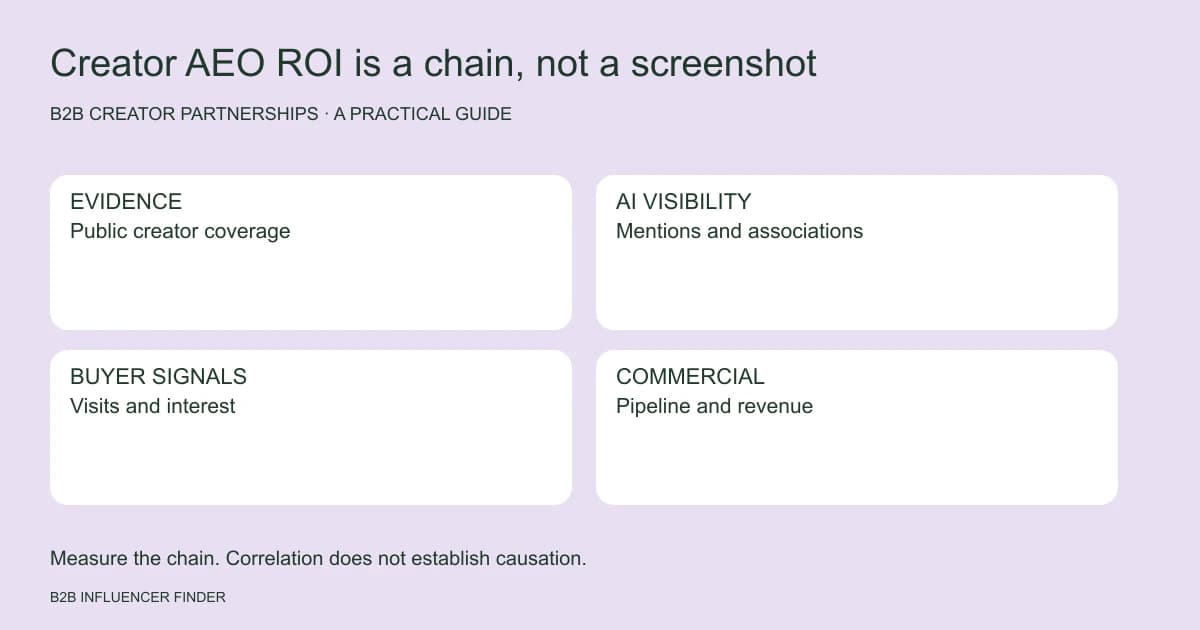
The better way to measure Creator AEO is as a chain: did credible third parties create useful public evidence about your brand? Did your visibility or associations inside AI answers change? Did buyers encounter, search for or visit you? And did any of that eventually contribute to pipeline or revenue?
You will rarely be able to prove that one creator article caused one AI answer. AI retrieval and recommendation systems are opaque, change constantly and can draw on many sources. So the measurement model needs to be more disciplined than 'we got mentioned, therefore it worked.'
First, define what Creator AEO is trying to change
Creator AEO is the practice of getting relevant creators and industry voices to publish useful third-party content around the subjects you want your company understood for. The creator might write an article, record a YouTube video, discuss your research on a podcast, publish a newsletter or share a detailed LinkedIn post.Further reading: What Is Creator AEO?
The theory is straightforward: your own website tells the market what you say about yourself. Creator coverage adds independent public context around your brand, category, expertise and evidence.
That can be useful to buyers directly. It can also create more material that search engines and AI systems may encounter when answering questions. But 'may' matters. There is no guaranteed path from one creator mention to one ChatGPT citation.
Measure Creator AEO in four layers
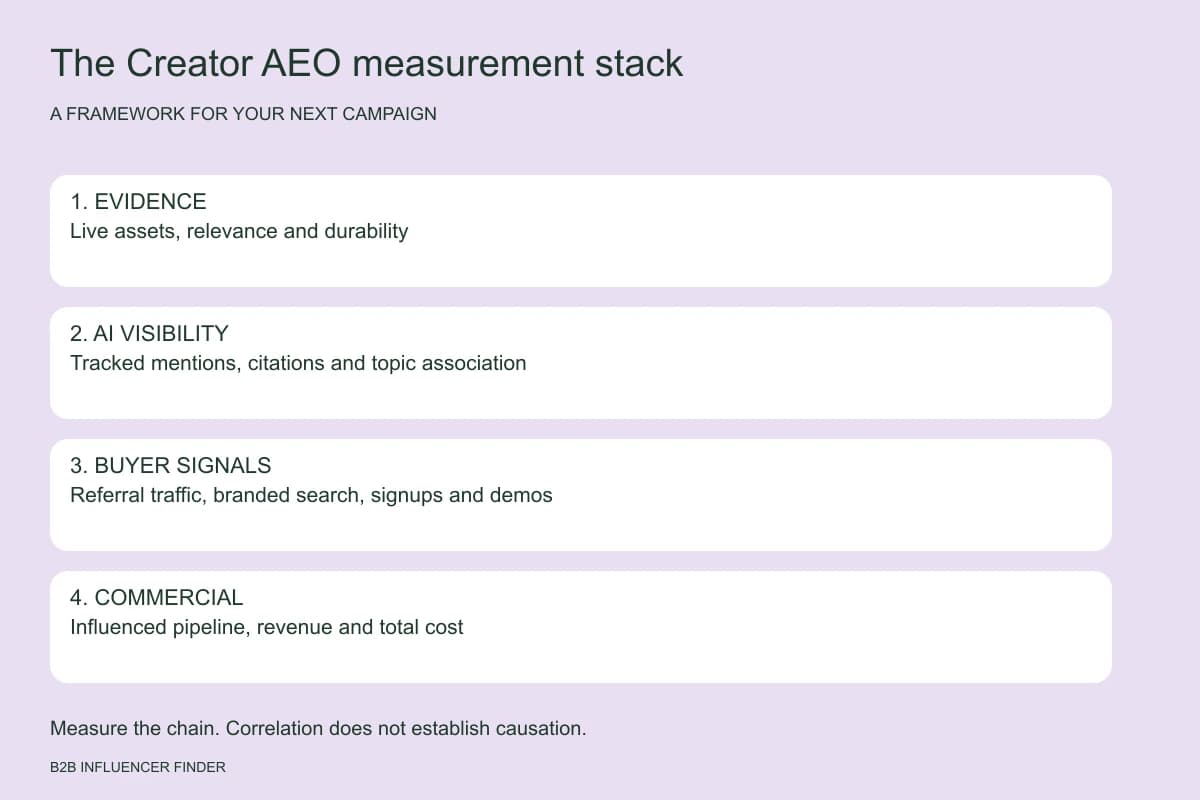
I would separate measurement into four layers. Do not collapse them into one vanity score.
1. Third-party evidence created
Start with the thing you can actually control and verify: what got published.
Track the number of creator collaborations that went live, the creators involved, the format, URL, publication date, topic, brand mention, link if there is one, and whether the content is public and still accessible.
Then add quality. Was the creator genuinely relevant to the subject? Did the piece contain useful context or just a passing brand mention? Did it discuss your evidence, case study, research or expertise? Is it the kind of page, video or transcript a buyer could actually learn from?
Twenty shallow mentions are not automatically better than five detailed pieces from people your market respects.
2. AI visibility and brand association
Before outreach starts, create a baseline. Choose a fixed set of prompts that reflect how buyers might research your category and the topics you want to own.
For example: 'best referral software for banks', 'how should a fintech launch a referral program?' or 'which B2B influencer tools help find niche creators?' The exact prompts depend on the company.
Record whether your brand appears, which competitors appear, how your company is described, what topics it is associated with and which sources are cited. Run the same prompt set again on a consistent schedule.
Useful metrics can include brand mention rate, share of voice within the tracked prompt set, citation rate, topic association and competitor co-mentions.Further reading: What Is AI Share of Voice and How Do You Improve It?
Do not treat these as universal market-share metrics. They describe performance inside the prompt set and systems you chose to monitor. AI answers can vary by model, date, location, account context and retrieval behavior.
3. Buyer behavior
Creator AEO should not live in an AI dashboard forever. Look for evidence that humans are also discovering or investigating the brand.
Track referral traffic from creator content where possible. Google Analytics supports campaign parameters such as utm_source, utm_medium and utm_campaign so campaign links can be identified in acquisition reporting. Use creator-specific URLs when the collaboration naturally includes a link.Sources: Google Analytics Help, URL builders: Collect campaign data with custom URLs
Also watch branded search, direct traffic, newsletter signups, demo requests, trials and self-reported attribution. Ask new leads how they heard about you. A buyer who says 'I saw Sarah's article about you' is useful evidence even if the browser journey lost the original click.
4. Pipeline and revenue
If the program is intended to create demand, connect it to the CRM. Track creator-sourced and creator-influenced leads, opportunities, pipeline and closed revenue where the evidence is credible.
Do not force every creator asset to produce a demo. A research discussion or expert article can have a much earlier job in the buying journey. But if you spend on Creator AEO for six months and cannot find any movement in evidence, AI visibility, buyer behavior or commercial outcomes, that is also information.
Build the baseline before you publish anything
This is the part most teams skip. If you only start measuring after the creator coverage goes live, you have no clean before-and-after view.
Save the initial prompt results. Record your current third-party coverage. Export baseline branded search and referral traffic. Note current pipeline sources. Then start the campaign.
You are not creating a perfect experiment. Other marketing will continue, competitors will change and AI systems will change too. The baseline simply gives you something better than memory.
Do not claim causation when you only have correlation
Suppose your brand appears in 8% of tracked AI answers before a campaign and 19% three months later. At the same time, twelve creators published detailed content about you.
That is interesting. It is not proof that the creator content caused the increase.
Maybe the creator coverage contributed. Maybe your own site improved. Maybe a large publication mentioned you. Maybe the AI product changed its retrieval system. Report the observation accurately: creator coverage increased and tracked AI visibility increased during the same period.
Over time, repeated patterns across campaigns become much more useful. That is why collecting structured campaign data from day one matters.
Separate creator performance from AI performance
You need both views.
At creator level, track who accepted, what they charged, what they created, relevant reach, engagement quality, referral traffic, content durability and any commercial outcomes. This tells you who deserves another collaboration.
At brand level, track the accumulation of third-party evidence and changes across your AI prompt set. This tells you whether the wider evidence environment around the company is changing.
A creator can be a successful partner even if you cannot trace an AI citation back to their exact page. And a page being cited by an AI system does not automatically mean the creator was commercially valuable.
What about citations?
Citations are useful because they give you something observable. If an AI answer cites a creator article, YouTube video or other page discussing your company, record it.
But do not make citation count the only KPI. Some AI systems mention brands without showing the source that shaped the answer. Others may cite a page for a factual detail without recommending the company at all. A citation is evidence of retrieval or sourcing in that answer, not a universal endorsement.
Measure the quality of the brand association
A brand mention can be positive and still be useless if it appears in the wrong context.
If you want to be known as referral software for enterprise fintech and AI systems keep describing you as a basic affiliate tool for small ecommerce stores, mention rate alone hides the problem.
Track the language around the brand. What category does the answer place you in? Which capabilities does it mention? Which customer type does it associate you with? Which competitors appear beside you?
For Creator AEO, being understood correctly can matter as much as simply being named.
Paid creator content still needs normal advertising discipline
If creators are compensated, the commercial relationship should be disclosed appropriately. In the US, the FTC says material connections between a brand and an endorser should be disclosed clearly and conspicuously, and endorsements must be honest and not misleading.Sources: FTC, Endorsement Guides: What People Are Asking
Creator AEO is not a reason to disguise sponsorship as independent editorial. Pay creators for their expertise, work, access and distribution. Do not pay them to make claims they do not believe or cannot substantiate.
A simple Creator AEO scorecard
For each reporting period, i would show the business five groups of numbers:
EVIDENCE: collaborations live, relevant creators, public assets, topic coverage and durable URLs.
AI VISIBILITY: tracked prompt mention rate, citations, share of voice within the prompt set, topic association and competitor co-mentions.
BUYER SIGNALS: creator referral traffic, branded search movement, direct traffic, signups, demos and self-reported discovery.
COMMERCIAL: influenced leads, opportunities, pipeline, closed revenue and cost.
LEARNING: which creator types, subjects and formats repeatedly produce the strongest signals.
That is much more useful than inventing one 'Creator AEO score' that hides what actually changed.
How do you calculate financial ROI?
When you can credibly connect commercial return to the program, use the normal ROI formula:Further reading: What ROI Can You Expect From B2B Influencer Marketing?
ROI = (return attributable to the program - total program cost) / total program cost x 100
Include creator fees, software, managed service or agency costs, paid amplification, production and meaningful internal time. If you are using revenue rather than profit as the return, label it as revenue return rather than pretending it is profit ROI.
For early Creator AEO programs, financial attribution may be incomplete. Say that. You can still report leading indicators while the commercial data matures.
How long should you measure for?
Longer than a weekend.
Creator content can remain public for months or years. B2B sales cycles can also be long. Measure immediate publication and engagement, then keep the AI visibility and commercial tracking running over a longer window.
The right window depends on your sales cycle and how durable the content is. The important part is consistency. If you change the prompts, models, measurement method and reporting window every month, your trend becomes difficult to interpret.
Where B2B Influencer Finder fits
B2B Influencer Finder starts before the measurement stage. It scans your brand's existing content and expertise, finds creators already publishing around overlapping subjects and shows why there could be a fit.Further reading: Explore B2B Influencer Finder
For managed campaigns, the useful long-term dataset is bigger than a creator list. It includes who was approached, who replied, what they charged, what got published, which topics were covered and what happened to the brand's visibility afterwards.
That is eventually how Creator AEO gets better benchmarks: not by guessing which creator should matter, but by accumulating real campaign evidence.
The goal is not to prove that AI noticed one post
Creator AEO is an evidence-building strategy. Measure it like one.
Track the third-party evidence you created. Track whether AI systems start mentioning and describing you differently. Track whether buyers discover you. Track pipeline and revenue when the journey becomes visible.
Then be disciplined about what the data can and cannot prove.
If creator coverage grows, AI visibility improves and buyer signals strengthen across repeated campaigns, you have a useful pattern. If nothing changes, you have learned that too. Both are better than celebrating one screenshot from ChatGPT.
Sources
Google Analytics Help, URL builders: Collect campaign data with custom URLsSources: Google Analytics Help, URL builders: Collect campaign data with custom URLs
FTC, Endorsement Guides: What People Are AskingSources: FTC, Endorsement Guides: What People Are Asking