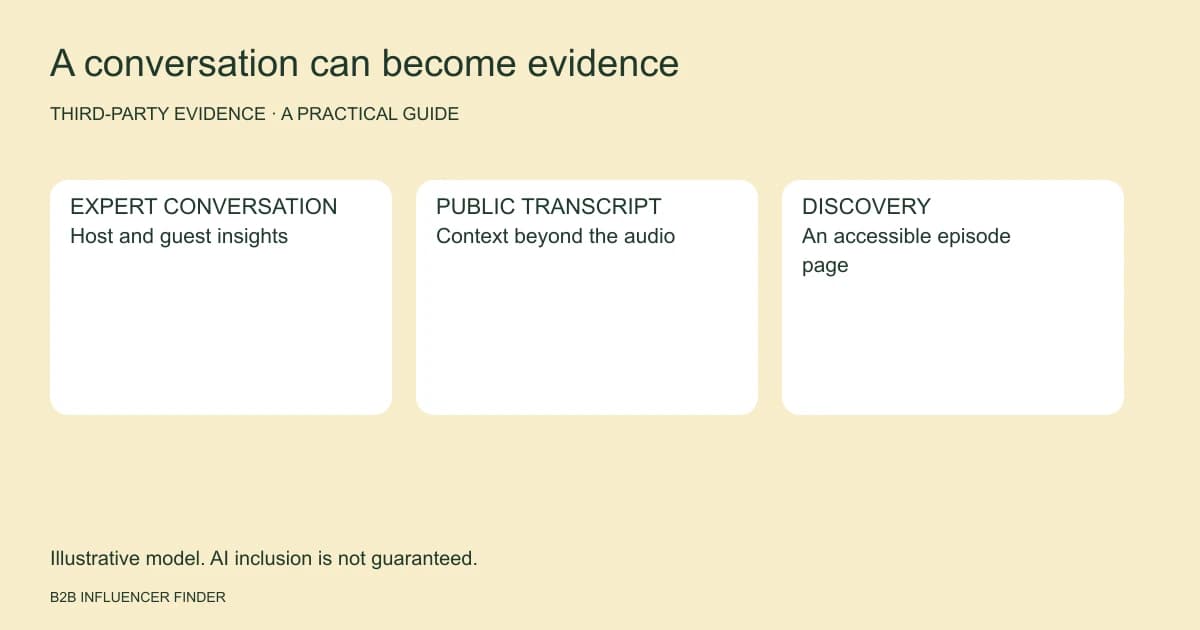
Yes, podcasts can help with AI search visibility. But the useful part is not the audio file by itself. It is the public evidence a podcast appearance creates around your brand: episode pages, show notes, transcripts, summaries, YouTube versions and other crawlable pages.
That distinction matters. A brilliant 45-minute conversation locked inside an audio player gives an AI retrieval system much less obvious text to work with than the same conversation published with a detailed transcript and clear context.
So i would not think of podcasts as an AI ranking trick. I would think of them as a way to create credible, long-form third-party evidence around the topics you want your company associated with.
Why podcasts fit Creator AEO so well
Podcasts are unusually good at context. A guest can explain a problem, give examples, challenge assumptions and describe where a product or company fits. That is much richer than a one-line brand mention.
For B2B brands this is particularly useful because expertise is often the thing being sold. A specialist podcast lets a founder, customer or subject expert demonstrate that expertise in somebody else's environment.
That is third-party evidence. The host owns the audience and the conversation. Your company contributes useful knowledge rather than publishing another claim on its own website.Further reading: How Do I Find Podcasts and Podcast Hosts in My Industry?
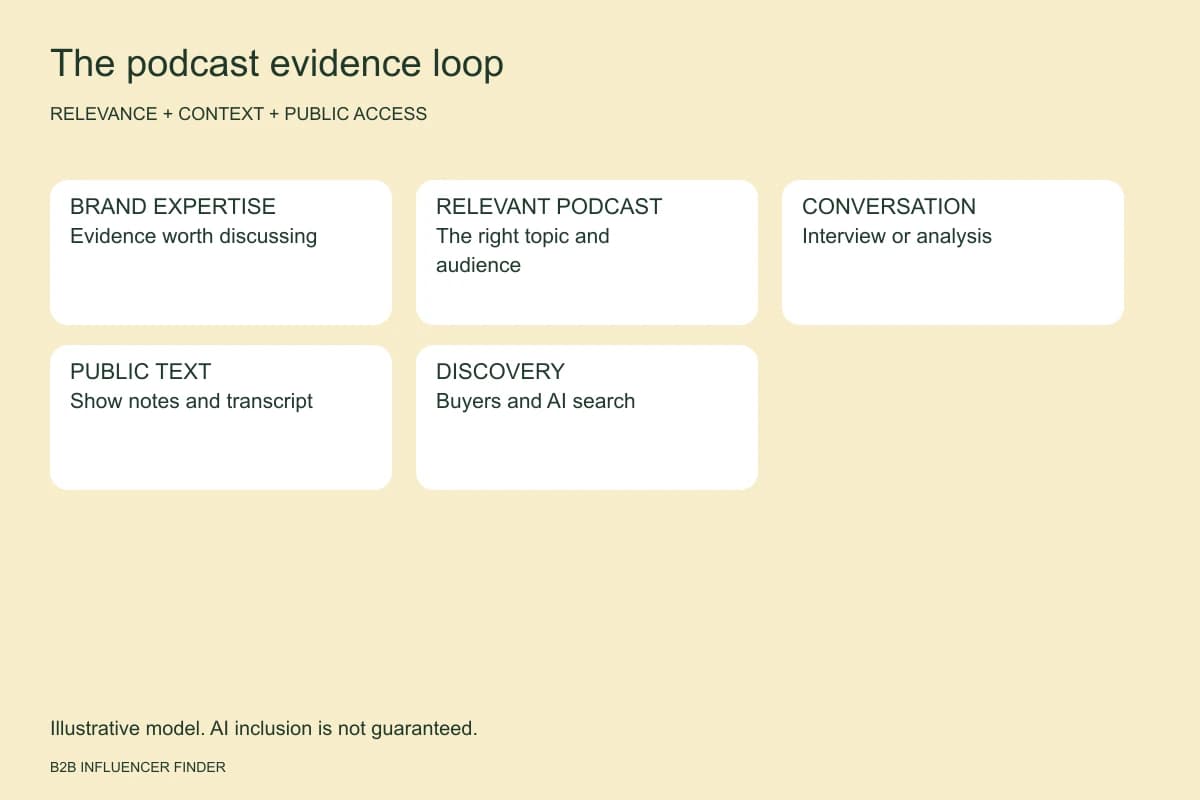
The transcript is where a podcast becomes much easier to discover
The practical issue is accessibility. AI-search systems retrieve information from public web surfaces, and text is an obvious retrieval surface. Podcast transcripts, detailed show notes and episode summaries turn a spoken conversation into searchable text.
This is why i would strongly prefer a podcast that publishes proper episode pages and transcripts over one that only uploads an MP3 to a closed player. The second show may have a larger audience, but the first creates a more durable web asset.
Do not take that to mean audio is invisible to every AI system. Platforms can process media in different ways and those capabilities keep changing. The defensible marketing point is simpler: a public transcript gives the web a clear textual record of the conversation.
Podcasts can create more than one evidence surface
One appearance can become an episode page, transcript, Apple or Spotify listing, YouTube upload, newsletter recap, social clips and sometimes a written article. The same expert conversation can therefore exist across several public surfaces.Further reading: Does YouTube Help Your Brand Get Mentioned in AI Search?
That does not mean duplicating the same promotional paragraph everywhere. The value is that a real conversation produces multiple pieces of contextual evidence that all connect the guest, company and subject.
The host and topic matter more than raw download numbers
For Creator AEO, i would rather appear on a small podcast that is deeply relevant to your category than a broad business show where your company is mentioned for thirty seconds.Further reading: How Can B2B Creators Improve AI Visibility?
If you sell fraud detection software, a payments-risk podcast with a specialist audience can connect your brand to fraud operations, chargebacks and risk teams in a very precise way. That topical fit is useful to buyers and creates clearer public evidence about what your company actually does.
Reach still matters for normal marketing outcomes. It is simply not the only thing worth measuring when the goal also includes AI visibility.
Give the podcast something worth discussing
The weakest pitch is: can our CEO come on your podcast to talk about our company? The stronger pitch starts with information the audience would genuinely care about.
Original research, benchmark data, a surprising customer pattern, a useful case study, access to an expert, a strong point of view or lessons from operating in a difficult niche all give a host a reason to have the conversation.
This is the same logic behind B2B Influencer Finder. Start with what the company knows or has already produced, then find creators whose existing work overlaps with it. The collaboration becomes a topic match rather than a follower-count exercise.
A podcast mention is not automatically an AI citation
This is where marketers need to be careful. We do not have a universal rule saying a podcast appearance will make ChatGPT mention your brand. AI systems use different retrieval methods, indexes and source mixes, and those change over time.Sources: Ahrefs - AI Visibility IndexFurther reading: How Do I Get My Brand Cited by ChatGPT?
Even being cited is different from being recommended. Ahrefs separates AI visibility into metrics such as mentions, citations and share of voice for exactly this reason. A source can be present in the evidence without your brand becoming the final recommendation.Sources: Ahrefs - AI Visibility Metrics
Treat podcast activity as evidence creation, then measure whether that evidence appears to coincide with changes in visibility over time. Do not manufacture a causal claim you cannot prove.
How i would use podcasts for AI visibility
First choose the topics you want your company associated with. Build a stable set of buyer questions and AI prompts around those topics.
Next identify the evidence you can contribute: data, research, customer stories, product expertise or a genuinely useful opinion. Then find podcast hosts who already cover those subjects.
Pitch a conversation their audience would want even if your company name disappeared from the email. During the interview, be specific. Explain the category, use examples and give the host something quotable rather than repeating marketing copy.
After publication, check whether the episode has a public page, useful show notes and ideally a transcript. If the host publishes on YouTube too, that creates another discovery surface.
Then track normal campaign outcomes separately from AI outcomes. Normal metrics include listens, referral traffic, leads and engagement. AI metrics can include brand mentions, citations, topic association and share of voice across a fixed prompt set.
Should you publish the transcript yourself?
If the podcast host permits it, repurposing your appearance into an owned article or interview recap can be useful. But do not confuse that with the independent evidence created by the original show.
The host's page is third-party evidence. Your recap is first-party content. Both can be valuable and they do different jobs.
The answer
Yes, podcasts can help with AI search visibility because they create detailed third-party conversations around your brand and expertise. Their value becomes much easier to discover when those conversations also exist as public transcripts, show notes, episode pages or video versions.
There is no guarantee that appearing on a podcast will make an AI system mention or recommend you. That is the wrong promise.
The better strategy is to appear on relevant shows, discuss subjects your buyers care about, create a durable textual footprint around those conversations and measure what happens over time.
For B2B brands, podcasts are not just an awareness channel anymore. They can also become part of the third-party evidence layer around what your company knows and where it belongs.
Sources
Ahrefs - AI Visibility MetricsSources: Ahrefs - AI Visibility Metrics