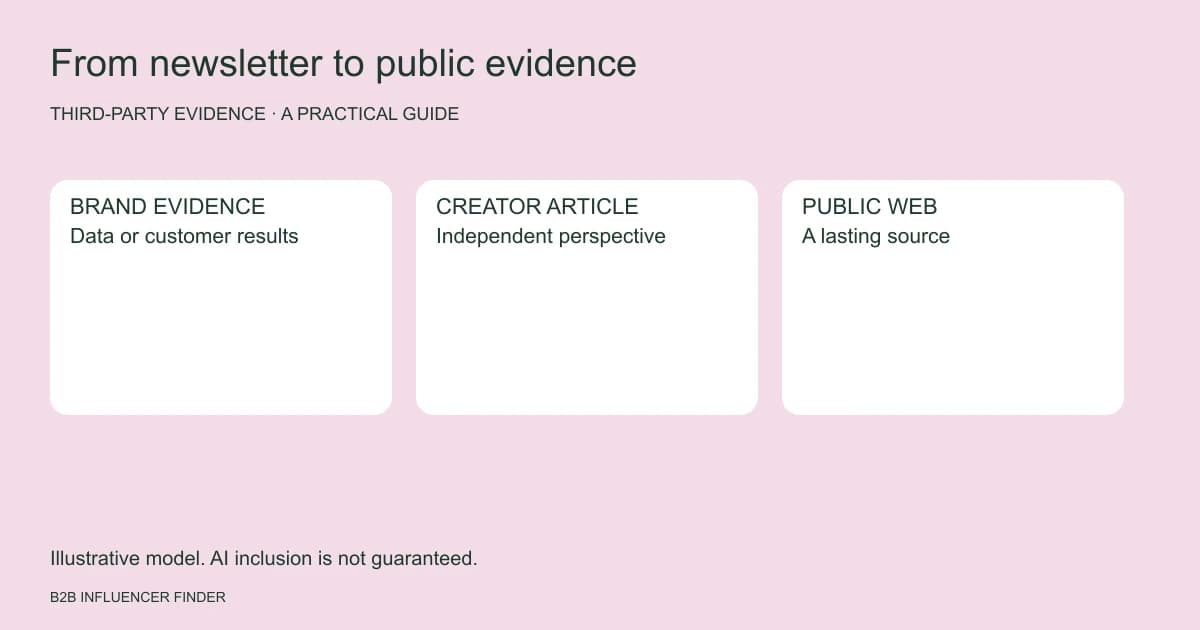
Yes, Substack articles can help with AI visibility. A public newsletter post is a web page written by somebody outside your company, and that can create useful third-party evidence around your brand, category and expertise.
But there is an important caveat. Publishing one sponsored Substack post does not make ChatGPT recommend you. There is no reliable formula where a newsletter mention produces an AI ranking.
The useful way to think about Substack is as a publishing surface. If a relevant writer publishes a specific, useful article that mentions your company in the right context, the web now has another independent source explaining where your brand fits.Further reading: How Do I Find B2B Newsletter and Substack Creators?
Why Substack is interesting for Creator AEO
Substack sits in a useful middle ground between social content and a traditional publication. The writer has their own audience and editorial voice, but the post can also exist as a public article on the web.
For B2B marketing that combination is attractive. You get distribution to subscribers now and, when the article is public and crawlable, a longer-lived piece of third-party content that can potentially be discovered later.
That is different from paying for a fleeting social mention. A good newsletter article can explain the problem, compare approaches, include examples and put your company inside a meaningful topic.
Public accessibility matters
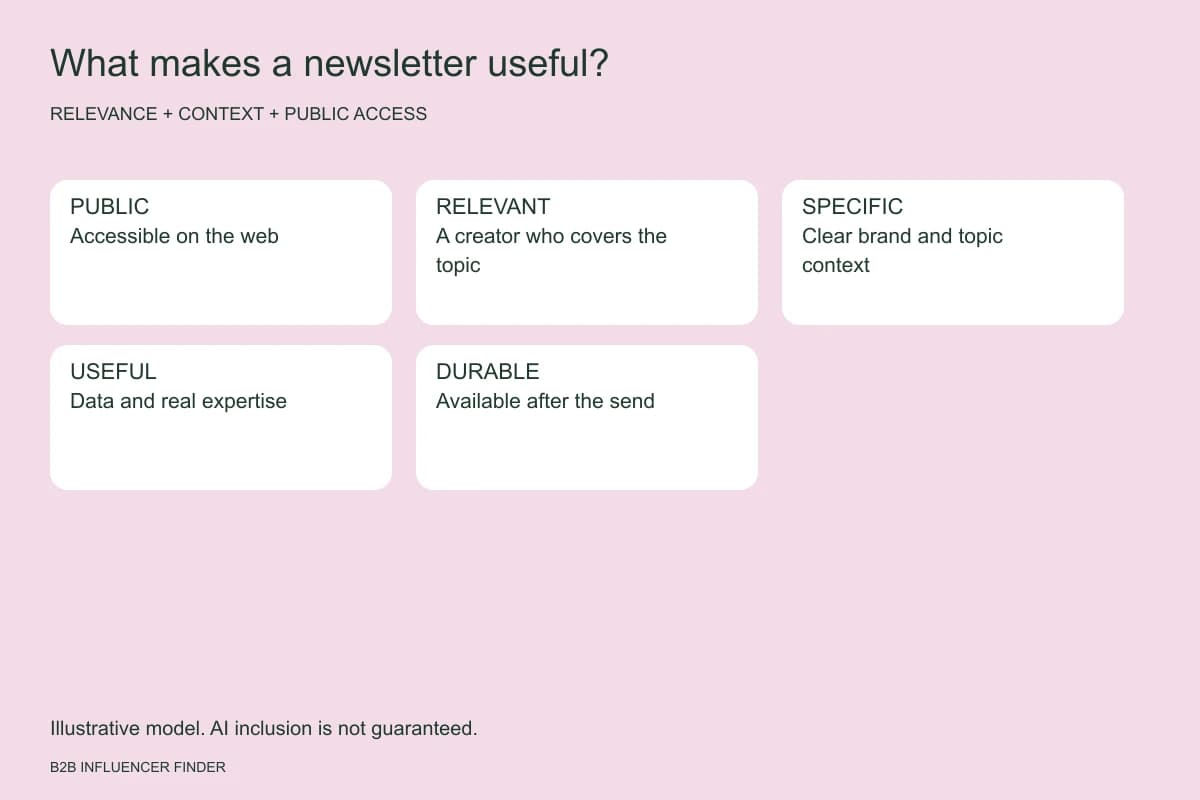
For AI search, the first practical question is whether the article is actually accessible on the public web. OpenAI says public websites can appear in ChatGPT search, and publishers can allow OAI-SearchBot so content is eligible to be discovered and surfaced. Placement is not guaranteed.Sources: OpenAI - Publishers and Developers FAQ · OpenAI - Overview of OpenAI Crawlers
Substack also gives publishers controls related to AI training. That is a separate issue from search discovery. OpenAI similarly separates its search crawler from its training crawler, so marketers should not collapse training, retrieval and citation into one idea.Sources: Ahrefs - AI Visibility Metrics · Substack - How can I detect AI on Substack?
In other words, the question is not simply 'is this on Substack?' The useful questions are: is the post public, can search systems access it, is the topic relevant, and does the article contain enough context to be useful?
A newsletter mention is stronger when it explains the relationship
Imagine a creator writes: 'Acme is great.' That is a brand mention, but it tells a reader almost nothing.Further reading: Does Getting Mentioned on Other Websites Help With AI Visibility?
Now imagine the same writer publishes an article about referral growth for European fintechs, explains where referral programs work, cites a benchmark from Acme and describes Acme as software used to run those programs. That creates a much clearer relationship between the brand and the topic.
This is the kind of evidence Creator AEO should aim for. Not more mentions for the sake of a mention count. Better context around the subjects you want the market to associate with you.
What the broader AI visibility research suggests
Ahrefs studied 75,000 brands and found branded web mentions correlated strongly with visibility across ChatGPT, AI Mode and AI Overviews, roughly 0.66 to 0.71 in its dataset. YouTube mentions were even more strongly correlated.Sources: Ahrefs - Top Brand Visibility Factors in ChatGPT, AI Mode, and AI Overviews
That research does not prove that creating more web mentions causes AI visibility. Ahrefs explicitly warns against treating correlation as causation. It does, however, support the broader idea that brands visible in AI answers also tend to be discussed around the web.
A public Substack article is one possible part of that wider web presence. It is not a special Substack ranking signal.
The writer matters more than the platform
I would not choose a newsletter collaboration just because it runs on Substack. The creator and subject fit matter more.
A cybersecurity founder mentioned by a respected cloud-security newsletter is very different from the same founder appearing in a generic entrepreneurship newsletter. The first creates much clearer topical evidence.
Audience size matters for reach, but relevance matters for the evidence you are trying to create. A specialist writer with 8,000 highly relevant subscribers may be far more useful than a broad business newsletter with 100,000 readers.
Give newsletter creators evidence, not a press release
The easiest way to produce a bad creator article is to send a brand brief full of adjectives and ask the writer to repeat it.
Give them something they can actually work with: original data, a customer result, an expert interview, a useful product test, a benchmark, a strong opinion or a real example from the market. Then let the creator add their own perspective.
This is also how B2B Influencer Finder approaches matching. It starts with useful assets and expertise already inside a company, then looks for creators whose existing content overlaps with those subjects. The result should be a plausible article idea, not a random list of newsletter writers.
Paid Substack articles can still be useful
Paying a creator does not automatically make the article useless. Sponsorship is a normal part of creator media. What matters is that paid relationships are disclosed properly and the article still has independent value for the audience.Further reading: Does Sponsored Creator Content Help With AI Visibility?
A thin advertorial that exists only to repeat product claims is weak evidence. A disclosed collaboration built around real research, expertise or a useful analysis can still create a substantive third-party page.
Do subscribers matter for AI visibility?
Subscriber count is mainly an audience metric. There is no established rule that a 100,000-subscriber Substack carries ten times the AI value of a 10,000-subscriber one.
For campaign economics, subscriber quality and engagement obviously matter. For an AI-evidence strategy, i would also look at topical relevance, the quality of the public article, how clearly your brand is connected to the subject and whether the page remains accessible over time.
How i would use Substack in a Creator AEO campaign
Start with one topic you want your company associated with. Audit the evidence you can contribute to that topic. Then find newsletter writers who already publish about it.Further reading: What Types of Creator Content Can Appear in AI Search?
Instead of pitching 'write about our company', pitch the useful overlap. Perhaps you have original benchmark data the writer can analyse. Maybe you have a customer case that challenges a common assumption. Maybe your founder has direct operating experience the writer has been trying to understand.
If a collaboration goes live, record the URL, topic, brand description, whether it links to you, whether it is publicly accessible and how the audience responds. Then track AI visibility separately across a stable set of prompts.
Over time you can ask a much more useful question than 'did this Substack post rank us in ChatGPT?' You can ask whether your growing body of independent coverage coincides with stronger brand mentions, citations and topic association across the AI systems you monitor.
The answer
Yes, Substack articles can help with AI visibility when they create relevant, public third-party evidence around your brand. They are particularly interesting because a newsletter creator can combine a trusted niche audience with a durable web article.
But Substack itself is not the strategy. The strategy is getting credible people who already understand your market to publish useful content that connects your brand to the subjects you want to be known for.
That is a much stronger objective than trying to manufacture mentions for an algorithm. It is useful to buyers first, and it gives AI-search systems more independent context to encounter too.
Sources
OpenAI - Publishers and Developers FAQSources: OpenAI - Publishers and Developers FAQ
OpenAI - Overview of OpenAI CrawlersSources: OpenAI - Overview of OpenAI Crawlers
Substack - How can I detect AI on Substack?Sources: Substack - How can I detect AI on Substack?
Ahrefs - Top Brand Visibility Factors in ChatGPT, AI Mode, and AI OverviewsSources: Ahrefs - Top Brand Visibility Factors in ChatGPT, AI Mode, and AI Overviews
Ahrefs - AI Visibility MetricsSources: Ahrefs - AI Visibility Metrics