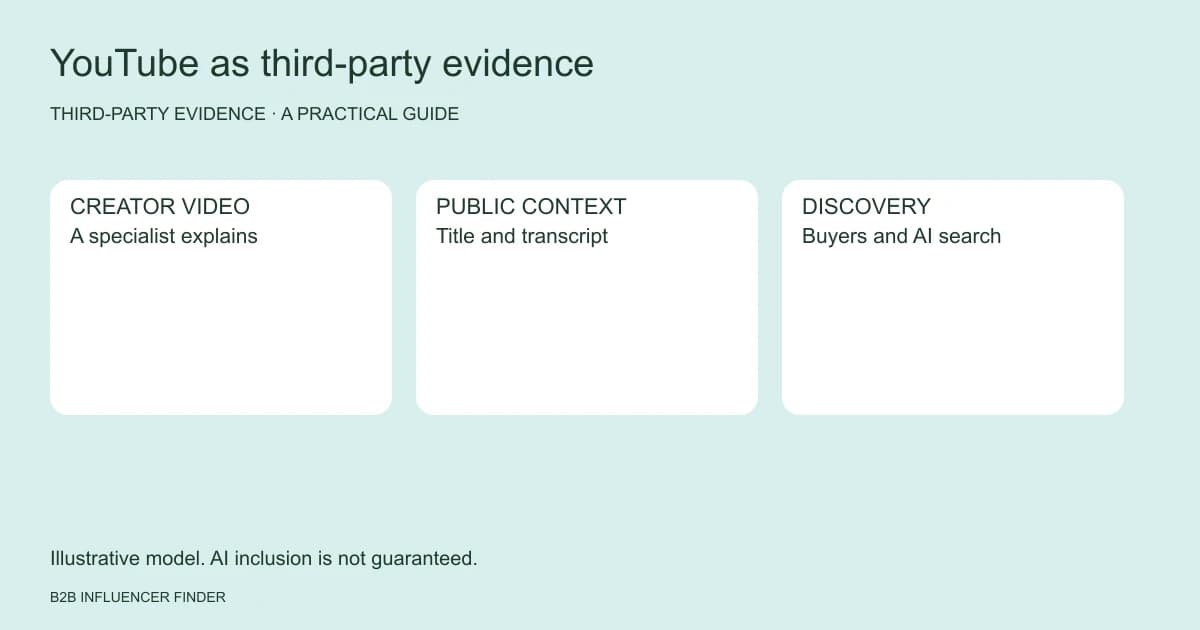
Yes. If i were choosing one creator channel to take seriously for AI visibility right now, YouTube would be very high on the list.Further reading: How Do I Find B2B Creators on YouTube?
Not because uploading a video gives you a secret route into ChatGPT. We do not have evidence of that. The reason is much more practical: YouTube videos are public, searchable, rich in context through titles, descriptions and transcripts, and current AI-search studies keep finding YouTube in the citation mix.
The data is unusually strong compared with most of the claims being made around AEO. But it still needs to be interpreted carefully.
YouTube keeps appearing in AI-search research
Ahrefs analysed 75,000 brands and found YouTube mentions had the strongest correlation with AI visibility of every factor it tested, at roughly 0.737 across ChatGPT, Google AI Mode and AI Overviews. Branded web mentions also correlated strongly, around 0.66 to 0.71.Sources: Ahrefs - Top Brand Visibility Factors in ChatGPT, AI Mode, and AI Overviews (75k Brands Studied)
That is a correlation. It does not prove that getting one YouTube creator to mention your company will cause ChatGPT to recommend you next week. Bigger and better-known brands naturally get discussed more in many places, so there are plenty of confounding factors.
Still, it is difficult to ignore the pattern when YouTube also shows up strongly in citation data.
YouTube is not just correlated with AI visibility. It is being cited
In Ahrefs' August 2026 AI Visibility Index, youtube.com was the most-cited source domain across its tracked AI responses in the US, with 26.55 million citations in that index. The dataset spans hundreds of millions of modeled prompts across AI platforms, so this is a visibility index rather than a census of every AI answer on the internet.Sources: Ahrefs - AI Visibility Index
Google AI Overviews show a similar pattern. An Ahrefs analysis of four million AI Overview URLs found YouTube represented 5.6% of all cited URLs in the dataset. More interestingly, among citations that did not rank in Google's top 100 organic results for the same query, 18.2% were YouTube URLs.
That suggests video can sometimes enter the AI answer layer even when the same URL is not winning the traditional blue-link ranking battle for that query.
Branded searches make the YouTube effect even more obvious
In October 2026 Ahrefs looked at Google AI Overviews for branded searches. In its separate panel of 100 major brands, YouTube appeared in 22 of the external-source lists it could analyse, making it one of the most common external citation domains alongside Wikipedia and LinkedIn.Sources: Ahrefs - AI Overviews Currently Appear for 83% of Branded Searches
This matters because somebody searching your brand name is no longer guaranteed to see only information you control. Google can synthesize an answer and use third-party videos as supporting material.
That can be useful when creators describe you accurately. It can be uncomfortable when an old review, comparison or tutorial contains outdated information.
Why YouTube is particularly useful for B2B Creator AEO
Video gives a creator room to explain context. A 12-minute tutorial can show what a product does, who it is for, where it works well and where it does not. A comparison can place a brand next to the alternatives buyers already know. An interview can connect a company with a specific area of expertise.
The transcript turns that spoken explanation into machine-readable text. Titles and descriptions add another layer of context. That does not mean every AI engine processes every video in the same way, but it gives retrieval systems far more material than a logo placement or a one-line sponsorship mention.
For B2B companies, this is why i care much more about a relevant creator explaining the product or idea properly than a huge creator saying the brand name once.
The transcript may be more valuable than marketers realise
Ahrefs' YouTube visibility tooling tracks brand mentions across video titles, descriptions and transcripts. That is a useful way to think about the asset you are creating.Further reading: Do Podcasts Help With AI Search Visibility?
A creator might never put your company in the title. But if they spend four minutes explaining your research, product, case study or point of view inside the video, the transcript contains a substantial block of contextual evidence connecting your brand with that subject.
This is not a reason to stuff brand names into scripts. It is the opposite. Give the creator enough useful material that talking about your company naturally requires explaining what you know or what your product does.
Searchable videos are probably more useful than random viral videos
For Creator AEO, i would rather have a video that answers a durable buyer question than a video engineered only for a short spike in entertainment views.
Think tutorials, comparisons, implementation walkthroughs, expert interviews, case-study breakdowns, benchmark discussions and 'best tools for X' content where your company genuinely belongs.
Those formats have a reason to remain useful after launch week. They also map naturally to the kinds of specific questions people ask search engines and AI assistants.
A viral mention can obviously create awareness. But if the objective includes AI visibility, durable topical context is the part i would optimise for.
A creator does not need to make a video about your brand
This is one of the mistakes i think brands will make as Creator AEO gets more attention. They will ask creators for a dedicated product review when the creator's audience would rather learn something broader.
A cybersecurity company might have data about the most common phishing patterns. A payments company might have a case study showing why checkout conversion changed. A referral platform might have benchmarks on what makes customer referral programs work.
The stronger collaboration may be a creator making a useful video about the wider problem and using the company's evidence as part of the explanation.
That creates something better for the creator's audience and a more natural association between the brand and the topic.
This is where creator matching matters
Follower count is a weak starting point. The more useful question is: who already makes videos about the exact subject where this company has something credible to add?Further reading: How Do You Build a Creator AEO Strategy?
That is the logic behind B2B Influencer Finder. The product first looks at the useful content and expertise a company already has, then matches it with creators whose existing work overlaps with those subjects.
If you have a strong case study about reducing SaaS churn, the match should not be 'large B2B YouTuber'. It should be somebody who already publishes about retention, customer success, SaaS growth or adjacent problems, plus a specific angle they could build from your evidence.
What makes a YouTube mention useful for AI visibility?
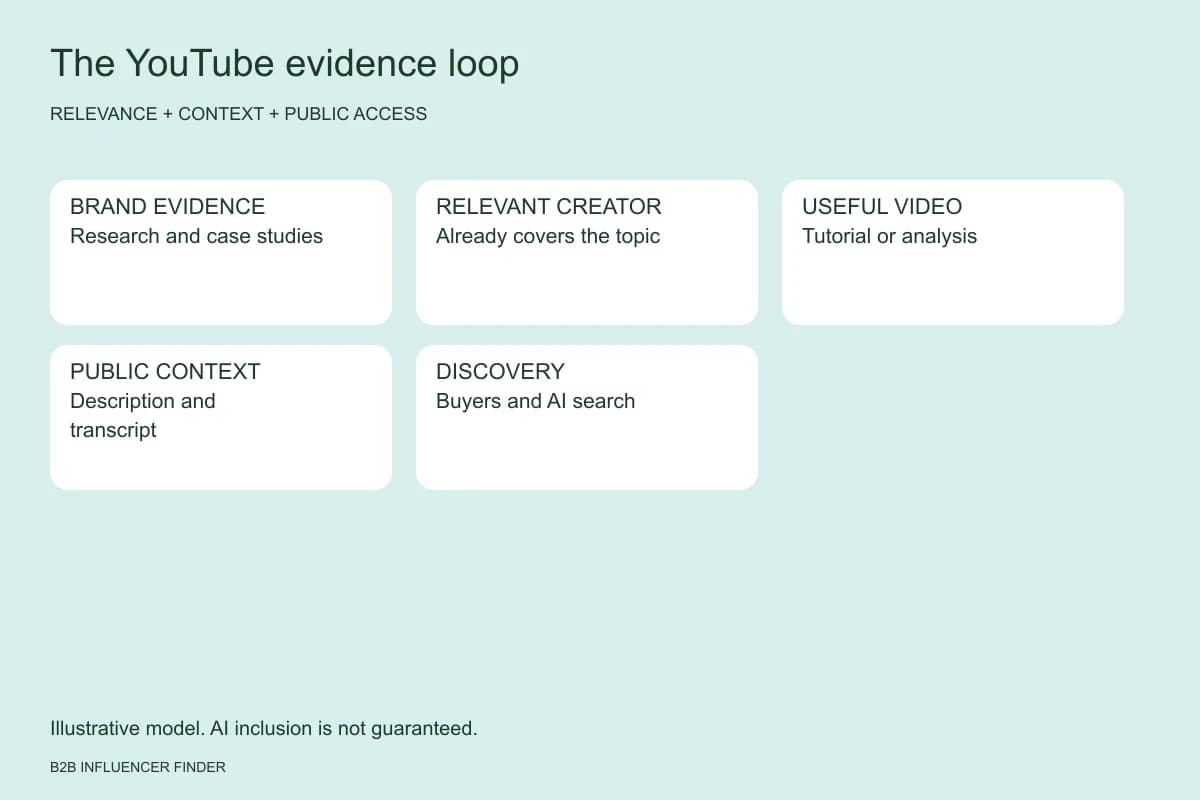
I would look for five things: topical relevance, enough context around the brand, an independently useful video, a creator with genuine subject credibility, and a video that stays publicly discoverable.
The brand mention itself is not the strategy. The strategy is creating a piece of third-party evidence where somebody credible explains the brand in the context you want the market to understand.
That also means editorial freedom matters. If every creator reads the same marketing script, you are manufacturing duplicate advertising rather than building independent evidence.
YouTube does not replace your own website
Strong creator coverage cannot rescue a company whose own website is vague, inaccessible or contradictory. Your product pages, documentation, research and case studies still need to explain the business clearly.Further reading: What Types of Creator Content Can Appear in AI Search?
The better model is two layers. Your website provides first-party evidence. YouTube creators, newsletters, podcasts, LinkedIn experts, publications and customers add third-party evidence around it.
AI search can encounter both.
Do not confuse citation data with a guaranteed ranking factor
This is the most important caveat in the article.
YouTube's citation volume and its strong correlation with brand visibility are observations. They are not proof of a simple ranking formula. We do not know the exact weighting used by ChatGPT, Google AI Mode, Gemini, Perplexity or other systems, and those systems change constantly.
We also should not assume that because Google owns YouTube, YouTube receives a secret AI Overview boost. The observable evidence is enough: YouTube is frequently cited. There is no need to invent the mechanism.
How i would run a YouTube Creator AEO campaign
Start with a topic, not a creator list. Pick the category questions you want your brand to be associated with. Then audit what useful evidence you already have: research, customer results, product expertise, benchmarks, internal data or a genuinely interesting point of view.
Find YouTube creators already publishing around those questions. Review their recent videos, not just their subscriber count. Match each creator with one specific asset or idea that fits what they already cover.
Pitch the video angle, not a demand for a brand mention. If the collaboration is paid, disclose it. Give the creator accurate information and enough access to form their own view.
Then measure two things separately. Measure the creator campaign normally: views, engagement, referral traffic, leads and conversions where available. Separately track AI visibility across a stable prompt set: brand mentions, citations, topic association and share of voice over time.
Do not claim the creator video caused an AI-visibility change unless you have a study designed well enough to support that conclusion.
The answer
Yes, YouTube can help your brand get mentioned in AI search. Current research shows YouTube is frequently cited by AI-search systems, and brand mentions on YouTube have one of the strongest observed relationships with AI visibility in large-scale brand studies.
That makes YouTube a serious channel for Creator AEO, especially when a specialist creator produces useful, durable content that connects your company with a subject buyers actually care about.
But the goal should not be to collect random YouTube mentions and hope ChatGPT notices.
The goal is to create better third-party evidence about what your company knows, what it does and where it belongs. YouTube happens to be one of the strongest places we can currently see that evidence surfacing in AI search.
Sources
Ahrefs - Top Brand Visibility Factors in ChatGPT, AI Mode, and AI Overviews (75k Brands Studied)Sources: Ahrefs - Top Brand Visibility Factors in ChatGPT, AI Mode, and AI Overviews (75k Brands Studied)
Ahrefs - AI Visibility IndexSources: Ahrefs - AI Visibility Index
Ahrefs - Update: 38% of AI Overview Citations Pull From the Top 10Sources: Ahrefs - Update: 38% of AI Overview Citations Pull From the Top 10
Ahrefs - AI Overviews Currently Appear for 83% of Branded SearchesSources: Ahrefs - AI Overviews Currently Appear for 83% of Branded Searches
Ahrefs Academy - YouTube VisibilitySources: Ahrefs Academy - YouTube Visibility
Google - New ways to find your favorite sources and original content in AI SearchSources: Google - New ways to find your favorite sources and original content in AI Search