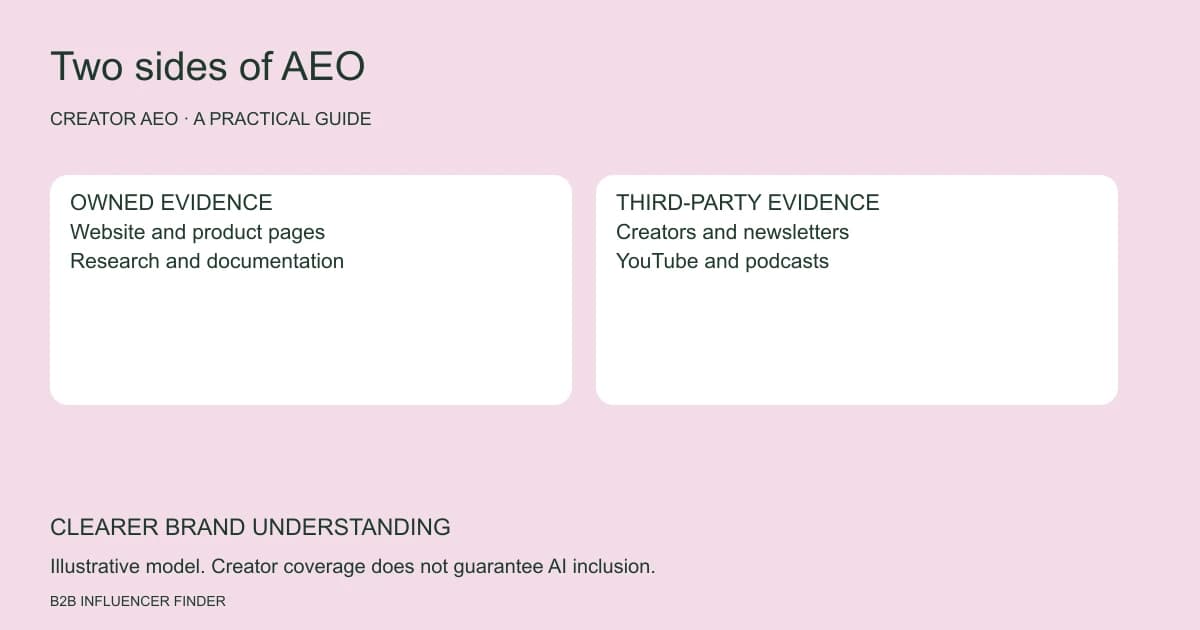
Traditional AEO and Creator AEO are trying to solve different parts of the same problem. Traditional AEO improves the information your company publishes and controls. Creator AEO builds relevant evidence about your company in places you do not control, through creators, experts and other independent voices.Further reading: What Is Creator AEO?
I would not choose one over the other. If your own website is vague, creator coverage cannot fix your positioning for you. But if the only useful information about your company lives on your own website, you are also leaving a pretty big gap.
What do I mean by traditional AEO?
AEO, or answer engine optimization, is the broad practice of making your information easier for AI-powered search and answer systems to find, understand and use. In practice that often looks familiar: clear pages, direct answers, strong topical coverage, useful original information, crawlability, sensible structure and content that actually answers the questions buyers ask.
There is overlap with SEO because AI search systems still use the web, search indexes and existing ranking systems in different ways. The terminology is new. A lot of the underlying work is not.
Traditional AEO usually starts with assets you control: your website, product pages, documentation, research, case studies and other owned content.
So what is Creator AEO?
Creator AEO extends the job beyond your own domain. It asks a different question: who else is talking about this subject, and what useful reason could they have to include your company in that conversation?
That might mean an industry expert discusses your research in a newsletter. A YouTuber includes your product in a category comparison. A practitioner analyses one of your case studies. A podcast host talks to your founder about a problem your company knows unusually well.
The point is not to spray your brand name across the internet. It is to create credible, topic-relevant third-party evidence around what your company does and what it knows.
The simplest difference
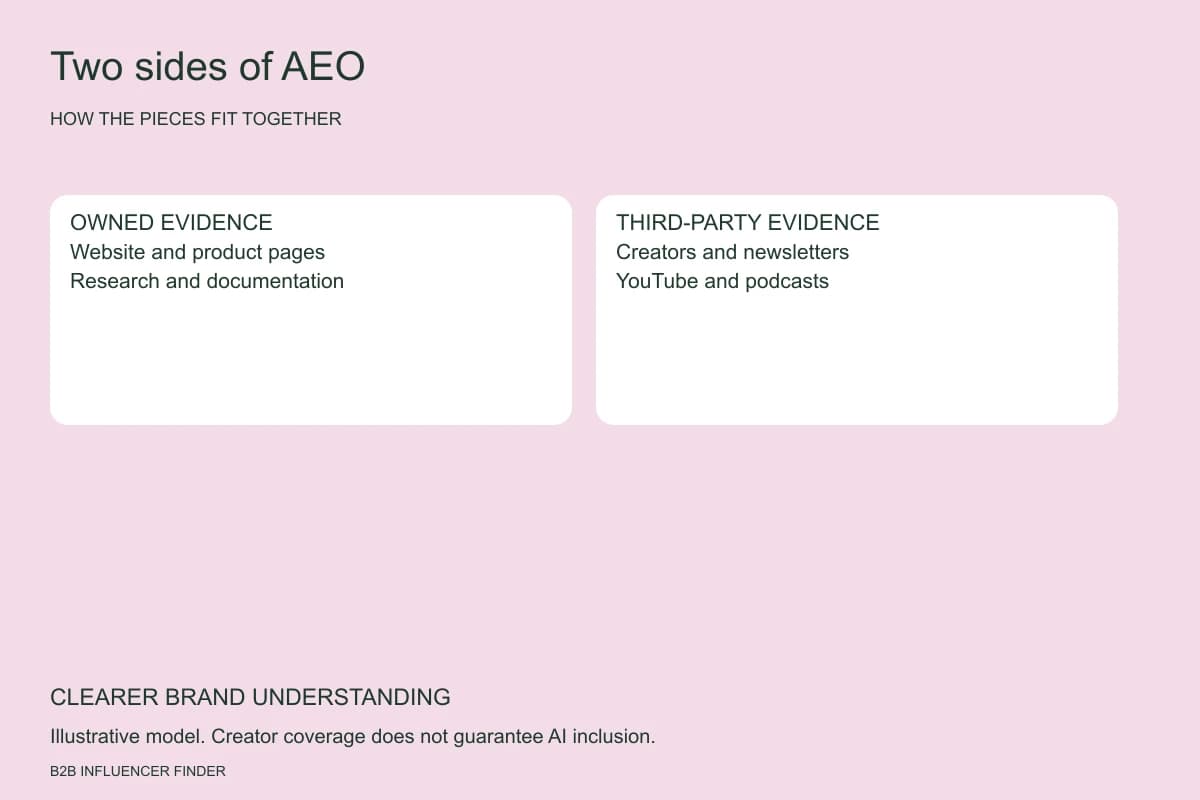
I think of it as two evidence layers.
Traditional AEO strengthens what you say about yourself. Creator AEO strengthens what relevant people outside your company say about you.
Both can help buyers understand the brand. Both can create information AI systems may encounter. But they happen in different places and require different skills.
· Traditional AEO · Creator AEO
- : Primary surface; Traditional AEO: Your website and owned content; Creator AEO: Independent creator and expert channels
- : Main job; Traditional AEO: Make your information clear, useful and retrievable; Creator AEO: Build relevant third-party evidence around the brand
- : Typical assets; Traditional AEO: Product pages, guides, research, docs, case studies; Creator AEO: Articles, videos, newsletters, podcasts, expert commentary
- : Control; Traditional AEO: High; Creator AEO: Lower, because another person is publishing
- : Core skill; Traditional AEO: Content, technical SEO/AEO, information architecture; Creator AEO: Creator discovery, matching, outreach and collaboration
- : Best outcome; Traditional AEO: AI can understand and use your own information; Creator AEO: Your brand appears in credible conversations beyond your own site
Why third-party evidence matters more in AI search than many marketers expected
For years, marketers were trained to think about off-site authority mainly through backlinks. AI search has made plain-text brand mentions, context and third-party discussion much harder to ignore.
Ahrefs analysed 75,000 brands and found branded web mentions correlated strongly with visibility across ChatGPT, Google AI Mode and AI Overviews, at roughly 0.66 to 0.71. YouTube mentions showed an even stronger correlation of about 0.737. In the same research, classic link and site-volume metrics were much weaker.
That does not prove that buying creator mentions causes an AI system to recommend you. Correlation is not causation, and established brands naturally attract more discussion everywhere. But it does show something useful: brands visible in AI answers also tend to exist as entities across the wider web, not only on their own websites.
That is the gap Creator AEO is designed to work on.
Traditional AEO is still the foundation
It would be a mistake to interpret this as “stop working on your website and pay creators instead.”
Your own site is where you can be most precise about what the product is, who it is for, how it works and what evidence supports your claims. It is also where you can publish the original research, customer data and expertise that gives other people something worth referencing.
If a creator lands on your website and cannot work out what makes you different, that is an AEO problem and a positioning problem before it is a creator problem.
Creator AEO works better when there is something solid underneath it.
Creator AEO solves a distribution and evidence problem
The problem I keep seeing with B2B companies is not always a lack of content. Many have hundreds of pages. The problem is that almost all of the evidence lives on domains they own.
Ahrefs found almost no relationship between the number of pages on a brand’s site and its AI visibility in its 75,000-brand study. More content by itself was not the answer.
This is where Creator AEO starts to look less like a content strategy and more like a distribution strategy. You take the genuinely useful things your company already knows and find credible people who already talk to the audience that cares about those things.
The creator adds their own perspective. The result lives somewhere other than your company blog. Now the idea has travelled.
A practical example
Imagine you sell fraud detection software to fintech companies.
Traditional AEO might mean publishing a clear page explaining transaction fraud detection, a benchmark report on fraud patterns, a case study with a neobank and an article answering how fraud detection systems are evaluated.
Creator AEO might mean finding a fintech newsletter writer who already covers fraud, a YouTube creator who reviews fintech infrastructure, and a payments podcast host. Instead of sending all three the same generic pitch, you match each person with the piece of evidence most relevant to their existing work.
The newsletter writer might analyse one benchmark. The YouTuber might compare approaches. The podcast might use the case study as the starting point for a wider discussion.
That creates three genuinely different pieces of third-party evidence around the same topic association.
Where B2B Influencer Finder fits
This matching problem is the reason I built B2B Influencer Finder.Further reading: B2B Influencer Finder
Most influencer databases start with a person and their audience size. For Creator AEO, I think the more useful starting point is the overlap between what your company actually knows and what a creator already talks about.
The tool scans the useful content and evidence on a company’s site, finds B2B creators across channels, then matches the two. The aim is not “find me someone with 100,000 followers.” It is “find me someone credible who has a real reason to talk about this specific thing.”
That distinction matters because relevance is the whole strategy.
Creator AEO does not mean paying people to repeat your marketing copy
If every creator publishes the same paragraph from your brief, you have created advertising with extra steps.
Useful third-party evidence should contain an independent perspective. Sponsored content can still be useful and should be disclosed properly, but the creator needs enough freedom to explain, compare, question or contextualise the information for their audience.
The goal is not to manufacture fake consensus. It is to get your expertise into real industry conversations where it belongs.
How I would combine the two
I would run traditional AEO and Creator AEO as one loop rather than two separate marketing projects.
Start by deciding which topics you actually want the company associated with. Build strong owned evidence around those topics. Identify the assets that contain something genuinely interesting. Then distribute those ideas through relevant creators and experts. Watch which questions, comparisons and objections come back from those conversations, and use them to improve the owned content again.
Website evidence feeds creator coverage. Creator coverage exposes gaps in the website. Both create a clearer public picture of the company.
How should you measure them?
Traditional AEO can be measured through prompt visibility, citations to your own pages, organic visibility, branded search, referral traffic and whether AI systems describe the company accurately.Further reading: What Is AI Share of Voice and How Do You Improve It?
Creator AEO needs an extra layer. Track which creators mention the brand, what topics those mentions are connected to, where the content is published, whether it gets cited or surfaced in AI answers, and how your share of voice changes across the prompt set you care about.
I would avoid pretending every improvement can be attributed to one creator post. AI systems are opaque and many things change at once. The useful question is whether your brand is becoming more consistently present in the right external conversations and the right AI answers over time.
Which one should you start with?
If your website cannot clearly explain what your company does, start with traditional AEO.
If your site is already strong but nobody outside your company talks about you, Creator AEO is probably the bigger gap.
For most established B2B companies, the answer is both. Your owned content gives the market something worth understanding. Third-party voices give the market evidence that the conversation exists beyond your marketing team.
The bigger shift
The interesting part of AEO is that brand visibility is becoming less contained inside the company website.
You still need excellent owned content. But the web’s understanding of a company has always been bigger than the company’s own description of itself. AI search makes that much more obvious.
So traditional AEO asks: can an answer engine understand what we publish?
Creator AEO asks: is there enough credible evidence elsewhere for the wider web to understand us too?
That is why I do not see Creator AEO as a replacement for AEO. It is the off-site layer that many AEO strategies are currently missing.
Sources
Ahrefs — Top Brand Visibility Factors in ChatGPT, AI Mode, and AI Overviews (75k Brands Studied)Sources: Ahrefs — Top Brand Visibility Factors in ChatGPT, AI Mode, and AI Overviews (75k Brands Studied)
Ahrefs — An Analysis of AI Overview Brand Visibility Factors (75K Brands Studied)Sources: Ahrefs — An Analysis of AI Overview Brand Visibility Factors (75K Brands Studied)
Ahrefs — Brand Mentions for SEO: How to Get Cited by AISources: Ahrefs — Brand Mentions for SEO: How to Get Cited by AI
Ahrefs — What Is AI Visibility? The 3 Types Every Marketer Needs to KnowSources: Ahrefs — What Is AI Visibility? The 3 Types Every Marketer Needs to Know
Ahrefs — How to Track AI VisibilitySources: Ahrefs — How to Track AI Visibility