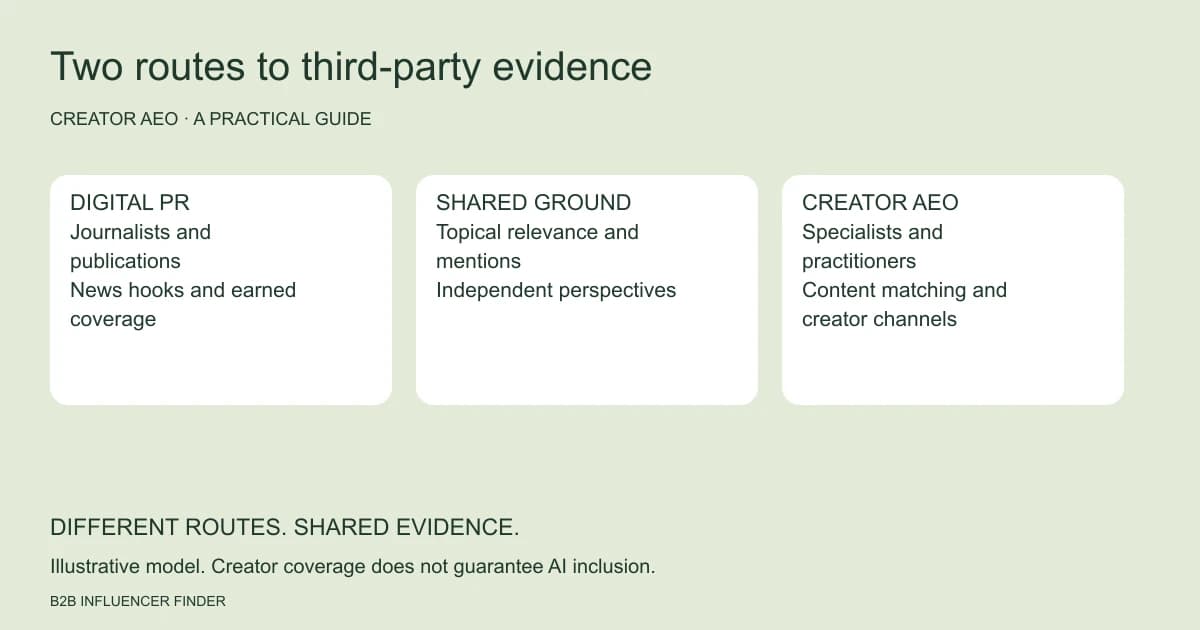
Creator AEO and digital PR overlap a lot. Both are trying to get credible people outside your company talking about your brand, expertise or data. The main difference is who you work with and how the coverage gets created.Further reading: What Is Creator AEO?
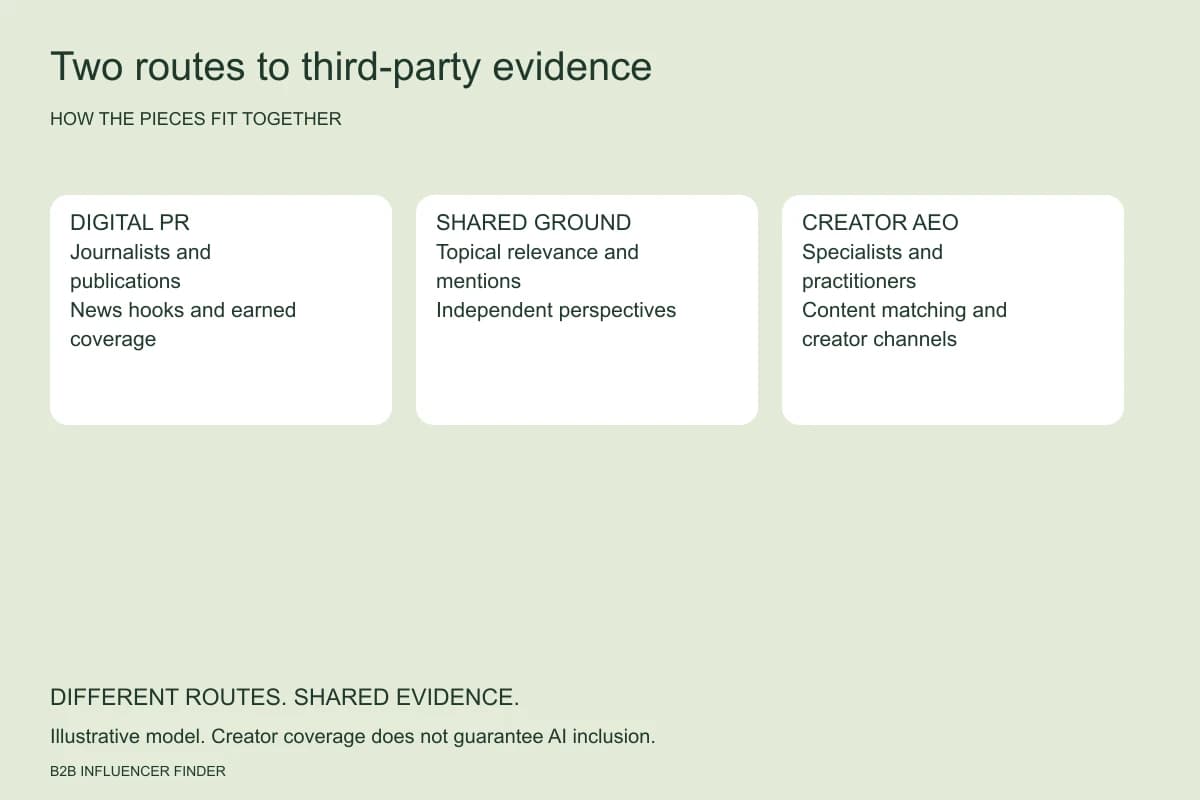
Digital PR usually works through journalists, editors and publications. Creator AEO works through creators, subject-matter experts, newsletter writers, YouTubers, podcasters and other independent voices with an audience around a specific topic.
For AI visibility, I think they belong in the same strategy. Digital PR can create authority and broad earned coverage. Creator AEO can create much more targeted discussion around the exact subjects you want your company associated with.
First, what is digital PR?
Digital PR is the practice of earning online coverage for a company through stories, data, commentary, research and expert contributions. Depending on the team, the goal might be brand awareness, links, search authority, reputation or all of those at once.
In the AI-search world, digital PR has picked up another job. Coverage on independent websites creates external evidence about the brand. Semrush now explicitly frames digital PR for AI visibility around building the wider internet record that answer engines can encounter when learning about a company.Sources: Semrush - Digital PR for AI visibility: 5 tactics + how to measure (July 30, 2026) · Semrush - Expanded 2026 AI Visibility Index, analyzing 126 million AI search prompts (June 26, 2026)
That makes sense to me. A company can say it is the best fraud platform, referral tool or HR system in the world. It becomes more interesting when publications, analysts, customers and experts independently describe it in that context too.
What is Creator AEO then?
Creator AEO is the part of answer engine optimization that deliberately builds relevant third-party content through creators and specialist voices.
Instead of pitching a journalist with a news story, you might find a fintech newsletter writer whose audience cares about your research. Or a YouTube creator who already compares tools in your category. Or a practitioner with a respected LinkedIn audience who can analyse one of your case studies.
The creator is not there to repeat your homepage. The useful part is their perspective, because that turns your first-party information into independent discussion.
So are Creator AEO and digital PR basically the same thing?
No, but there is a large middle section where they meet.
Both create third-party evidence. Both depend on relevance and credibility. Both can produce articles, interviews, commentary and mentions that live away from your own website. Both can help a buyer discover your brand before they ever visit it.
But the operating model is different enough that I would not collapse them into one discipline.
· Digital PR · Creator AEO
- : Typical partner; Digital PR: Journalists, editors, publications; Creator AEO: Creators, practitioners, newsletter writers, YouTubers, podcasters
- : Usual starting point; Digital PR: A newsworthy story, data point or expert angle; Creator AEO: A match between brand expertise and a creator’s existing subject matter
- : Common outputs; Digital PR: News coverage, features, expert quotes, contributed articles; Creator AEO: Videos, newsletters, articles, podcasts, social analysis
- : Audience logic; Digital PR: Publication authority and relevance; Creator AEO: Creator expertise, audience relevance and content fit
- : Relationship model; Digital PR: Earned editorial relationship; Creator AEO: Earned, paid or hybrid creator collaboration
- : Shared AI-search role; Digital PR: Build credible third-party evidence around the brand; Creator AEO: Build credible third-party evidence around the brand
Digital PR starts with a story. Creator AEO often starts with a match.
A PR team usually asks: what is newsworthy here? What data, opinion, launch or trend could a journalist reasonably cover?
Creator AEO can start somewhere else. What does our company know that this specific creator’s audience already cares about?
That difference sounds small, but it changes the workflow. A good creator match does not necessarily need a news hook. A six-month-old benchmark can still be useful if a creator is making a video about the problem this week. A customer case study can become the basis of a newsletter analysis. A product expert can join a podcast conversation without the company announcing anything new.
This is one reason I think Creator AEO fits B2B particularly well. B2B companies often have a lot of useful expertise sitting in case studies, documentation, webinars and research. It is valuable, but it is trapped inside company-owned channels.
Digital PR can reach authority that creators cannot
Creator AEO is not a reason to stop doing PR.
A strong trade publication, respected business title or analyst can provide a kind of authority that a creator may not. Journalists can also introduce your company into broader stories you would never create yourself. That matters for reputation, discovery and the overall public record around a brand.
There is also growing evidence that off-site brand discussion is associated with AI visibility. Ahrefs’ analysis of 75,000 brands found branded web mentions correlated strongly with visibility across ChatGPT, Google AI Mode and AI Overviews. The study also found a particularly strong relationship for YouTube mentions.Sources: Ahrefs - Top Brand Visibility Factors in ChatGPT, AI Mode, and AI Overviews (75k Brands Studied)
I would treat that as evidence that the wider web matters, not as proof that a PR placement or creator mention causes an AI recommendation. Big brands naturally earn more coverage too. Correlation is not causation.
Creator AEO can go much narrower than traditional PR
This is where creators become interesting.
Imagine you sell treasury software for mid-market companies. You probably do not need a creator with a million followers. You might need the person who writes a newsletter for 14,000 CFOs, hosts a finance operations podcast or makes detailed YouTube videos about treasury systems.
A mainstream publication may have far more authority and reach. The niche creator may have much better topical alignment.
For Creator AEO, that alignment matters because the goal is not simply to have your company name appear somewhere. You want your brand discussed in the context you want buyers, and potentially AI systems, to understand it.
This is where B2B Influencer Finder fits
This is also the reason I built B2B Influencer Finder around content matching rather than follower counts.Further reading: B2B Influencer Finder
The tool looks at what useful evidence a company already has, then finds creators whose existing work overlaps with it. The question is not just “who is influential?” It is “who already talks about this problem, and which thing we know would actually be useful to them?”
That is a different workflow from PR databases where you search for journalists and pitch a story. Both are useful. They solve different distribution problems.
Digital PR and Creator AEO should share the same evidence
The smartest version is not a PR team and creator team inventing separate stories every month.
Build strong source material once, then think about all the credible ways it can travel.
A proprietary benchmark could become a journalist pitch, a creator video, a newsletter analysis, a podcast discussion and an expert LinkedIn article. A strong customer story could be useful to a trade publication and to a specialist creator for completely different reasons.
The asset stays the same. The angle changes for the person and audience.
AI search makes this overlap more important
The interesting change is that earned media and creator marketing are no longer only distribution channels for humans.
AI answer systems can retrieve, cite and synthesise information from third-party sources too. Semrush’s 2026 guidance on digital PR for AI visibility argues that independent sources help build the external evidence layer around a brand. Later has made a similar argument from the creator side, launching a Creator AEO offering built around creator and community activations across channels including YouTube, Reddit, LinkedIn and Substack.Sources: Later - AEO is a creator marketing opportunity most brands are missing (May 21, 2026) · Later / PR Newswire - Later Launches Creator AEO (May 21, 2026)
I would be careful with the marketing claims around this category. Nobody can promise that one article or creator video will make ChatGPT recommend your company. AI systems are opaque, their retrieval changes, and not every piece of online content is equally accessible or useful to them.
But the strategic direction is fairly logical: if buyers and AI systems increasingly learn about companies from sources beyond the company website, then the quality of that external evidence becomes a marketing problem worth managing.
What should you measure?
For digital PR, I would still track coverage quality, publication relevance, referral traffic, branded search, links where useful and the topics the brand is being associated with.Further reading: What Is AI Share of Voice and How Do You Improve It?
For Creator AEO, add creator relevance, content format, topic match, brand mentions, creator response and publication rates, plus AI visibility across a fixed set of prompts.
Then measure the shared outcome separately: are more credible third-party sources talking about the company in the context you actually want to own?
AI mention rate, citation rate and share of voice can sit on top of that, but they should not replace normal commercial metrics. Semrush makes the same distinction in its AI visibility ROI guidance: mentions and citations show that AI systems are talking about a brand, not whether that attention is producing revenue.Sources: Semrush - How to determine AI visibility ROI and revenue impact (July 27, 2026)
Which one should you invest in first?
If you have genuinely newsworthy research, data or company stories and almost no earned coverage, digital PR may be the obvious first move.
If you already have strong expertise and content but struggle to get it into the hands of the specialist people your buyers actually listen to, Creator AEO may expose a bigger opportunity.
For most B2B companies I would eventually do both, especially if AI visibility is part of the goal. Publications create one type of third-party authority. Creators create another. Customers, review platforms and communities add more again.
The real competition is not Creator AEO vs PR
I think arguing over which discipline owns AI visibility misses the useful part.
The company website is one source of evidence about your brand. The rest of the internet is another. Digital PR helps you earn part of that external evidence through publications and journalists. Creator AEO helps you earn it through specialist people and creator-led channels.
The best strategy is to make sure the two are reinforcing the same story.
If you want to be known for employee referral software, fraud prevention, B2B payments or whatever your category is, your website should make that clear. Your PR should reinforce it. Relevant creators should be able to add their own perspective to it.
That is when the public evidence around a brand starts to become much harder to ignore.
Sources
Semrush - Digital PR for AI visibility: 5 tactics + how to measure (July 30, 2026)Sources: Semrush - Digital PR for AI visibility: 5 tactics + how to measure (July 30, 2026)
Ahrefs - Top Brand Visibility Factors in ChatGPT, AI Mode, and AI Overviews (75k Brands Studied)Sources: Ahrefs - Top Brand Visibility Factors in ChatGPT, AI Mode, and AI Overviews (75k Brands Studied)
Later - AEO is a creator marketing opportunity most brands are missing (May 21, 2026)Sources: Later - AEO is a creator marketing opportunity most brands are missing (May 21, 2026)
Later / PR Newswire - Later Launches Creator AEO (May 21, 2026)Sources: Later / PR Newswire - Later Launches Creator AEO (May 21, 2026)
Semrush - How to determine AI visibility ROI and revenue impact (July 27, 2026)Sources: Semrush - How to determine AI visibility ROI and revenue impact (July 27, 2026)
Semrush - Expanded 2026 AI Visibility Index, analyzing 126 million AI search prompts (June 26, 2026)Sources: Semrush - Expanded 2026 AI Visibility Index, analyzing 126 million AI search prompts (June 26, 2026)