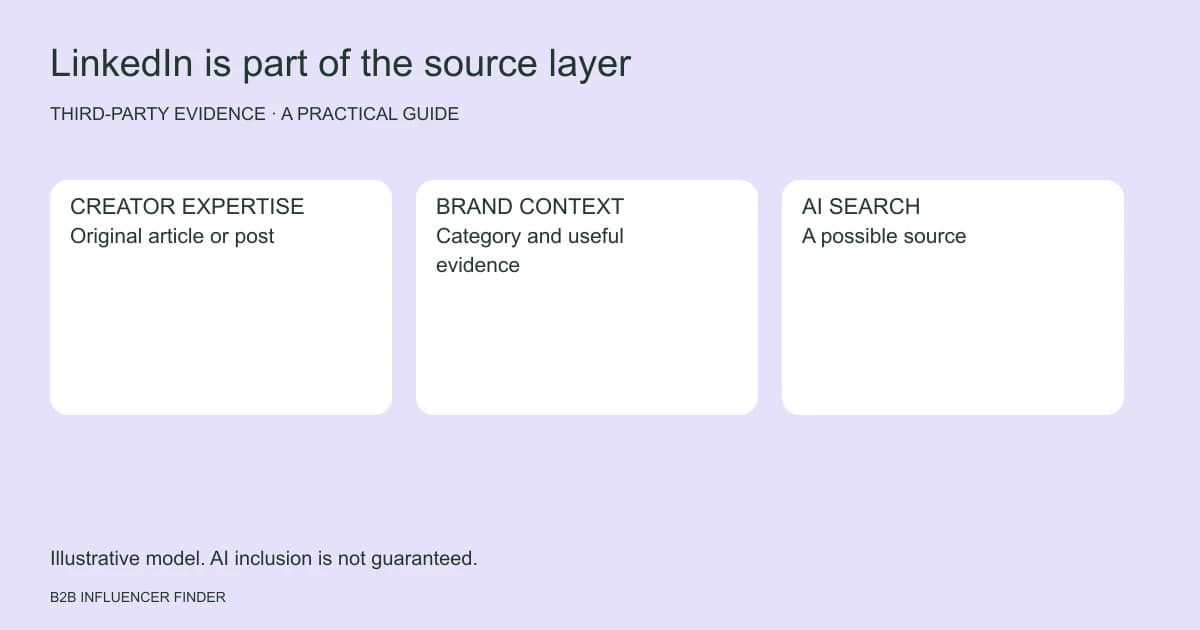
Yes, LinkedIn content can influence what appears in AI search about a brand, but i would be careful with the word influence. We now have solid evidence that ChatGPT Search, Google AI Mode, Perplexity and Google AI Overviews cite LinkedIn pages. We do not have evidence that publishing a LinkedIn post directly changes an LLM's underlying beliefs or guarantees your brand a recommendation.
That distinction matters. The useful opportunity is not 'post on LinkedIn so ChatGPT learns about you'. It is that LinkedIn has become one of the public third-party sources AI search systems can surface when answering professional and B2B questions.
And the latest data makes LinkedIn much harder for B2B marketers to ignore.
LinkedIn is already showing up in AI answers
Semrush analysed 89,000 unique LinkedIn URLs cited across ChatGPT Search, Google AI Mode and Perplexity in early 2026. In that dataset LinkedIn was the second most-cited domain and appeared in about 11% of AI responses on average. The rate varied by engine: 5.3% on Perplexity, 13.5% on Google AI Mode and 14.3% on ChatGPT Search.Sources: Semrush - We Analyzed 89K LinkedIn URLs Cited in AI Search: Here is What Drives Visibility
This is not a universal percentage for all AI searches. The study covered a specific prompt sample and many prompts were in technology, business services, finance and industrial categories. That actually makes it particularly interesting for B2B marketers.
A separate Ahrefs study published in October 2026 found LinkedIn among the most common external citations in Google AI Overviews for branded searches, alongside Wikipedia and YouTube. Different dataset, different methodology, same broad signal: LinkedIn content can become part of the source environment around a brand.Sources: Ahrefs - AI Overviews Currently Appear for 83% of Branded Searches
The interesting part is who AI search is citing
If this were only about company pages, it would basically be another owned-content channel. It is not.
In Semrush's dataset, individual members accounted for 59% of LinkedIn citations on both ChatGPT Search and Google AI Mode. Perplexity leaned the other way, with company pages accounting for 59% of its LinkedIn citations.
That difference is useful. It tells us there is no single LinkedIn tactic for every AI engine. But it also supports the broader Creator AEO idea: people outside the brand, plus employees and subject-matter experts, can create public context around a company that exists separately from its website.Further reading: How Do I Find B2B Influencers on LinkedIn?
For B2B brands, that is potentially much more valuable than treating LinkedIn as a place to repost company announcements.
LinkedIn articles seem especially interesting
Semrush found long-form LinkedIn articles represented 50% to 66% of cited LinkedIn content depending on the AI platform, while feed posts represented 15% to 28%. Articles between 500 and 2,000 words were the most commonly cited article length in its sample.
That does not mean every company should suddenly publish 1,200-word LinkedIn articles because an algorithm likes them. The more sensible interpretation is that self-contained content with enough depth to answer a question gives retrieval systems more useful material to work with.
Normal posts still appeared in citations too. For feed posts, the largest cited group was 50 to 299 words. So this is not an argument that short-form LinkedIn is invisible to AI search.
Original expertise matters more than reshares
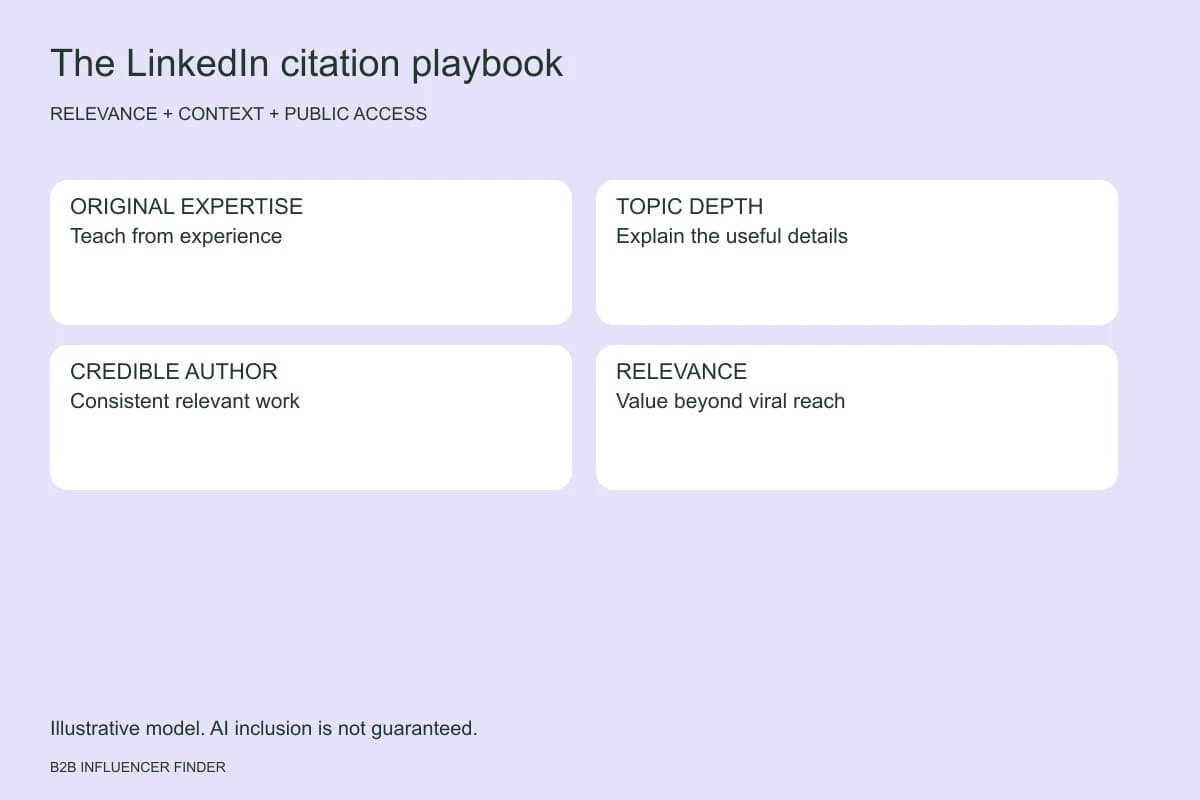
One finding i really like is that roughly 95% of the cited LinkedIn posts in Semrush's analysis were original rather than reshares. More than half of cited content was educational or advice-driven.
That fits the direction LinkedIn itself is pushing. In 2026 LinkedIn said it was reducing distribution of low-effort, generic AI-generated content and prioritising real perspectives, context and expertise. It reported a 40% reduction in views of content classified as AI slop after recent changes.Sources: LinkedIn - How LinkedIn is Continuing to Tackle AI Slop · LinkedIn - Keeping conversations real on LinkedIn
For marketers, the lesson is not to produce more LinkedIn content. It is to produce more useful LinkedIn content.
A founder explaining what went wrong in a real implementation is useful. A specialist analysing original data is useful. A customer explaining why they chose one approach over another is useful. A generic post saying 'AI is changing everything' probably adds almost no new evidence about your company or category.
You do not need a massive influencer
The follower-count data is also interesting for B2B creator strategy.
Semrush found nearly half of cited LinkedIn post authors had more than 2,000 followers, but it also found that creators with fewer than 500 followers beyond their connections still appeared consistently in citations. The median cited post had only around 15 to 25 reactions and no more than one comment.
In other words, citation visibility in this dataset was not simply a leaderboard of viral LinkedIn celebrities.
That supports the way i think B2B creator discovery should work. If somebody with 8,000 followers writes constantly about the exact procurement problem your product solves, i am more interested in that person than a generic business influencer with 500,000 followers.
So can somebody else talking about you matter more than your company page?
Sometimes, yes. But not because third-party LinkedIn posts have magical authority.Further reading: Does Getting Mentioned on Other Websites Help With AI Visibility?
Your company page tells the market what you say about yourself. A customer, practitioner or specialist creator can add a different layer: what somebody else observed, tested, compared or concluded about you.
This is the third-party evidence problem that keeps coming up in Creator AEO. If every useful claim about your company exists only on your own website and company account, there is very little independent context around the brand.
LinkedIn is one place to create that context because professional people already publish expertise there and AI search systems are demonstrably citing some of it.
What should a B2B creator actually publish?
I would not brief a creator with 'please write a post about our software'. Start with the useful thing your company can contribute.Further reading: What Types of Creator Content Can Appear in AI Search?
Maybe you have a case study with surprising results. Maybe you have proprietary data. Maybe your product gives the creator something they can test. Maybe your team has seen a pattern across hundreds of customers that the creator's audience would genuinely care about.
Then match that evidence to somebody who already talks about the subject.
This is exactly why B2B Influencer Finder starts with the company's existing content and expertise before matching creators. A good match is not just 'this person has B2B in their bio'. It is 'this person already publishes about the topic, and here is the specific evidence or angle your company can add to their work'.
A LinkedIn mention is not automatically useful
There is a big difference between being tagged in a launch announcement and being discussed inside a useful explanation of a buyer problem.
If your goal includes AI visibility, i would care about context. What topic is the brand associated with? Is the company described accurately? Does the creator explain why the product or approach is relevant? Is the content original enough to stand on its own?
A naked brand mention gives an AI system, and a human reader, much less to work with than a paragraph explaining what the company does, who it is for and how it fits into the subject.
Consistency seems to matter, but do not turn it into a posting quota
Around three-quarters of the cited post authors in Semrush's study had published more than five posts in the previous four weeks. For cited LinkedIn articles, around 60% of authors were frequent posters.
That is an association, not proof that posting six times a month unlocks AI citations. Active experts simply create more opportunities to publish useful material and may also build stronger topical footprints over time.
I would use that finding to favour creators who are genuinely active in a subject, not to force everybody into a content treadmill.
What LinkedIn cannot tell us
We still do not know exactly why a particular LinkedIn page is selected for a particular AI answer. Citation studies show us observed patterns, not the complete retrieval or ranking systems inside ChatGPT, Google or Perplexity.
We also should not confuse AI-search retrieval with model training. A LinkedIn post being publicly accessible or cited in a current search answer does not prove it was used to train the underlying model.
And LinkedIn itself prohibits unauthorised crawlers and scraping tools on its service. So i would avoid simplistic claims about every AI bot freely crawling every LinkedIn post. What we can observe directly is the output: LinkedIn URLs are appearing as citations in AI search at meaningful scale.Sources: LinkedIn Help - Prohibited software and extensions
How i would use LinkedIn for Creator AEO
First, choose the topics you want the brand to be associated with. Then find the people already producing useful LinkedIn content around those subjects. Give them something worth adding to the conversation: evidence, access, data, a real case study or an expert point of view.Further reading: How Do You Build a Creator AEO Strategy?
Do not script the conclusion. Let the creator add their own perspective. If it is paid, disclose it properly. And do not judge the collaboration only by likes in the first 48 hours.
Track the public evidence you created. Which topic did it cover? Who published it? Did it generate discussion or referral traffic? Does it later appear in AI citations? Does your brand's mention rate or topic association change across the prompt set you are monitoring?
That is a much more useful measurement system than 'our LinkedIn post got 4,000 impressions'.
The answer
LinkedIn content can influence what AI search says about a brand because LinkedIn pages are already being cited in AI-generated answers. Current research suggests original, educational content from active, credible people can surface even without huge follower counts or viral engagement.
But there is no guarantee that publishing on LinkedIn will make ChatGPT mention you, and no evidence that one creator post directly changes an LLM's view of your company.
The useful strategy is simpler: create more accurate, relevant third-party discussion around the subjects you want to be known for. LinkedIn is now one of the places where that evidence can live.
For a B2B brand, that makes it worth taking seriously.
Sources
Semrush - We Analyzed 89K LinkedIn URLs Cited in AI Search: Here is What Drives VisibilitySources: Semrush - We Analyzed 89K LinkedIn URLs Cited in AI Search: Here is What Drives Visibility
Ahrefs - AI Overviews Currently Appear for 83% of Branded SearchesSources: Ahrefs - AI Overviews Currently Appear for 83% of Branded Searches
LinkedIn - How LinkedIn is Continuing to Tackle AI SlopSources: LinkedIn - How LinkedIn is Continuing to Tackle AI Slop
LinkedIn - Keeping conversations real on LinkedInSources: LinkedIn - Keeping conversations real on LinkedIn
LinkedIn Help - Prohibited software and extensionsSources: LinkedIn Help - Prohibited software and extensions